Lecture 25: Local and Absolute Extrema of Functions
Graduate Entrance Examination Mathematics study notes: Lecture 25: Local and Absolute Extrema of Functions. Original formulas, diagrams, and examples are retained.
On this page
1.1 Extremum of the Function
1.1.1 Basic Concepts
Definition: Theextremumofthefunction
description: if $\exists\delta>0$, make it
1) $\forall x\in U(x_0,\delta)$ always has $f(x)\geq f(x_0)$, then $f(x)$ is said to take the minimum value at $x_{0}$.
2) $\forall x\in U(x_0, \delta)$ always has $f(x)\leq f(x_0)$, then it is said that $f(x)$ takes the maximum value in $x_0$
Theorem: Extremaisanecessarycondition
description: If $f(x)$ is differentiable at $x_0$ and extremum is obtained at $x_0$, then $f^{\prime}(x_0)=0$
Significance
- For differentiable functions, this theorem narrows down the range of possible extremum points of the function;
- 1. For differentiable functions, only the stationary point needs to be considered;
- 2. For non-differentiable points, just look at stationary points and non-existent points;
The Relationship Between Extremals and Stations
- Location:
- The point of the derivative equal to zero is called thestationary point of the function;
- Take the extreme value at $x_0$, whose derivative is zero;
- The relationship between stationary points and extreme points
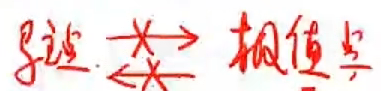
- For differentiable functions, the extremum is the stationary point;
Corollary 1: Possible extrema points of a general function
- 1. Points where the derivative equals 0;
- 2. Points where the derivative does not exist;
Theorem: Thefirstsufficientconditionforextremevalues
Description: Let $f$ be continuous at $x_0$ and differentiable in a punctured neighborhood of $x_0$.
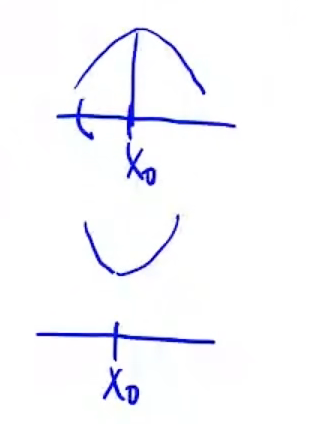
1. If $f'(x)\geq0$ for $x<x_0$ and $f'(x)\leq0$ for $x>x_0$, then $f$ has a local maximum at $x_0$.
2. If $f'(x)\leq0$ for $x<x_0$ and $f'(x)\geq0$ for $x>x_0$, then $f$ has a local minimum at $x_0$.
3. If $f'$ has the same sign on both sides of $x_0$, then $f$ has no local extremum there.
Significance
- Determine whether a point is truly an extreme point;
- How to use:
- From the necessary condition (theorem) of
extremum->several possible extremum points->the first sufficient condition (theorem) for extremums->the true extremum point;
Explanation
- Geometry
- Cases 1 and 2 respectively:
- Advantages
- It can analyze points where the derivative equals 0, and points where the derivative does not exist;
Theorem: Thesecondsufficientconditionfortheextremum
description: $\text{ Let }\quad f^{\prime}(x_0)=0,f^{\prime\prime}(x_0)\neq0$
1) When $f^{\prime\prime}(x_0)<0$, $f(x)$ take the maximum value at $x_{0}$
2) When $f^{\prime\prime}(x_0)>0,\quad f(x)$ takes the minimum value at $x_{0}$
Explanation
- Meaning:
- Determine whether a point has reached an extreme value by using the value of thesecond derivativeof a point whose derivative equals 0;
- Limitations:
- Unable to analyze points where the derivative does not exist;
1.1.2 Example Problems
Example Question: $\text{ Find the inverse of }f(x)=x^3-3x^2-9x+5\text{ Extremes }$
- Analysis
- From the form, thefunction is a differentiable function -> The extremum of the differentiable function can only be taken at the stationary position of;
- But a stationary point is not necessarily an extreme point; You need to use sufficient conditions to determine whether a point with zero first derivative of -> changes its sign (positive or negative);
- Analysis
- Using the first sufficient condition
- $f(x)=3x^{2}-6x-9=3\left(x_{-2}^{2}x-3\right)=3(x-3)(x+1)=0\Longrightarrow x_{1}=-1,x_{2}=3$
- At $x=-1$, the function derivative ranges from positive to >, so it is the maximum point;
- At $x=3$, the function derivative ranges from negative to >, so it is the minimum value;
- Use the second sufficient condition
- $\begin{aligned}f^{\prime\prime}(x)=6x-6,\quad f^{\prime\prime}(-1)=-12<0,\quad \text{ Extremely large }\\f^{\prime\prime}(3)=12>0\quad \text{ Very small }\end{aligned}$
- Question Type: Theextremumofthefunction
1.2 Maximum and Minimum Values
Definition: Themaximumandminimumvaluesofthecontinuousfunction
Description: Find the absolute extremum of continuous function $f(x)$ on $[a, b]$
0) Establishing the objective function (for word problems)
1) Find the station, non-differentiable, and endpoint $x_1,x_2,x_3 ...$ of $f(x)$ within $(a,b)$;
2) Find the function values for each point
3) Compare the calculated value with the endpoint; the larger value is the maximum, the smaller is the minimum
Explanation
- If the continuous function f(x) has only a unique extremum point in
(a,b)->If it is maximal, it is a maximum; If it is small, it is a minimum;
Supplement: Word problems for maximum-minimum values
- Step 1: Create the objective function $y=f(x)$
- Convert into general questions
Example: $\text{Find the maximum and minimum values of }f(x)=2x^3-3x^2\text{ on }[-1,2].$
- Analysis
- Since it is a polynomial, there are no points where the derivative does not exist, so only points where the derivative equals zero are needed;
- Analysis
- $f^{\prime}(x)=6x^2-6x=6x(x-1)=0\Longrightarrow x_1=0,x_2=1$
- Find the value of the stationary point
- $f(0)=0,f(1)=-1$
- Find the value of the endpoint
- $f(-1)=-5,f(2)=4$
- Therefore, x = -1 is the minimum point, and x = 2 is the maximum point
- Question Type: Themaximumandminimumvaluesofthecontinuousfunction
1.3 Related Question Types
Question Type: Findtheextremumandextremaofthefunction
PART 1: Problem-solving methods
Core: Composed of the necessary conditions (theorem) for extremums -> several possible extremum points, -> first sufficient condition (theorem) -> true extremum points;
Possible Extremes
- 1. Points where the derivative equals 0;
- 2. Points where the derivative does not exist;
Determining whether a possible extreme point is truly an extreme point
- When the derivative exists: the first sufficient condition of the extreme value can be used.
->Whether the left and right limits of the derivative change in signs.->When the derivative changes from positive to negative: maximum + from negative to positive: minimum; - The derivative does not exist:
- 1. When the function is continuous: you can use the first sufficient condition for the extreme value + continuous derivative
->You can derive whether the point where the derivative does not exist is an extremum->When the derivative changes from positive to negative: maximum + from negative to positive: minimum value; - 2. Unclear whether the function is continuous: use the first sufficient condition of the extremum + determine if this point is continuous (whether the left and right limits are equal)
->If continuous->derivative changes from positive to negative: maximum + derivative from negative to positive: minimum; - Or use the second sufficient condition for the extremum
->The second derivative is not zero;
Supplement: About the derivatives of functions and the left-right derivatives
- If one of the left and right derivatives of the derivative does not exist, then this derivative does not exist;
- And if one of the left and right derivatives has already been determined, then the other half does not need to be discussed;
Finding Derivatives Based on Function Formulas
- 1. Analyze the function and see if there are points where the derivative does not exist.
->Usually, the boundary points and zero points around the piecewise function may be points where the derivative does not exist; - 2. After removing the nonexistent points, derivative is taken from the function;
Application Problems for Maximum/Minimum: First, establish a goal, then solve it using methods to find maximum/minimum.
- Note: Objective functions are usually not unique; consider whether there are simpler objective functions;
PART 2: Typical Example Problems
Example: Given that $f(x)$ is continuous in a neighborhood of $x=0$ and $f(0)=0,\lim_{x\to0}\frac{f(x)}{1-\cos x}=2$, then at point $x=0$ $f(x)$ __
- Analysis
- Analysis
- Direct Method:
- Since $\lim_{x\to0}\frac{f(x)}{1-\cos x}=2$ and $1-\cos x$ is greater than 0
->near $x=0$, so near 0, $f(x)>0$; - Because at 0 o'clock, $f(0)=0$, and near 0 again, $f(x)>0$;
- Therefore, it can be known that $f(0)=0$ is the smallest point near point 0, so the minimum value is obtained;
- Elimination method:
- substitute specific functions and analyze;
- Let $f(x)=x^2$, at which point it meets all the conditions of the question;
- From this, $f(x)=x^2$ finds its minimum value at point 0, and the limit exists, is differentiable, and its derivative equals 0;
- Question Type: #