Lecture 21: Differential Mean Value Theorems
Graduate Entrance Examination Mathematics study notes: Lecture 21: Differential Mean Value Theorems. Original formulas, diagrams, and examples are retained.
On this page
Common Question Types and Typical Examples in This Chapter
Frequently Tested Question Types
- 1. Find the extremum and extrema of the function, determine the concave direction and inflection point of the curve; (Basic question)
- 2. Find the asymptote; (Basic question)
- 3. Roots of the equation; (More difficult problem)
- 4. Proof of inequalities: (relatively difficult problem)
- 5. Mean Value Theorem Proof Problem (Difficult Problem)
1.1 Mean Value Theorem for Differentiation
Purpose: Why is the mean value theorem for differential differential needed? `-> Establish the relationship between derivatives and functions. ->` Lay the foundation for studying functions through derivatives;
Frequently Tested Question Types
- Problem Type 1: Find limits
- Problem Type 2: Extrema and Extrema of Functions, Concave Directions and Inflection Points of Curves
- Question Type 3: Asymptote of a curve
- Problem Type 4: Roots of the Equation
- Problem Type 5: Proof of inequalities
- Problem Type 6: Proof of the Mean Value Theorem (Difficult)
1.2 The Three Major Theorems
The Meaning of the Three Theorems
- Rolle's theorem: $\xi\in(a, $ exists $b)$, make $f^{\prime}(\xi)=0$
- Lagrange mean value theorem: $f(b)-f(a)=f^{\prime}(\xi)(b-a)$
- Establish a relationship between the local and the whole
- The derivative reflects the rate of change at a point, which is local;
- But (a, b) is a variation of the entire interval;
- Therefore: $f(b)-f(a)=f^{\prime}(\xi)(b-a)$ Establish the relationship between the local and the whole;
- Established the relationship between function values and derivative values
- Established the theoretical foundation for studying functions using derivatives;
- Cauchy mean value theorem
The Relationship of the Three Major Theorems

Scope of Application
- Prove the identity
- Proof of inequalities
- Supporting the conclusions about the median issue
1.2.1 Rolle's Theorem
Definition: maximum and minimum
description: $\text{ If } \exists\delta>0\text{ , so that }$
Minimum value: $\forall x\in U(x_0, \delta)$ always has $f(x)\geq f(x_0)$, then it is said that $f(x)$ takes the minimum value in $x_0$
Maximum value: $\forall x\in U(x_0, \delta)$ always has $f(x)\leq f(x_0)$, then it is said that $f(x)$ takes the maximum value in $x_0$
Explanation
If a function is differentiable at an interior extremum, its tangent is horizontal; equivalently, its derivative is zero.
Lemma: Fermat's lemma
- If $f$ has a local extremum at $x_0$ and is differentiable there, then $f'(x_0)=0$.
- Fermat's theorem gives a necessary condition for a differentiable function to have an interior extremum.
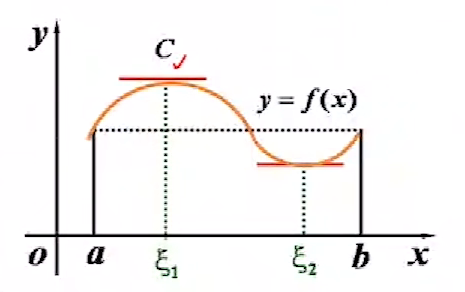
Theorem: Rohr's theorem
description: meet three conditions:
1) $f$ continuous on $[a,b]$;
2) $f$ conductivable within $(a,b)$;
3)f(a)=f(b)
Thus, it can be known: $\text{ then }\exists\xi\in(a,b)\text{ , to use }f^{\prime}(\xi)=0$
Derivation conclusion: A tangent line to a point is parallel to the line connecting points ab -> Lagrange theorem;
Explanation
- Derivation relations: [Definition] Maximum and minimum values
->[Theorem] Fermat's lemma->[Theorem] Lawr's theorem - Illustration
1.2.2 Lagrange Mean Value Theorem
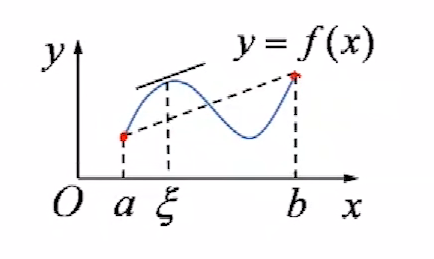
Theorem: Lagrange's mean value theorem
Description: if the following conditions are met:
1) $f$ continuous on $[a,b]$
2) $f$ is differentiable within ($a,b)$
Therefore, there exists $\xi\in(a,b)$ such that $f(b)-f(a)=f^{\prime}(\xi)(b-a)$;
Explanation
- Lagrange's theorem is a generalization of the Roll theorem;
- The Rolle theorem is a special case of the Lagrange theorem;
Additional Information
- $a>b,a<b\quad\text{ All conclusions hold true }$
- Rewriting form: $f(b)-b(a)=f^{\prime}[a+\theta(b-a)](b-a)\quad(0<\theta<1)$
-Important-> Rewriting format: $f(x_0+\Delta x)-f(x_0)=f^{\prime}[x_0+\theta\Delta x]\Delta x\quad(0<\theta<1)$
- This form is an exact description of the following differential approximation form: $\Delta y\approx f^{\prime}(x_0)\Delta x$
Explanation
- Illustration
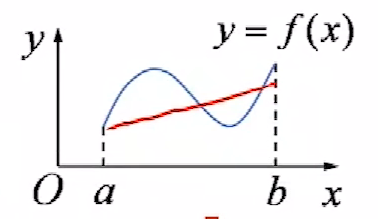
- Without the constraint of f(a) = f(b), there may not necessarily be tangents parallel to the X-axis;
- However, there will be a point of slope equal to the current function value connecting the line:
Corollary 1: Finite increment formula
- $f(x_0+\Delta x)-f(x_0)=f^{\prime}[x_0+\theta\Delta x]\Delta x\quad(0<\theta<1)$
- Approximate description: $\Delta y\approx f^{\prime}(x_0)\Delta x$
Corollary 2: If $f$ is continuous on an interval $I$ and differentiable in its interior, then $f(x)\equiv C$ on $I$ if and only if $f^{\prime}(x)\equiv0$ there.
- The forward implication is immediate.
- The key is proving the converse.
Proof: Use analytical methods to prove the Lagrange mean value theorem
- Core method: construct an auxiliary function and apply Rolle's theorem.
- The goal is to prove that $\exists\xi\in(a,b)$ such that $f(b)-f(a)=f^{\prime}(\xi)(b-a)$.
- Equivalently, prove $f^{\prime}(\xi)-\frac{f(b)-f(a)}{b-a}=0$.
- Construct a function for which $F^{\prime}(\xi)=0$.
- Therefore, we get: let $F (x)=f (x)-\frac{f (b)-f (a)}{b-a}x$
- Rolle's theorem then gives $F^{\prime}(\xi)=0$.
1.2.2.1 Example Problems
Example Question: $\text{ Proof }\quad|\sin x-\sin y|\leq|x-y|$
- Analysis
- Analysis process:
- Analysis
- Conclusion: $\mathrm{~sinx<x<tanx,x\in(0,\frac\pi2)}$
Example: $\text{Prove that, for }x\in(0,\frac\pi2),\quad\arctan x+\arctan\frac1x=\frac\pi2.$
- Analysis
- Since the goal is to prove that a function value equals a constant within a range, it is possible to consider using {Lagrange mean value theorem corollary 2};
- Analysis
- $f^{\prime}(x)=\frac{1}{1+x^{2}}+\frac{-\frac{1}{x^{2}}}{1+(\frac{1}{x})^{2}}=0.$
- Therefore, the derivative equals 0, according to the corollary 2
->The current function value is a constant within the range; - So by substituting any point, the current function value is always $\pi/2$
1.2.3 Cauchy Mean Value Theorem
Theorem: Cauchy's mean value theorem
Description: if the following conditions are met:
1) $f, F$ on $[a, b]$ continuity $; $
2) $f, F$ is differentiable within $(a, b)$, and $\forall x\in(a, b), F^{\prime}(x)\neq0$
Therefore, there exists $\xi\in(a,b)$ such that $\frac{f(b)-f(a)}{F(b)-F(a)}=\frac{f^{\prime}(\xi)}{F^{\prime}(\xi)}$;
Explanation
- From Lagrange's mean value theorem
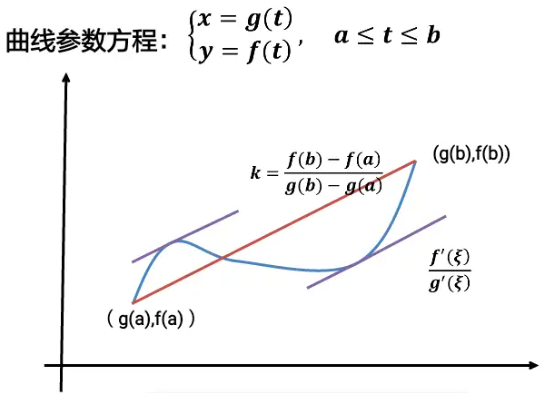
->Cauchy mean value theorem; - Regard $Y=f(t)$ and $x=F(t)$ as a parametric curve.
- At this point, $\frac{f(b)-f(a)}{F(b)-F(a)}$ represents the slope of segment ab;
- And for $\xi$ points y and x, derivative
->$\frac{f^{\prime}(\xi)}{F^{\prime}(\xi)}$ = $dy/dx$->equals the slope at this point; - Therefore, for some $\xi\in(a,b)$,
$$\frac{f(b)-f(a)}{F(b)-F(a)}=\frac{f^{\prime}(\xi)}{F^{\prime}(\xi)}.$$
- Geometric meaning
- Example: $\lim_{x\to0}\frac{x-\sin x}{x^3}=\lim_{x\to0}\frac{(x-\sin x)-(0-\sin^{}0)}{x^3-0^3}$
- By Cauchy's mean value theorem, for some $\xi$ between $0$ and $x$,
$$\frac{x-\sin x}{x^3}=\frac{1-\cos\xi}{3\xi^2}.$$
- So we get $\lim_{x\to0}\frac{1-\cos x}{3x^{2}}=\lim_{x\to0}\frac{\frac{1}{2}x^{2}}{3x^{2}}.$
- Final result is 1/6;
1.2.4 Summary of the Three Major Theorems
Core: Establish the relationship between derivative values and function values
Problem Analysis:
- 1. If the given problem is a derivative and the function is studied, the mean value theorem for differential can be used;
- 2. If the given condition is a function and the proof is a derivative, the mean value theorem for differential can also be used;
The Relationship Among the Three Parties
Usage Analysis
- Lagrangian's theorem and Rolle's theorem are more commonly used;
- Especially the Lawr theorem;