Lecture 26: Drawing Function Graphs
Postgraduate Entrance Exam Mathematics Study Notes: Lecture 26: Drawing Function Graphs. Retain original formulas, diagrams, and example problems.
On this page
1.1 Steps to Describe Function Graphs
Specific Steps
- 1. Determine the domain of function $y= f(x)$, and consider its parity and periodicity;
- 2. Find the first and second derivatives, and find the points where the first and second derivatives are 0 or if they do not exist
->Find extremals, inflection points, intervals of increase and decrease, and concave-convex intervals; - 3. Lists distinguish increases and decreases and concave-convex intervals to find extremes and inflection points;
- 4. Find the asymptote;
- 5. Identify key points and sketch the graph.
1.1.1 Basic Concepts of Asymptotes
Definition: Theasymptoteofthecurve
description:
1) Horizontal asymptote: if $\lim_{x\to+\infty}f(x)=A$ or $\lim_{x\to-\infty}f(x)=A$, then $y=A$ is a horizontal asymptote of $y=f(x)$ in the corresponding direction.
2) Vertical asymptote: if $\lim_{x\to x_0^-}f(x)=\pm\infty$ or $\lim_{x\to x_0^+}f(x)=\pm\infty$, then $x=x_0$ is a vertical asymptote.
3) Oblique asymptote: if
$$a=\lim_{x\to\pm\infty}\frac{f(x)}x,\qquad b=\lim_{x\to\pm\infty}(f(x)-ax)$$
are finite, then $y=ax+b$ is an oblique asymptote in that direction.
Explanation
- When d `
->` 0, it is called the asymptote; 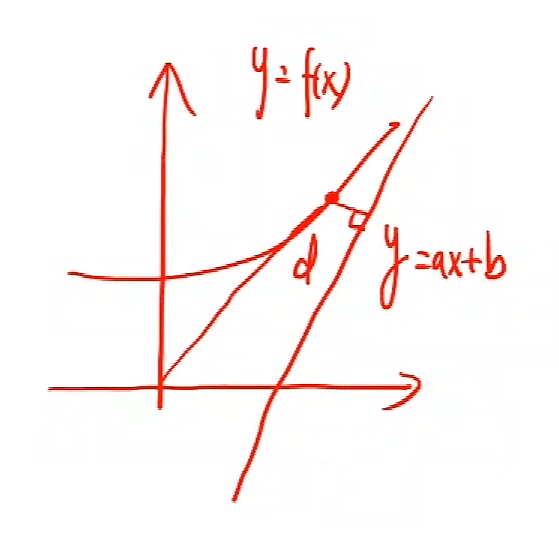
1.1.2 Example Problems
Example Problem: Find the asymptote of curve $y=\frac{(x-1)e^x}{e^x-1}$;
- Analysis
- First, analyze whether there is a horizontal asymptote;
- Then analyze whether there are vertical asymptotes;
- Analysis
- Level
- When x
->-infinity, the ex on the numerator approaches zero, and the denominator is also infinite times 0, making it difficult to determine; - $\operatorname{lim}_{x\rightarrow\infty}xe^{x}=\operatorname{lim}_{x\rightarrow\infty}\frac{x}{e^{-x}}=\operatorname*{lim}_{x\rightarrow\infty}\frac{1}{-e^{-x}}$
- Vertical
- Because: $\lim_{x\to 0}y=\infty$
- Therefore, $x=0$ is its vertical asymptote;
- Slanting
- $\lim_{x\to\infty}\frac{y}{x}=\lim_{x\to\infty}\frac{(x-1)e^{x}}{x(e^{x}-1)}=\lim_{x\to+\infty}\frac{1-\frac{1}{x}}{1-\frac{1}{x}}=1=a$
- Oblique asymptote is $y=x-1$;
- Question Type: Findtheasymptote
Example: Let $y=\frac{x^3+4}{x^2}$. Find (1) its intervals of increase and decrease and its extrema; (2) its intervals of concavity and inflection points; (3) its asymptotes; and (4) sketch its graph.
- Analysis
- Solve in the order in which the figures are drawn;
- Analysis
- 1. Find the domain:
- $\text{Domain: }(-\infty,0)\cup(0,+\infty).\text{ When }x=-\sqrt[3]{4},\ y=0.$
- 2. Find critical points and points where the derivative is undefined:
- $y^{\prime}=1-\frac8{x^3}$, so the critical point is $x=2$.
- $y^{\prime}(0)$ is undefined, but $x=0$ is not in the domain.
- The function is increasing on $(-\infty,0)$ and $(2,+\infty)$, decreasing on $(0,2)$, and has a local minimum $y=3$ at $x=2$.
- 3. Determine concavity:
- $y^{\prime\prime}=\frac{24}{x^4}>0$
- The graph is concave upward on both $(-\infty,0)$ and $(0,+\infty)$ and has no inflection point.
- 4. Find the asymptote;
- It has no horizontal asymptote
- There are vertical asymptotes
- $\lim_{x\to0}\frac{x^3+4}{x^2}=+\infty\quad\color{red}{x=0}$
- Oblique asymptote
- $\lim_{x\to\infty}\frac yx=\lim_{x\to\infty}\frac{x^3+4}{x^3}=1=a,\quad\lim_{x\to\infty}(y-ax)=\lim_{x\to\infty}\frac4{x^2}=0=b$
- Therefore, the oblique asymptote is $y=x$.
- 5. Drawing
- 1. Start by drawing an asymptote
- 2. Starting from $-\infty$, reach the asymptote line, add or remove the change points, then keep moving toward x
->$\infty$; Draw all the images; 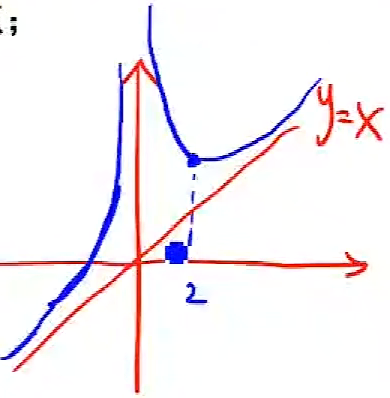
- Question Type: Functiongraphdrawing
Question Type: Findtheasymptote
PART 1: Problem-solving methods
Determining if a curve has an asymptote
- 1. Determine the horizontal asymptote
->When x->is infinite, y tends toward a finite value; - 2. Determine the vertical asymptote
->When x->a certain point (finite value), y approaches infinity; - 3. Determine the oblique asymptote
->$\lim_{x\to\infty}\frac{f(x)}x=a$ Finite value;->$\lim_{x\to\infty}(f(x)-ax)=b$ exist- At this time, there is an oblique asymptote;
Quick Assessment Method
- Inference:
- The relationship between oblique asymptotes and functions: When x
->is infinite, the distance between $y=f(x)$ and $y=ax+b$ approaches zero; 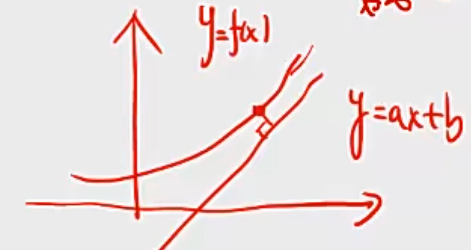
- When x
->is infinite, when the infinitesimal α(x)->0 in $y=ax+b+α(x)$, then this equals the oblique asymptote $y=ax+b$, so the oblique asymptote exists; - Summary
- When the function is of $y=ax+b+α(x)$, where α(x)
->0, then the function has an oblique asymptote;
PART 2: Typical Example Problems
PART 3: Key Points Review
Note: When calculating the number of asymptote lines and considering horizontal asymptotes, besides considering x -> negative infinity, you also need to consider x -> positive infinity;
Note: When analyzing intervals (such as concave-convex, increment/subtraction), be sure to pay attention to the current defined range of the function and whether there are any defined points;
- 1. Zero cannot be used as the denominator;
- 2. Pay attention to the scope of $Inx$;
- 3. Pay attention to the scope of $e^x$;