Lecture 24: Monotonicity, Convexity, and Inflection Points
Postgraduate Entrance Exam Mathematics study notes: Lecture 24: Monotonicity, Convexity, and Inflection Points. Original formulas, diagrams, and examples are retained.
On this page
1.1 Determining Monotonicity
1.1.1 Derivatives and Monotonicity
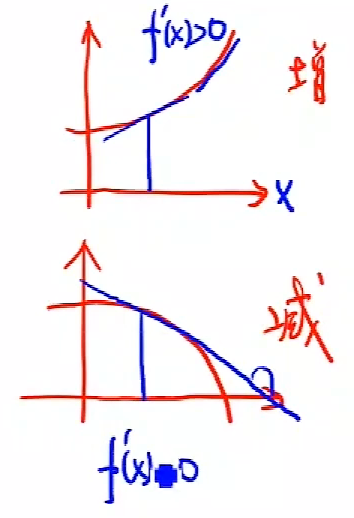
- Geometric illustration:
Theorem: derivatives-and-monotonicity
Let $f$ be continuous on $[a,b]$ and differentiable on $(a,b)$.
- If $f'(x)\ge0$, then $f$ is nondecreasing on $[a,b]$.
- If $f'(x)\le0$, then $f$ is nonincreasing on $[a,b]$.
- If $f'(x)>0$, then $f$ is strictly increasing; if $f'(x)<0$, then $f$ is strictly decreasing.
The condition $f'(x)\ge0$ together with only finitely many zeros of $f'$ is also sufficient for strict increase; the decreasing case is analogous. More generally, strict monotonicity follows if $f'$ is not identically zero on any subinterval.
1.1.2 Examples
Example 1: Determine the monotonic intervals of $f(x)=e^x-x-1$
- For $x<0$, $f'(x)<0$, so $f$ is strictly decreasing on $(-\infty,0)$.
- For $x>0$, $f'(x)>0$, so $f$ is strictly increasing on $(0,+\infty)$.
Example 2: Prove that $x-\frac{x^3}{6}<\sin x<x$ for $x>0$
- Let $F(x)=x-\sin x$. Since $F(0)=0$ and $F'(x)=1-\cos x\ge0$, we have $F(x)>0$ for $x>0$, hence $\sin x<x$.
- Let $G(x)=\sin x-x+\frac{x^3}{6}$. Then $G(0)=G'(0)=G''(0)=0$ and
Applying monotonicity successively gives $G''(x)>0$, $G'(x)>0$, and $G(x)>0$ for $x>0$. Therefore $x-\frac{x^3}{6}<\sin x$.
1.2 Convexity and Inflection Points
1.2.1 Definitions and the Second-Derivative Test
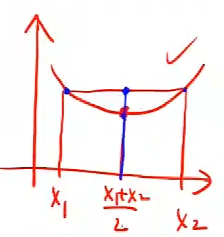
Definition: convexity
Let $f$ be continuous on an interval $I$. For any distinct $x_1,x_2\in I$:
- If
then $f$ is strictly convex on $I$.
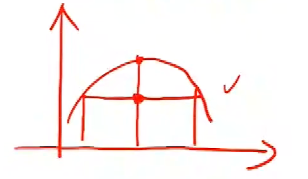
- If the inequality is reversed, then $f$ is strictly concave on $I$.
Geometric meaning
- Convex: each chord lies above the graph, and the slope increases.
- Concave: each chord lies below the graph, and the slope decreases.
Theorem: second-derivative-test
Let $f$ be continuous on $[a,b]$ and twice differentiable on $(a,b)$.
- If $f''(x)>0$, then $f$ is convex on the interval.
- If $f''(x)<0$, then $f$ is concave on the interval.
The sign of the first derivative determines monotonicity; the sign of the second derivative determines convexity or concavity.
1.2.2 Inflection Points
Definition: inflection-point
An inflection point is a point on a continuous curve where the curve changes from convex to concave or from concave to convex.
Candidate abscissas satisfy one of the following:
- $f''(x_0)=0$;
- $f''(x_0)$ does not exist, but $f$ is continuous at $x_0$.
A candidate is not automatically an inflection point. The convexity must actually change across $x_0$.
1.2.3 Examples
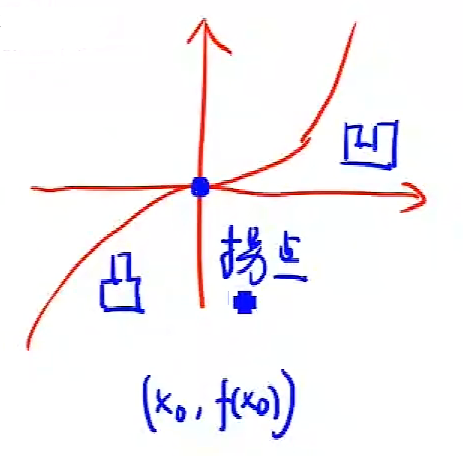
Example 1: Determine the convexity of $y=x^3$
- On $(-\infty,0)$, $y''<0$, so the curve is concave.
- On $(0,+\infty)$, $y''>0$, so the curve is convex.
- Convexity changes across $x=0$, so $(0,0)$ is an inflection point.
- Original illustration:
Example 2: Find the convexity intervals and inflection point of $h(x)=\sqrt[3]{x}$
For $x\ne0$,
- For $x<0$, $h''(x)>0$, so the curve is convex.
- For $x>0$, $h''(x)<0$, so the curve is concave.
- Although $h''(0)$ does not exist, $h$ is continuous at $0$ and the convexity changes there. Thus $(0,0)$ is an inflection point.
1.3 Common Question Types
Question Type 1: convexity-and-inflection-points
- Compute $f''(x)$.
- Find the points where $f''(x)=0$ or $f''(x)$ does not exist.
- Use these candidates to divide the domain and determine the sign of $f''$ on each interval.
- A candidate is an inflection point only if the convexity changes across it.
Question Type 2: number-of-roots
- Existence: if $f$ is continuous on $[a,b]$ and $f(a)f(b)<0$, the Intermediate Value Theorem guarantees at least one zero in $(a,b)$.
- Uniqueness: if $f$ is strictly monotone on an interval, it has at most one zero there.
- Rolle's theorem helps bound the number of roots: if $f$ has two distinct zeros, then $f'$ has at least one zero between them.
Question Type 3: proving-inequalities
- Move all terms to one side, define an auxiliary function, and use its derivative to establish monotonicity.
- The Lagrange Mean Value Theorem is useful for differences of function values.
For example, prove that for $x>0$,
Let $F(x)=\ln(1+x)-\frac{x}{1+x}$. Then
so $F(x)>0$. Next let $G(x)=x-\ln(1+x)$. Then
so $G(x)>0$. The desired inequality follows.