Lecture 19: Eigenvalues and eigenvectors
Postgraduate Entrance Exam Mathematics Study Notes: Lecture 19: Eigenvalues and eigenvectors. Retain original formulas, diagrams, and example problems.
On this page
19.1 Definition of Eigenvalues and Eigenvectors
19.1.1 Basic Concepts
Definition: Eigenvaluesandeigenvectors
description: Let $A$ be the $n$ order matrix $, \lambda$ be a number $, $ If there is a $n$ dimensional non-zero column vector $\xi, $ such that $: $
$$A\xi=\lambda\xi$$
is called:
1. $\lambda$ is the eigenvalue;
2. $\xi$ is the eigenvector of A corresponding to the eigenvalue $\lambda$;
Explanation
- Features:
- React to a property of matrix A;
- Explanation: eigenvalue
- For example, when A is a matrix, when A acts on a vector, its result can be represented by a number (scaling the vector with a number), and this number is the eigenvalue;
- Spatially, it can reflect properties such as extremes and similarities within space;
- Concept:
- A matrix of
norder will haveneigenvalues. By looking at this number, one can know certain characteristics of theAmatrix; - Explanation: $\xi$
- $\xi$ must not be zero;
- Because if $\xi$ equals 0, it means the current matrix has only a unique zero solution, i.e.,
S=r(A). Acting A on $\xi$ does not reflect A's effect, because the matrix is still zero on the zero vector, so here $\xi$ is a nonzero vector; - Demonstrate the effect, so you can understand the role of eigenvalues;
- Meaning:
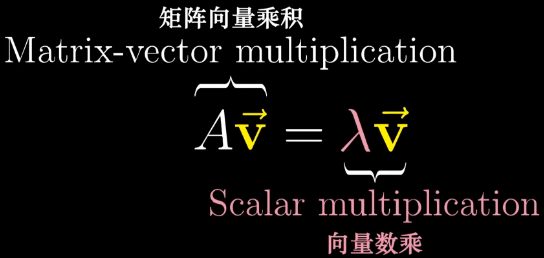
Analysis: Analyze the $A\xi=\lambda\xi$
- Steps:
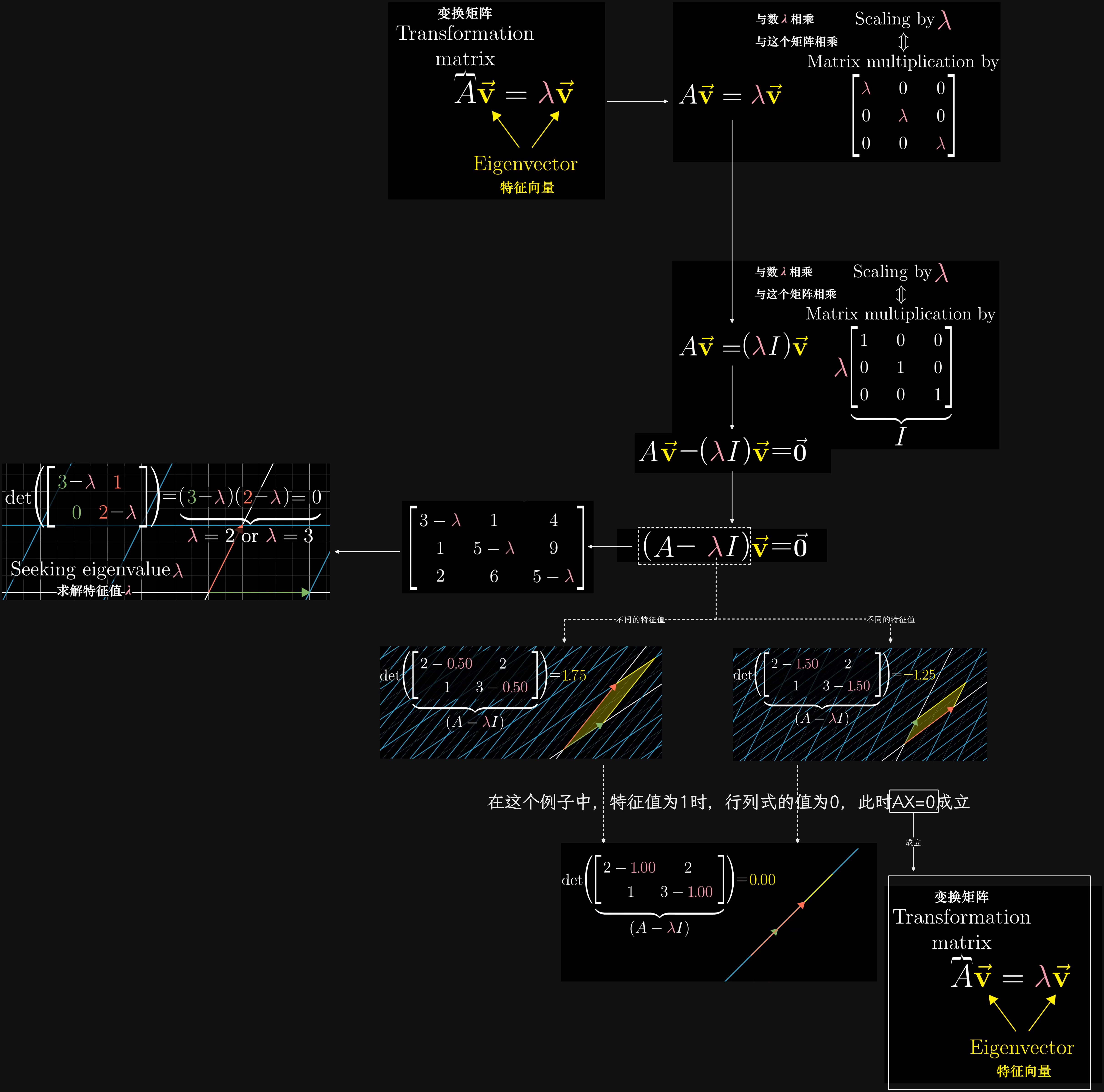
->$\lambda\xi-A\xi=0$ // $\xi$ is a nonzero vector->$(\lambda E-A)\xi=0$ // Extract the common factor->$(\lambda E-A)X=0$- // Set $\xi$ to be the solution to the current system of equations;
- // Because
Xis $\xi$, $\xi$ is a nonzero vector, and the current expression equals 0->means the current equation is homogeneous; - // Because this homogeneous system has a nonzero solution, the columns of $\lambda E-A$ are linearly dependent
<-Theorem 4 on linear dependence: Lecture 11: Linear Dependence of Vectors and Vector Sets; - // Therefore, $r(\lambda E-A)<n$: the rank of the matrix is less than $n$;
- // For $n$ column vectors $a_1,a_2,\cdots,a_n$ in $\mathbb{R}^n$, linear dependence is equivalent to $\left|a_1,a_2,\cdots,a_n\right|=0$. Hence $|\lambda E-A|=0$
->$|\lambda E-A|=0$- // Here you can find $\lambda_i(i=1,2,3...)$
- Illustration:
Definition: Characteristicequations
description: $$\begin{vmatrix}\lambda E-A\end{vmatrix}=\begin{vmatrix}\lambda-a_{11}&-a_{12}&\cdots&-a_{1n}\\-a_{21}&\lambda-a_{22}&\cdots&-a_{2n}\\\vdots&\vdots&&\vdots\\-a_{n1}&-a_{n2}&\cdots&\lambda-a_{nn}\end{vmatrix}=0$$
Explanation
- $|\lambda E-A|$: called the characteristic equation
19.1.2 Geometric Explanation
Concepts: Geometric explanation of eigenvalues and eigenvectors
- Concept:
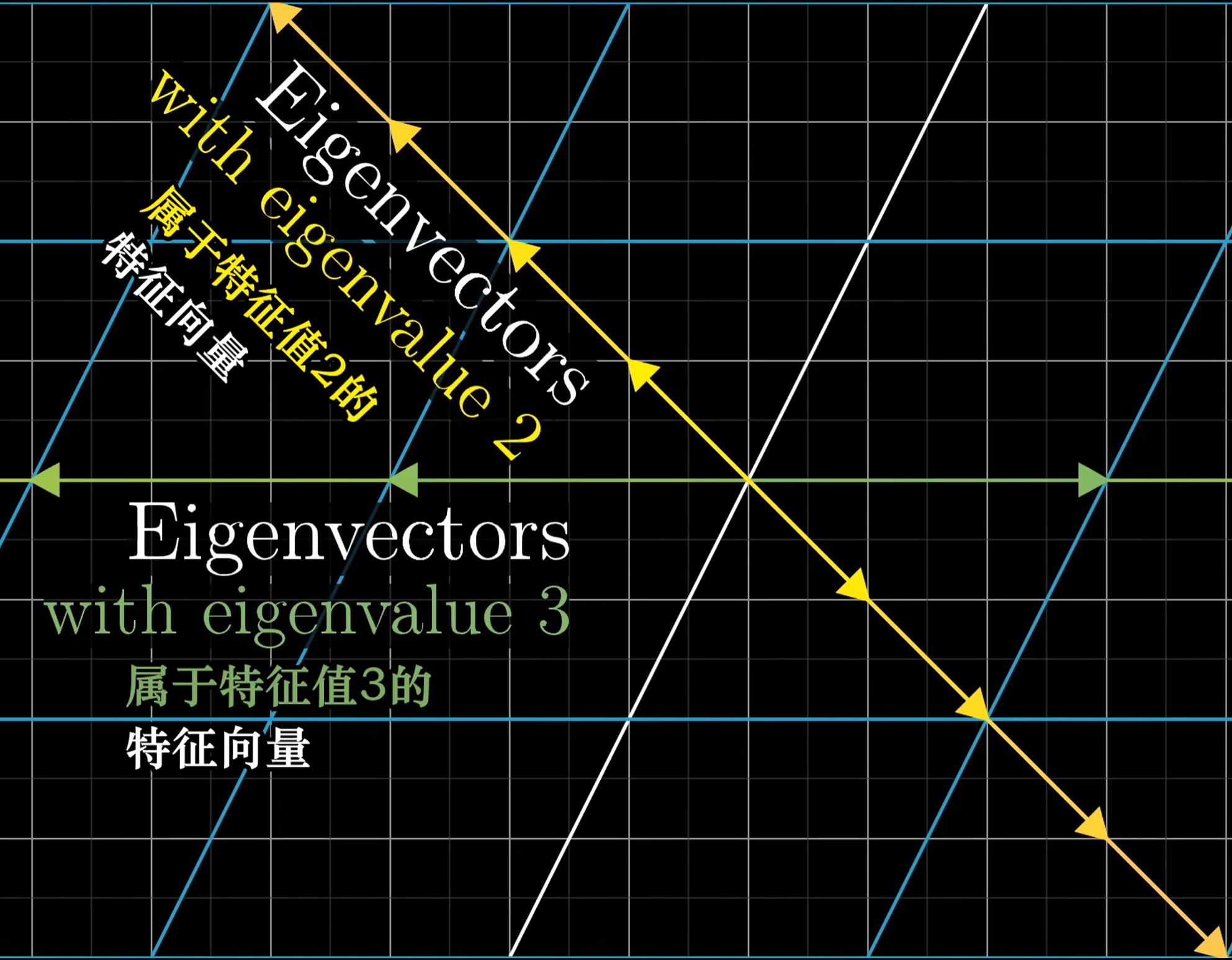
- After the basis vector is transformed, some transformations correspond only to proportional transformations after and before the solution, while the angular position remains unchanged;
- The value used to describe the transformation ratio of an eigenvector, called an eigenvalue;
- Eigenvectors are those vectors that remain on the original line after transformation;
- Illustration:
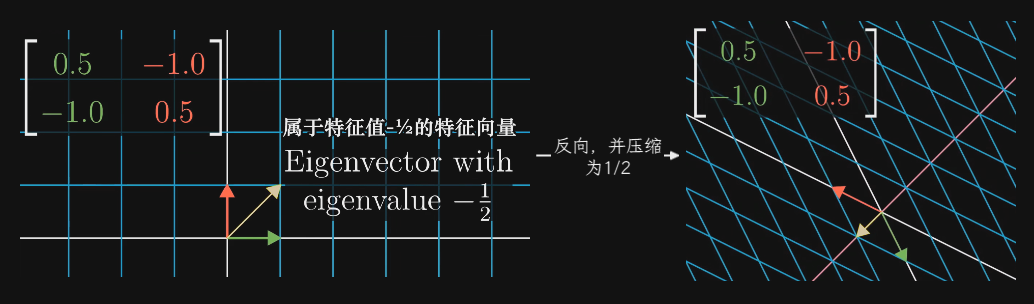
Concept: When the eigenvalue is negative
- Illustration:
19.2 Calculation method
19.2.1 Methods for Finding Eigenvalues and Eigenvectors
Method: Find eigenvalues
- Step 1: Write the characteristic equation $|\lambda E-A|$
- $A=\begin{bmatrix}2&2&-2\\2&5&-4\\-2&-4&5\end{bmatrix}$
- $|\lambda E-A|=\left|\begin{matrix}\lambda-2&-2&2\\-2&\lambda-5&4\\2&4&\lambda-5\end{matrix}\right|$
- Step 2: Calculate the determinant of the characteristic equation to obtain the equation about $\lambda$;
- In the end, you will definitely get an equation similar to $\lambda^3+a\lambda^2+b\lambda+c=0$, which can then be transformed into a form that finds roots;
- Step 3: Find all eigenvalues (the roots of the characteristic polynomial);
Method: Find eigenvectors
- Step 1: For each eigenvalue $\lambda$, substitute it into $(\lambda E-A)x=0$;
- Step 2: Row-reduce $\lambda E-A$ and find a basis for its null space;
- The eigenspace dimension is $S=n-r(\lambda E-A)$;
- These
Svectors solved form the space of understanding. All vectors on this two-dimensional plane are eigenvectors corresponding to the current substituted $\lambda_i$; - Except for the zero vector;
- 2.2 If simplification does not allow for a stepped matrix, you can also determine the current rank by using the
determinant = 0for the restriction on rank and the number of irrelevant term vectors in the current matrix $\lambda E-A$, to determine its current rank and obtain its maximally independent group; - Step 3: According to step two, when you get the current $\lambda=\text{ A certain value }$, you get $\xi=k_1\xi_1+k_2\xi_2$
- Viewing
k1andk2cannot be 0 at the same time; - Step 4: If there are other $\lambda_i$, continue using the above steps to find the eigenvector $\xi$;
19.2.2 Finding the Root
Supplement: Method to find roots
- If there are no constant terms in $\lambda^3+a\lambda^2+b\lambda+c=0$, then $\lambda=0$ is definitely rooted;
- If $\lambda^3+a\lambda^2+b\lambda+c=0$ among them, $a+b+c=0$, then $\lambda =1$ is definitely their root: $(\lambda -1)$
- If the sum of the even-degree terms in $\lambda^3+a\lambda^2+b\lambda+c=0$ equals the sum of odd-degree terms, then $f(-1)=0$, so $-1$ is its root;
Method: Root testing method
- Concept:
- Using the root-finding method to obtain the sum of a given root, using polynomials to obtain codivision with co-division, and using a calculator for quadratic terms;
- Example:
Theorem: PolynomialRoots
description: let the following formula be a polynomial with coefficients $a_i$ both integers: $$f\left(x\right)=1·x^{k}+a_{k-1}x^{k-1}+\cdots+a_{1}x+a_{0}$$
then the rational roots of $f(x)=0$ are integers, and $a_0$ factor of.
Explanation
- The solution to the equation is a factor of $a_0$
- Therefore, its factors can be framed first, and once the factors are known, their range is determined;
19.3 Significant Nature and Conclusion
19.3.1 Properties and Conclusions of Eigenvalues
Concept: Property one
- $$\lambda_0\text{ is an eigenvalue of }A\Leftrightarrow|\lambda_0 E-A|=0.$$
- Similarly, $$\lambda_0\text{ is not an eigenvalue of }A\Leftrightarrow|\lambda_0E-A|\neq0,$$ in which case $\lambda_0E-A$ is invertible and has full rank.
- Supplement:
- If $|aA+bE|=0$ (equivalently, $aA+bE$ is singular) and $a\neq0$, then $-\frac{b}{a}$ is an eigenvalue of $A$.
Concept: Property two
- Nature:
- If $\lambda_1,\lambda_2,\ldots,\lambda_n$ are the $n$ eigenvalues of $A$, counted with algebraic multiplicity, then:
- $$\begin{cases}\left|A\right|=\lambda_{1}\lambda_{2}\cdots\lambda_{n},\\\mathrm{tr}\left(A\right)=\lambda_{1}+\lambda_{2}+\cdots+\lambda_{n}.\end{cases}$$
-Conclusion 1:
- 1. There is a matrix with eigenvalue
0, whose determinant must be0 - 2. $\lambda_{1}+\lambda_{2}+\cdots+\lambda_{n}$ The sum of eigenvalues equals the sum of the main diagonal elements of the current matrix
Atr(A)
-Conclusion Two: Based on Conclusions One and Proof
- From equations (1) and (2), we get:
- $$\begin{cases}a_{11}+a_{22}+a_{33}=\lambda_{1}+\lambda_{2}+\lambda_{3},\\A_{11}+A_{22}+A_{33}=\lambda_{2}\lambda_{3}+\lambda_{1}\lambda_{3}+\lambda_{1}\lambda_{2},\\\left|A\right|=\lambda_{1}\lambda_{2}\lambda_{3}.\end{cases}$$
- More generally, the sum of the principal minors of order $k$ equals the $k$th elementary symmetric sum of the eigenvalues.
- Proof for order $3$: expand the characteristic polynomial $|\lambda E-A|$ in two ways.
- $$\text{Equation (1)}\quad|\lambda E-A|=\begin{vmatrix}\lambda-a_{11}&-a_{12}&-a_{13}\\-a_{21}&\lambda-a_{22}&-a_{23}\\-a_{31}&-a_{32}&\lambda-a_{33}\end{vmatrix}=\lambda^{3}-\left(a_{11}+a_{22}+a_{33}\right)\lambda^{2}+\left(A_{11}+A_{22}+A_{33}\right)\lambda-\left|A\right|$$
- $$\text{Equation (2)}\quad\left|\lambda E-A\right|=\left(\lambda-\lambda_1\right)\left(\lambda-\lambda_2\right)\left(\lambda-\lambda_3\right)=\lambda^3-(\lambda_1+\lambda_2+\lambda_3)\lambda^2+(\lambda_1\lambda_2+\lambda_1\lambda_3+\lambda_2\lambda_3)\lambda-\lambda_1\lambda_2\lambda_3$$
- Supplement: Principal minors
- A principal minor uses the same index set for its selected rows and columns.
- For a $3\times3$ matrix, the three principal minors of order $2$ are $\begin{vmatrix}a_{22}&a_{23}\\a_{32}&a_{33}\end{vmatrix}=A_{11},\begin{vmatrix}a_{11}&a_{13}\\a_{31}&a_{33}\end{vmatrix}=A_{22},\begin{vmatrix}a_{11}&a_{12}\\a_{21}&a_{22}\end{vmatrix}=A_{33}$.
19.3.2 Properties and Conclusions of Eigenvectors
Concept: Property One
- A nonzero vector $\xi$ is an eigenvector of $A$ associated with $\lambda_0$ if and only if $\xi$ is a nonzero solution of $(\lambda_0E-A)x=\mathbf{0}$;
Concept: Conclusion One
- An eigenvalue $\lambda$ of algebraic multiplicity
khas at mostklinearly independent eigenvectors;
Concept: Conclusion two
- If $\xi_1,\xi_2$ are eigenvectors of
Aassociated with distinct eigenvalues $\lambda_1,\lambda_2$, then $\xi_1,\xi_2$ are linearly independent;
Summary: $\text{For matrix }A,\begin{cases}\lambda_{1}\neq\lambda_{2}\Rightarrow\xi_{1},\xi_{2}\text{ are linearly independent},\\\lambda_{1}=\lambda_{2}\Rightarrow\xi_{1},\xi_{2}\text{ may be linearly dependent or linearly independent}.\end{cases}$
Concept: Conclusion three
- If $\xi_1,\xi_2$ are eigenvectors of $A$ associated with the same eigenvalue $\lambda$ and $k_1\xi_1+k_2\xi_2\neq0$, then $k_1\xi_1+k_2\xi_2$ is also an eigenvector associated with $\lambda$ (a common special case has one coefficient, such as $k_2$, equal to
0);
Concept: Conclusion Four
- If $\xi_1,\xi_2$ are eigenvectors of $A$ associated with distinct eigenvalues $\lambda_1,\lambda_2$ and $k_1,k_2\neq0$, then $k_1\xi_1+k_2\xi_2$ is not an eigenvector of $A$ (a common special case is $k_1=k_2=1$);
Concept: Conclusion Five
- Let $\lambda_1,\lambda_2$ be distinct eigenvalues of $A$. If $\xi$ is an eigenvector associated with $\lambda_1$, then it cannot also be an eigenvector associated with $\lambda_2$;
19.3.3 Common Eigenvalues and Eigenvectors of Matrices
Summary: Eigenvalues and eigenvectors of commonly used matrices
- Illustration:

Concept: The matrix is $f(A)$
- Important formula - When
Ais a polynomial equal to0 - Formula:
- $$A\xi=\lambda \xi \rightarrow f(A)\xi=f(\lambda)\xi$$
- Proof:
- For example: $A^2\xi=\lambda A\xi=\lambda^2\xi$
- Example:
- When $A^2-2A+3E$ $\lambda$: $\lambda^2-2\lambda+3$
- Note:
- The equation obtained from the polynomial of $A$ about $\lambda$ only represents the possible values of $\lambda$ under the current polynomial conditions of A (what relation or range they satisfy), and does not represent the different $\lambda$ of the current characteristic equation;
Concept: The matrix is $A^*$
- Formula:
- When the matrix is $A^*$, its eigenvalue equals $\frac{|A|}{\lambda}$;
- And since $|A|=\lambda_1\lambda_2\lambda_3$, so $\frac{|A|}{\lambda}=\lambda_1\lambda_2\text{ or }\lambda_1\lambda_3\text{ or }\lambda_2\lambda_3$
Supplement: $P^{-1}AP$, its eigenvalues do not change -> similar; but the eigenvectors change: $P^{-1}\xi$;
Concept: The conclusion of a rank 1 matrix
- When
r(A)=1, matrix $A_{n*n}$ can definitely be reduced to two nonzero determinants: $\alpha\beta^{T}$ product of the two; - And: $\lambda_1=\lambda_2=\lambda_3=...=\lambda_{n-1}=0$
- And: $\lambda_n=tr(A)=\beta^T\alpha$