Lecture 45: Calculation of Double Integrals
Postgraduate Entrance Exam Mathematics Study Notes: Lecture 45: Calculation of Double Integrals. Retain original formulas, diagrams, and example problems.
On this page
45.1 Calculation of Double Integrals
Core Idea: Transform a double integral into the calculation of a definite integral in one variable, simplifying the calculation method;
Method Selection
- Choose methods based on the following:
- 1. integrand;
- 2. Scoring area;
Suitable for polar coordinates
- (1) Integrands suitable for polar coordinates calculations
- Formula:
- $$f(x^2+y^2),f(\sqrt{x^2+y^2}),f(\frac yx),f(\frac xy)$$
- Cause:
- $\sqrt{x^2+y^2}$ is more complex in the Cartesian coordinate system, but represents
ρin polar coordinates - $\frac yx$ In polar coordinates, it represents an angle
- (2) Integration fields suitable for polar coordinates
- $$x^{2}+y^{2}\leq R^{2};\quad\quad\quad r^{2}\leq x^{2}+y^{2}\leq R^{2};\quad\quad\quad\\x^{2}+y^{2}\leq2ax;\quad\quad\quad x^{2}+y^{2}\leq2by;$$
- Note:
- When the center is not at the origin, $x-x_0$ can be set to $\rho\sin\theta$, and similarly, $y-y_0$
- If (1) and (2) have a conflict, (1) takes precedence
45.2 Calculation Using Cartesian Coordinate System
Theorem: Doubleintegrationcalculationbasedonrectangularcoordinatesystem
description:
(1) FirstYLaterX: $$\int\int_D{f(x,y)d\sigma = \int_{a}^{b}[\int_{y_{1}(x)}^{y_{2}(x)}f(x,y)dy]dx}$$
Area: $\begin{aligned}\varphi_1(x)&\leq y\leq\varphi_2(x)\cdot\\a&\leq x\leq b\end{aligned}$
$\varphi_1(x)\leq y\leq\varphi_2(x)$ represents the range of x values, which is the function of x with respect to y, and $\varphi_1(x)$ is the actual value of y equal to.
(2) FirstXLaterY: $$\iint_Df(x,y)\mathrm{d}\sigma=\int_c^ddy\int_{\psi_1(y)}^{\psi_2(y)}f(x,y)dx$$
Area: $\begin{aligned}\Psi(y)&\leq X\leq\Psi_2(y)\\c&\leq y\leq d\end{aligned}$
Method: Set the points limit;
- When Y comes first, then X:
dyupper and lower integral limits->Draw a ray from bottom to top, with the lower end of the ray being thedylower limit of integration and the upper end of the ray being the upper limit of the integral of dy;dxupper and lower limits of integration->Observe the graph to see the range of x values;- When X comes first, then Y:
- The upper and lower limits of
dxintegration->Draw a ray from left to right, with the left end of the ray as thedxlower limit and the upper end as thedxlower limit; dyupper and lower limits of integration->Observe the image and see therangeofy;
Explanation
- Concept:
- Both can be used; choose whichever is more convenient for calculation;
- First
YX: - Concept:
- $\int_{a}^{b}[\int_{y_{1}(x)}^{y_{2}(x)}f(x,y)dy]dx$ or $\int_a^b\mathbf{d}x\int_{y_1(x)}^{y_2(x)}f(x,y)\operatorname{d}y.$
- Reasoning:
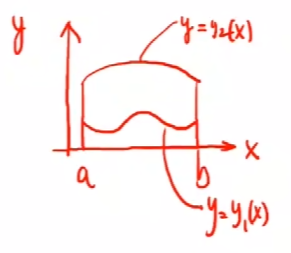
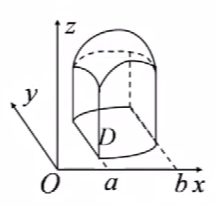
- 1. First, find the cross-sectional area: $S(x)=\int_{y_1(x)}^{y_2(x)}f(x,y)\mathsf{d}y.$
- 2. Then, for the curved edge body area, solve: $V=\int_a^bS(x)\operatorname{d}x$
- 3. Merging the two: $\int_{a}^{b}[\int_{y_{1}(x)}^{y_{2}(x)}f(x,y)dy]dx$
- Illustration:
- 2D:
- 3D:
- First
XY: - Premise: $(\sigma)=\{(x,y)\mid x_1(y)\leq x\leq x_2(y),c\leq y\leq d\}$
- Illustration:
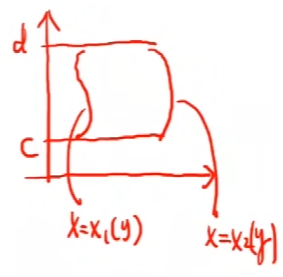
- Convert to two single-invariant integrals with x before y;
- Formula: $\begin{aligned}\iint_{(\sigma)}f(x,y)\operatorname{d}\sigma&=\int_c^d[\int_{x_1(y)}^{x_2(y)}f(x,y)dx]\operatorname{d}y\\\\&=\int_c^d\operatorname{d}\left.y\right]_{x_1(y)}^{x_2(y)}f(x,y)\operatorname{d}x.\end{aligned}$
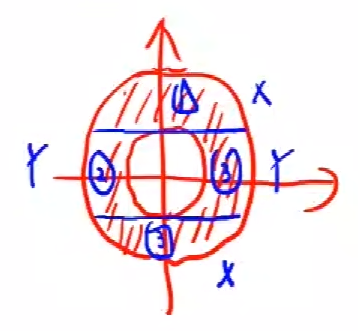
- Non-X and non-Y regions
- Illustration
- Concept:
- A complex double integral of a non-X and non-Y figure;
- Method:
- Canbe converted by partitioning to: sum of multiple X-types and multiple Y-types;
45.3 Calculation Using Polar Coordinates
Theorem: Doubleintegralcalculationbasedonpolarcoordinates
description: $$\text{ First }\rho\text{ Afterwards }\theta\quad\iint_Df (x, y)\mathrm{d}\sigma=\int_\alpha^\beta d\theta\int_{\varphi_1 (\theta)}^{\varphi_2 (\theta)}f (\rho\cos\theta,\rho\sin\theta)\rho d\rho$$
Area: $\begin{aligned}\varphi_1(0)&\leq p\leq\varphi_2(0)\\\alpha&\leq\theta\leq\beta.\end{aligned}$
>
Explanation
- Note:
- When integrating with $\rho$, $\theta$ in the expression can be regarded as a constant. Similarly, when integrating with $\theta$;
- Supplement:
- The contents of a function can be divided into two integrals for calculation;
- $\iint_D\frac{x\sin (\pi\sqrt{x^2+y^2})}{x+y}dxdy=\int_0^{\frac\pi 2}\frac{\cos\theta}{\cos\theta+\sin\theta}d\theta\cdot\int_1^2\rho\sin (\pi\rho) d\rho$
- $\Delta\sigma=\frac12[(\rho+\Delta\rho)^2\Delta\theta-\rho^2\Delta\theta]$ = $\rho\Delta\rho\Delta\theta+\frac12(\Lambda\rho)^2\Delta\theta.$
45.4 Calculation Using Symmetry and Parity
45.4.1 Parity
Concepts: When Y is symmetrical, look at X; when about X, look at Y;
Property One: If the integral D relation Y axial, then the function is evenly X:
- If the function with respect to
Xis even, it doubles; If the function with respect toXis odd, it is0; - $$\iint\limits_{D}f(x,y)d\sigma=\begin{cases}2\iint\limits_{D_{x\geq0}}f(x,y)\mathrm{d}\sigma;&f(-x,y)=f(x,y)\\0;&f(-x,y)=-f(x,y)\end{cases}$$
Property Two: If the integral D relation X axiosymmetric, then the function has parity with respect to Y:
- $$\iint\limits_{D}f(x,y)d\sigma=\begin{cases}2\iint\limits_{D_{y_{z_0}}}f(x,y)\mathrm{d}\sigma&f(x,-y)=f(x,y)\\0&f(x,-y)=-f(x,y)\end{cases}$$
45.4.2 Symmetry
Theorem: Variablesymmetryofdoubleintegrals
description: $$\text{ If }D\text{ About }y=x\text{ Symmetric, then }\quad\iint_Df(x,y)\mathrm{d}\sigma=\iint_Df(y,x)\mathrm{d}\sigma $$
Explanation
- The integration field is the same, where the independent variable is swapped;
- Because the point of $(x,y)$ symmetric about
y=xis $(y,x)$
Inference: A more generalized conclusion
- $$\int\int_{D(x,y)} f(x,y)\mathrm{d}x\mathrm{d}y=\int\int_{D(u,v)} f(u,v)\mathrm{d}u\mathrm{d}v=\int\int_{D(y,x)} f(y,x)\mathrm{d}y\mathrm{d}x$$
45.5 Frequently Tested Question Types
Question Type: Cumulativepointsexchangeorderorcalculation
PART 1: Problem-solving methods
Problem-solving steps: Example $\text{ Exchange cumulative points }\int_0^1dx\int_{x^2}^{2-x}f(x,y)dy\text{ The order }$
- Step 1: Draw the domain
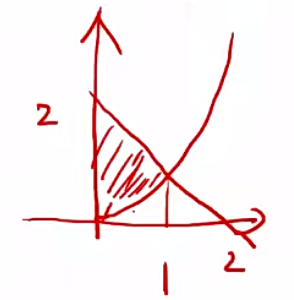
- Step 2: After drawing the domain, define the domain in another order
- Swap order and reline:
- $$\int_0^1dy\int_0^{\sqrt{y}}f(x,y)dx+\int_1^2dy\int_0^{2-y}f(x,y)dx$$
- Additional note: If it's hard to calculate after swapping order, consider using polar coordinates;
Question Type: Cumulative integrals in polar coordinates
- Example:
- $$\int_{0}^{\frac{\pi}{2}}\mathrm{d}\theta\int_{0}^{\cos\theta}f(\rho\cos\theta,\rho\sin\theta)\rho\mathrm{d}\rho $$
- Steps:
- (1) Drawing area;
- (2) Draw the limit, convert the polar coordinate equation into a rectangular coordinate equation;
Question Type: Calculate cumulative points
-
PART 2: Typical Example Problems
PART 3: Key Points Review
Question Type: Calculationofdoubleintegrals
PART 1: Problem-solving methods
Question Type: Calculation of double integrals
- First, draw the graph based on the function of D
- First, observe the form and analyze:
- 1. Can parity, symmetry,
->simplify the integral to be used; - 2. Observe the formula, whether Cartesian or polar coordinate systems are appropriate;
- Calculation:
- Using the rules for calculating double integrals, calculating;
Question Type: Double Integrals and Inequalities
- Basic idea: The integrand of the integrand is larger;
PART 2: Typical Example Problems
Example: Let $D=\{(x,y)|x^2+y^2\leq1\}$, then $\iint_D(x^2-y)dxdy=$
- Analysis
- Directly calculating the double integral of $x^2-y$ is difficult to compute, so consider analyzing parity and symmetry;
- Analysis
- From parity, it can be inferred: $\int\int ydxdy=0$
- From symmetry, it can be inferred: $\text{ Original form }=\int\int y^2dxdy=\int\int x^2dxdy=\frac{1}{2}\int\int(x^{2}+y^{2})db$