Lecture 47: Triple Integral
Postgraduate Entrance Exam Mathematics Study Notes: Lecture 47: Triple Integrals. Original formulas, diagrams, and example problems are retained.
On this page
46.1 Triple Integral
46.1.1 Basic Concepts
Definition: Triplepoints
description: $\iiint_{\Omega}f(x,y,z)\mathrm{d}\mathbf{v}=\lim_{\lambda\to0}\sum_{k=1}^{n}f(\xi_{k},\eta_{k},\xi_{k})\Delta\nu_{k}$
Explanation
- Concept:
- A ternary function integrating into a spatial field $\Omega$;
- $\Delta\nu_{k}$ is the volume of the geometric solid in the k-th region;
- Core:
- The core of the triple integral section is the calculation of the triple integral;
- The core of triple integral calculations is to convert them into definite integrals or double integrals;
46.1.2 Basic Calculation Methods
Theorem: Calculationoftherectangularcoordinateoftripleintegrals
description:
1. First one, then two: $$\iiint_{\Omega}f(x,y,z)\mathrm{dv}=\iint_{D_{xy}}d\sigma\int_{z_{1}(x,y)}^{z_{2}(x,y)}f(x,y,z)dz$$
2. Two first, one later: $$\iiint_{\Omega}f(x,y,z)\mathrm{d}\mathbf{v}=\int_{c_{1}}^{c_{2}}dz\iint_{D_{c}}f(x,y,z)dxdy$$
Explanation
- First one, then two:
- Explanation:
- First, take definite integrals on
z; - Double integration on
xy; - Limiting method:
- Draw a projection surface $D_{xy}$ of the current set on the
xyaxis, and draw a ray upward on this projection plane passing through the geometric solid; - The lower part of the point is the lower limit of the points $z=z_1(x,y)$, and the upper part of the part is the upper limit of the points $z=z_2(x,y)$;
- Two before one:
- Explanation:
- First, perform the double integral on
xy; - Taking definite integrals on
z; - Limiting method:
- When projecting a geometric solid onto the
zaxis, the upper and lower bounds ofzare its maximum and minimum values projected onto thezaxis;
46.2 Cylindrical Coordinates
46.2.1 Basic Concepts
Definition: Cylindricalcoordinates
description: $$\begin{cases}x=r\cos\theta,&\quad0\leq r<+\infty,\\y=r\sin\theta,&\quad0\leq\theta\leq2\pi,\\z=z,&\quad-\infty<z<+\infty.\end{cases}$$
Explanation
- Concept:
r: The distance from the point to thezaxis;z: height on the z-axis;angle: Limit the angle of the current line segment;- Illustration:
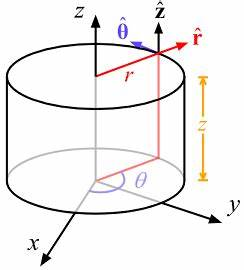
46.2.2 Methods for Calculating Cylindrical Coordinates
Theorem: Cylindricalcoordinatecalculationmethod
description:
Volume micro yuan: $dv=\rho d\rho d\theta dz$
Calculation: $$\iiint_\Omega f(x,y,z)d\nu=\iiint_{\Omega}f(\rho\cos\theta,\rho\sin\theta,z)r\operatorname{d}r\operatorname{d}\theta\operatorname{d}z$$
Supplement: Scope of application for cylindrical coordinates
- Function angle:
- If the integrand can be written as $g(x)*f(\sqrt{x^2+y^2})$
->cylindrical coordinates are suitable; - Regional Perspective:
- Cylindrical coordinates such as
z-axis cylinders, eccentric cylinders, and cones->are suitable for cylindrical coordinates;
46.3 Calculating Triple Integrals with Spherical Coordinates
46.3.1 Basic Concepts
Definition: Sphericalcoordinates
description: $$\begin{cases}x=r\sin\varphi\cos\theta,&\quad0\leq r<+\infty,\\y=r\sin\varphi\sin\theta,&\quad0\leq\varphi\leq\pi,\\z=r\cos\varphi,&\quad0\leq\theta\leq2\pi.\end{cases}$$
Explanation
- Illustration:
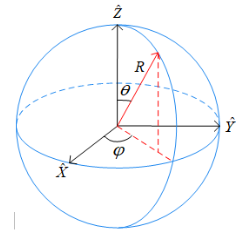
46.3.2 Methods for Calculating Spherical Coordinates
Theorem: Methodsforcalculatingsphericalcoordinates
description:
Volume micro yuan: $dv=r^{2}\sin\varphi drd\varphi d\theta$
Calculation: $$\iiint_{\Omega}f(x,y,z)d\nu =\iiint_\Omega f (r\sin\varphi\cos\theta, r\sin\varphi\sin\theta, r\cos\varphi) r^2\sin\varphi\operatorname{d}r\operatorname{d}\varphi\operatorname{d}\theta$$
Supplement: Scope of application for spherical coordinates
- Function angle:
- If the integrand can be written as $f(\sqrt{x^2+y^2+z^2})$
->spherical coordinates are suitable; - Regional Perspective:
- Spherical spheres, spheres, hemispheroids, and curved pyramids centered at the origin
->suitable for spherical coordinates;
46.4 Properties of Triple Integrals
46.4.1 Parity
Theorem: Paritycalculationoftripleintegrals
description: $$\text{ Like a division domain }\Omega\text{ About }xoy\text{ Coordinate face-to-face symmetry },\,\text{ then }\iiint_{\Omega}f(x,y,z)\mathrm{d}V=\begin{cases}2\iiint f(x,y,z)\mathrm{d}V&f(x,y,-z)=f(x,y,z)\\0&f(x,y,-z)=-f(x,y,z)\end{cases}$$
Explanation
46.4.2 Symmetry
Theorem: Symmetryoftripleintegrals
description:
46.5 Frequently Tested Question Types
Question Type: Calculationoftripleintegrals
PART 1: Problem-solving methods
PART 2: Typical Example Problems
PART 3: Key Points Review
Key Point: Suitable for situations where two comes first, then one
- 1. The integrand function is simply a single-variable function about
z; - 2. When using
z=zto truncate the area of a geometric solid, the formula for this area is easy to calculate (for example, $x^2+y^2<1-z^2$);