Chapter 3: mean value theorems — Advanced Mathematics - Collection of Formulas
Chapter 3: mean value theorems from the formula collection, kept as a focused chapter for faster reading and image loading.
On this page
Chapter 3: mean value theorems
3.1 Three major theorems
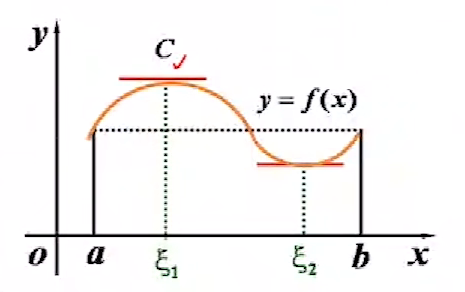
Rolle's theorem
- Definition:
- If three conditions are met:
- 1)$f$ on $[a, b]$ continuity;
- 2)$f$ is differentiable within $(a, b)$;
- 3)f (a)=f (b)
- So, it can be known: $$\text{ then }\exists\xi\in(a,b)\text{ , to use }f^{\prime}(\xi)=0$$
- diagram:
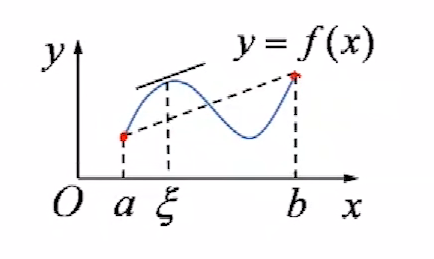
Lagrange's mean value theorem
- Definition:
- If the following conditions are met:
- 1)$f$ on $[a, b]$ continuity
- 2)$f$ is differentiable within ($a, b)$
- Therefore, there exists $\xi\in(a,b)$ such that $$f(b)-f(a)=f^{\prime}(\xi)(b-a).$$
- diagram:
Cauchy's mean value theorem
- Definition:
- If the following conditions are met:
- 1) $f, F$ on $[a, b]$ continuity $; $
- 2) $f, F$ is differentiable within $(a, b)$, and $\forall x\in(a, b), F^{\prime}(x)\neq0$
- Therefore, there exists $\xi\in(a,b)$ such that $$\frac{f(b)-f(a)}{F(b)-F(a)}=\frac{f^{\prime}(\xi)}{F^{\prime}(\xi)}.$$
- diagram:
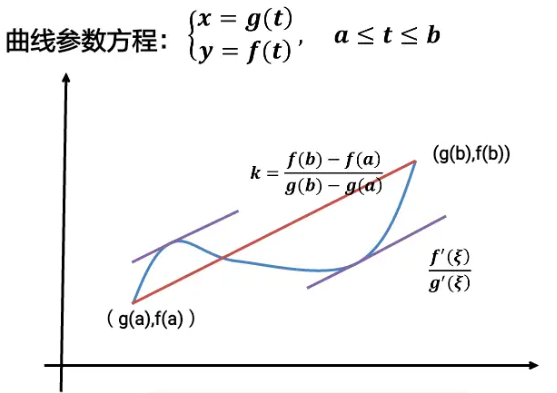
Relationship of three major theorems

3.2 derivative application
Convexity
- Definition:
- Let the function $f(x)$ be continuity on the interval $I$, if for any two points on $I x_1, x_2$
- 1. If $f\left(\frac{x_1+x_2}{2}\right)<\frac{f(x_1)+f(x_2)}{2}$ for every $x_1,x_2\in I$, then $f$ is strictly convex on $I$.
- 2. If $f\left(\frac{x_1+x_2}{2}\right)>\frac{f(x_1)+f(x_2)}{2}$ for every $x_1,x_2\in I$, then $f$ is strictly concave on $I$.
- Method:
- Use the positive and negative values of the first derivative
->determine the monotonicity of the function; - Use the positive and negative values of the second derivative
->determine the concavity of the function; - Test:
- Suppose $f$ is continuous on $[a,b]$ and twice differentiable on $(a,b)$.
- 1) If $f''(x)>0$ on $(a,b)$, then $f$ is convex (concave upward).
- 2) If $f''(x)<0$ on $(a,b)$, then $f$ is concave (concave downward).
Inflection Point
- Definition:
- A point on a continuous curve where its concavity changes.
- Possible value points:
- 1. ${f^{\prime\prime}(x_0)=0}$;
- 2. Points where the second derivative does not exist;
Asymptotes
- Definition:
- 1) Horizontal asymptote: if $\lim_{x\to+\infty}f(x)=A$ or $\lim_{x\to-\infty}f(x)=A$, then $y=A$ is a horizontal asymptote in the corresponding direction.
- 2) Vertical asymptote: if a one-sided limit of $f(x)$ at $x_0$ is $\pm\infty$, then $x=x_0$ is a vertical asymptote.
- 3) Oblique asymptote: if $a=\lim_{x\to\pm\infty}\frac{f(x)}x$ and $b=\lim_{x\to\pm\infty}(f(x)-ax)$ are finite, then $y=ax+b$ is an oblique asymptote in that direction.
- Method:
- 1. Determine the horizontal asymptote
->When x->is infinite, y tends toward a finite value; - 2. Determine the vertical asymptote
->When x->a certain point (finite value), y approaches infinity; - 3. Determine the oblique asymptote
->$\lim_{x\to\infty}\frac{f(x)}x=a$ Finite value;->$\lim_{x\to\infty}(f(x)-ax)=b$ exist- At this time, there is an oblique asymptote;