Chapter 2: Derivatives and Differentials — Advanced Mathematics - Collection of Formulas
Chapter 2: Derivatives and Differentials from the formula collection, kept as a focused chapter for faster reading and image loading.
On this page
Chapter 2: Derivatives and Differentials
2.1 derivative
derivative definition
- Definition:
- If $\lim_{\Delta x\to0}\frac{f(x_0+\Delta x)-f(x_0)}{\Delta x}$ exists, then $f$ is differentiable at $x_0$.
- Alternative form:
- $f^{\prime}(x_0)=\lim_{\Delta x\to0}\frac{f(x_0+\Delta x)-f(x_0)}{\Delta x}=\lim_{x\to x_0}\frac{f(x)-f(x_0)}{x-x_0}$
- Form 1: $f^{\prime}(x_0)=\lim_{\Delta x\to0}\frac{f(x_0+\Delta x)-f(x_0)}{\Delta x}$
- Form 2: $f^{\prime}(x_0)=\lim_{x\to x_0}\frac{f(x)-f(x_0)}{x-x_0}$
left and right derivative
- The relationship between the left and right derivatives: differentiable
<-->The left and right derivatives exist and are equal;
2.2 differentiate
2.2.1 Method 1: sum, difference, product, and quotient rules
algebraic manipulation law
Assume that $u(x), \nu(x)$ can all be imported, then
- $(u\pm v)^{\prime}=u^{\prime}\pm v^{\prime}$
- $(uv)^{\prime}=u^{\prime}v+uv^{\prime}$
- $(\frac\mu\nu)^{\prime}=\frac{\mu^{\prime}\nu-\nu^{\prime}\mu}{\nu^2}\quad(\nu\neq0)$
2.2.2 Method 2: inverse-function differentiation rule
inverse function differentiate
- Formula:
- $$(f^{-1})^{\prime}(x)=\frac1{f^{\prime}(y)}\quad\frac{dy}{dx}=\frac1{dx}$$
- Meaning:
- function and inverse function are two functions, but they are the same curve;
- Thereforewhen the function is continuity and monotonic, it can be known that its inverse function is also differentiable;
2.2.3 Method three: chain rule
Chain Rule
- Suppose $u=g(x)$ is differentiable at $x$ and $y=f(u)$ is differentiable at the corresponding $u$, then $y=f[g(x)]$ is differentiable at x.
- then: $\frac{dy}{dx}=f^{\prime}(u)g^{\prime}(x)$
- Other forms:
- $$\frac{dy}{dx}=\frac{dy}{du}\cdot\frac{du}{dx}$$
2.2.4 Method 4: differentiate conclusion
basic elementary functions
- Basic
- $\begin{aligned}&\quad(C)^{\prime}=0\quad&\quad(x^\alpha)^{\prime}=\alpha x^{\alpha-1}\\&\quad(a^x)^{\prime}=a^x\ln a\quad&\quad(e^x)^{\prime}=e^x\\&\quad(\log_ax)^{\prime}=\frac1{x\ln a}\quad&\quad(\ln|x|)^{\prime}=\frac1x\end{aligned}$
- trigonometric functions
- $(\sin x)'=\cos x\qquad(\cos x)'=-\sin x$
- $\begin{aligned}(\tan x)^{\prime}&=\sec^2x&(\cot x)^{\prime}&=-\csc^2x\\\\(\sec x)^{\prime}&=\sec x\tan x&(\csc x)^{\prime}&=-\csc x\cot x\end{aligned}$
- inverse function derivative
- $\begin{aligned}&(\arcsin x)'=\frac1{\sqrt{1-x^2}}&&(\arccos x)'=-\frac1{\sqrt{1-x^2}}\\&(\arctan x)'=\frac1{1+x^2}&&(\operatorname{arccot}x)'=-\frac1{1+x^2}\end{aligned}$
2.2.5 Method 5: logarithmic differentiation
Example: Let $y=(1+\sin x)^x$. Find $\mathrm{d}y\big|_{x=\pi}$.
- Analysis
- This is an exponent function type, logarithmic differentiation can be used;
- Analysis
- Logarithm first: $\ln y=x\ln(1+\sin x)$
- Differentiate both sides: $\frac{y'}{y}=\ln(1+\sin x)+\frac{x\cos x}{1+\sin x}$.
- Propose $y^{\prime}$, get the derivative function
- bring in x=Π;
IMPORTANT CONCLUSION
- $(\ln|x|)^{\prime}=\frac{1}{x}$
Applicable occasions
- 1. Power exponential function;
- 2. Continuous multiplication, continuous division, multiplication, square root;
2.3 higher-order derivative
Commonly find n-order derivative
- Index
- $(e^{x})^{(n)}=e^{x}$
- trigonometric functions
- $(\sin x)^{(n)}=\sin(x+n\frac\pi2)$
- $(\cos x)^{(n)}=\cos(x+n\frac{\pi}{2})$
Infunction- $(\ln(1+x))^{(n)}=(-1)^{n-1}\frac{(n-1)!}{(1+x)^n}$
- Addition
- $(u\pm v)^{(n)}=u^{(n)}\pm v^{(n)}$
- Multiplication
- Leibniz formula
- $(uv)^{(n)}=\sum_{k=0}^n\binom{n}{k}u^{(k)}v^{(n-k)}$
2.4 Differential
Differential Definition
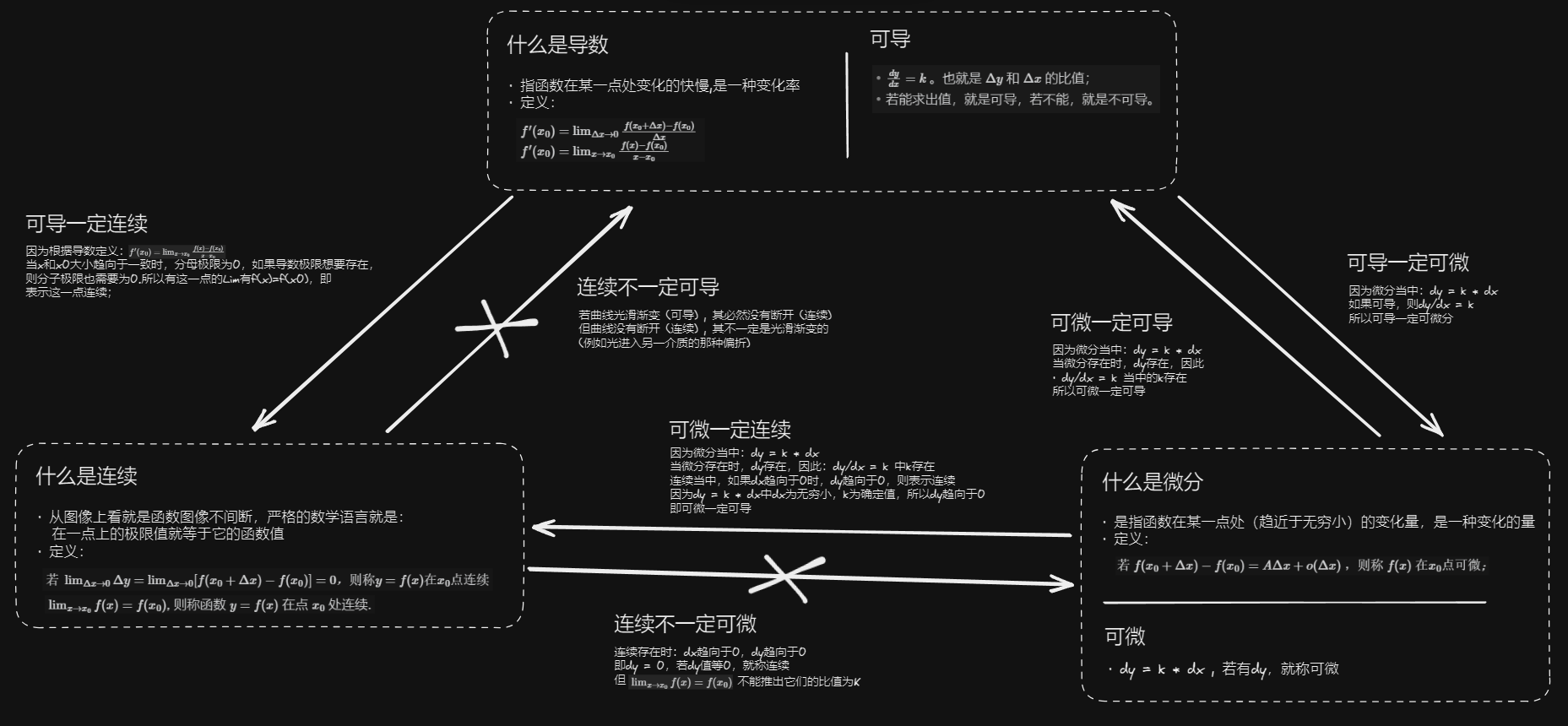
- If $f(x_0+\Delta x)-f(x_0)=A\Delta x+o(\Delta x)$, then $f(x)$ is said to be differentiable at $x _0$ point $; $
- $A\Delta x$ is called the derivative of $f(x)$ at the $x_0$ point
- The first part is the main part of the function change
- The second part is higher-order infinitesimal, which is the secondary part
The relationship between differentiability, differentiability, and continuity
2.5 Taylor's formula
Formula: Taylor's formula with Peano remainder
- Suppose $f(x)$ is differentiable in $n$ order at $x_0$, then:
- $$f(x)=\sum_{k=0}^n\frac{f^{(k)}(x_0)}{k!}(x-x_0)^k+o((x-x_0)^n)$$
- $$f\left(x\right)=\frac{f\left(x_{0}\right)}{0!}+\frac{f^{\prime}\left(x_{0}\right)}{1!}(x-x_{0})+\frac{f^{\prime\prime}\left(x_{0}\right)}{2!}(x-x_{0})^{2}+\ldots+\frac{f^{\left(n\right)}\left(x_{0}\right)}{n!}(x-x_{0})^{n}+o((x-x_0)^n)$$
- The remainder involving $f^{(n+1)}(\xi)$ is the Lagrange form of the remainder; a remainder written as $o\!\left((x-x_0)^n\right)$ is the Peano form.
Formula: Taylor's formula with Peano remainder - Taylor expansion of zero points
- $$\begin{gathered}\text{If }x_0=0,\text{ then}\\f(x)=f(0)+f^{\prime}(0)x+\frac{f^{\prime\prime}(0)}{2!}x^2+\cdots+\frac{f^{(n)}(0)}{n!}x^n+\frac{f^{(n+1)}(\theta x)}{(n+1)!}x^{n+1},\quad0<\theta<1.\\\text{This is the Maclaurin formula for }f(x).\end{gathered}$$
Formula: Taylor's formula with Lagrangian remainder
- where $\xi$ is between $x$ and $x_0$, so
- $$f(x)=f(a)+f^{\prime}(a)(x-a)+\frac{f^{\prime\prime}(a)}{2!}(x-a)^2+\cdots+\frac{f^{(n)}(a)}{n!}(x-a)^n+\frac{f^{(n+1)}(\xi)}{(n+1)!}(x-x_{0})^{n+1}$$