Chapter 1: Functions, Limits, Continuity — Advanced Mathematics - Collection of Formulas
Chapter 1: Functions, Limits, Continuity from the formula collection, kept as a focused chapter for faster reading and image loading.
On this page
Chapter 1: Functions, Limits, Continuity
1.1 Basic Properties of Functions
Basic Elementary Functions
- Power functions, exponents, logarithms, trigonometric functions, inverse trigonometric functions;
Elementary Functions
- 1. Constants and five classes of basic elementary functions;
- 2. Addition, subtraction, multiplication, division, and combination;
- 3. The resulting function expressed by an analytical expression;
Inverse and Composite Functions
- Scenario One: $f^{-1}[f(x)]=x$
- Scenario 2: $f[f^{-1}(x)]=x$
Parity
- Parity Judgment:
- Common odd functions: $\sin x, \tan x, \arcsin x, \arctan x, \ln\frac{1-x}{1+x}, {\ln(x+\sqrt{1+x^2})}, \frac{e^x-1}{e^x+1}, $$f(-x)=-f(x)$
- Common even functions: $x^2, |x|, \cos x, f(x)=f(-x)$
- Operation rules:
- odd function + odd function =odd function
- even function + even function = even function
- odd function + even function =neither odd nor even
- Odd function × odd function =Even function
- Even function × even function = even function
- odd function × even function = odd function
- composite function:
- What is odd inside is the same outside, what is even inside is even.
- If the inner function is an odd function, the parity of the composite function is the same as that of the outer function;
- If the inner function is an even function, then the composite function is an even function;
- derivative relationship:
- Derivatives of odd functions: even functions;
- Derivatives of even functions: odd functions;
Periodic
- 1. $\sin x,\cos x\text\text{ The period is }2\pi;\,\sin2x,|\sin x|\text\text{ The period is }\pi$
- 2. $\text{ If }f(x)\textit{\text{ With }}T\text\text{ This is the cycle },\text{ then }f(a\text{x}+b)\textit{ \text{ With }}\frac T{|a|}\text{ This is the cycle }.$
1.2 limit, continuity
Infinitesimal
- Same-order infinitesimals: $\frac{\alpha(x)}{\beta(x)}\to C$, where $C\neq0$.
- Equivalent infinitesimals: $\frac{\alpha(x)}{\beta(x)}\to1$.
- Higher-order infinitesimal: $\frac{\alpha(x)}{\beta(x)}\to0$; equivalently, $\alpha(x)=o(\beta(x))$.
- Lower-order infinitesimal: $\left|\frac{\alpha(x)}{\beta(x)}\right|\to\infty$.
- $$\text{ If }\lim\frac{\alpha (x)^{\color{red}{}}}{\left[\beta (x)\right]^{k}\color{red}}=C\neq 0,\text{ α is called the k-th order infinitesimal of β; }$$
continuity
- Definition:
- Definition 1: $y=f(x)$ is continuous at $x_0$ if $\lim_{\Delta x\to0}[f(x_0+\Delta x)-f(x_0)]=0$.
- Definition 2: $y=f(x)$ is continuous at $x_0$ if $\lim_{x\to x_0}f(x)=f(x_0)$.
- $f(x)$ Necessary and sufficient conditions for continuity: $f(x)$left continuity and right continuity,left and right continuity are equal;
Discontinuity
- 1. The first type of discontinuity point: both left and right limits exist;
- Can remove discontinuous points: and left limit = right limit;
- Jump break point: left limit is not equal to right limit;
- 2. The second type of discontinuity point: at least one of the left and right limits does not exist;
- Infinite discontinuity point: for example, in $1/x$, when x=0;
- Oscillation discontinuity point: For example, when x tends to 0, $sin1/x$ is the oscillation discontinuity point;
- Infinity and oscillation are two common types in the second category, but they are not necessarily the only two types, and it may be neither infinity nor oscillation;
- Common situations where it is necessary to divide left and right limits:
- 1. Piecewise function dividing point;
- 2. E infinity: $e^{\infty}$;
- 3. Arctan infinity;
1.3 Method to find limit
1.3.1 Use basic limit to find limit
Commonly used basic limit
- $$\lim_{x\to0}\frac{\sin x}x=1;$$
Power exponent and root
- $$\lim_{x\to0}(1+x)^{\frac1x}=e;$$
- It is of type $1^\infty$, and the base of the power in the brackets is greater than 0;
- $\lim_{x\to0}(1+\frac{1}{x})^{x}$ does not exist, because when x tends to 0, it can also tend to be negative toward 0;
- Common mistakes: Note that the following limits do not equal
a; $$\lim_{n\to \infty} a(\frac{n}{{n+1}})^n=\frac{a}{e}$$ - $\lim_{x\to0^+}(1+\frac{1}{x})^{x}=1$
- $\lim_{x\to\infty}(1+\frac1x)^x=e;$
- It is of type $1^\infty$, and the base of the power in the brackets is greater than 0
- $\lim_{x\to\infty}(1+x)^{\frac{1}{x}}$
- $\lim_{x\to+\infty}(1+x)^{\frac{1}{x}}=1$
- $\lim_{x\to0}\frac{a^x-1}x=\ln a;$
- $\lim_{n\to\infty}\sqrt[n]{n}=1.$
- Note that here is n, so it tends to positive infinity;
- $\lim_{n\to\infty}\sqrt[n]{a}=1,(a>0).$
- Note that here is n, so it tends to positive infinity;
piecewise function
- $\left.\lim_{{x\to\infty}}\frac{a_nx^n+a_{n-1}x^{n-1}+\cdots+a_1x+a_0}{{b}_mx^m+b_{m-1}x^{m-1}+\cdots+b_1x+b_0}=\left|\begin{array}{ll}\frac{a_n}{b_m},&n=m,\\0,&n<m,\\\infty,&n>m.\end{array}\right.\right.$
- With so many terms in the numerator and denominator, the result mainly depends on the largest number (the highest degree);
- Note that x goes to infinity.
- When x tends to 0, the value of the function should depend on the smallest number (lowest degree);
- $\lim_{{n\to\infty}}x^n=\begin{cases}0,&|x|<1,\\1,&x=1,\\+\infty,&x>1,\\\text{does not exist},&x\leq-1.\end{cases}$
- $\lim_{n\to\infty}e^{{nx}}=\begin{cases}0,&x<0,\\+\infty,&x>0\\1,&x=0.&\end{cases}$
1 to the power of infinity
- For $1^{\infty}$, the result is an infinitive, not necessarily equal to 1;
- $\text{ If }\lim\alpha(x)=0,\lim\beta(x)=\infty,\text{ and }\lim\alpha(x)\beta(x)=A.\text{ then }\lim(1+\alpha(x))^{\beta(x)}=e^A$
- that is, the core is in $\lim\alpha(x)\beta(x)=A$, see if it is established;
- Method Trilogy
- 1. Written in standard form: Original form $=\mathbf{lim}[1+\alpha(x)]^{\beta(x)}$;
- 2. Find limit: $\lim\alpha(x)\beta(x)=A; $
- 3. Write the result: Original $=e^A.$
1.3.2 equivalent infinitesimal substitution
Principle of equivalent substitution
- 1. Multiplication and division relationships can be exchanged
- $\text{ If }\alpha\sim\alpha_1,\beta\sim\beta_1,\text{ then }\lim\frac\alpha\beta=\lim\frac{\alpha_1}\beta=\mathbf{lim}\frac\alpha{\beta_1}=\mathbf{lim}\frac{\alpha_1}{\beta_1}$
- 2. Addition and subtraction relationships can be exchanged under certain conditions
- Subtraction
- $\text{ If }\alpha{\sim}\alpha_1,\beta{\sim}\beta_1,\text{ and }\lim\frac{\alpha_1}{\beta_1}=A\neq1.\text{ then }\alpha{-}\beta{\sim}\alpha_1{-}\beta_1$
- Conditions for subtraction and substitution:Two subtraction terms are not equivalent, A is not equal to 1;
- For example: $sin2x - tanx$ ~ $2x - x$
- Addition
- $\text{ If }\alpha{\sim}\alpha_1,\beta{\sim}\beta_1,\text{ and }\lim\frac{\alpha_1}{\beta_1}=A\neq-1.\text{ then }\alpha{-}\beta{\sim}\alpha_1{+}\beta_1$
- Conditions for subtraction and substitution: two addition terms are not equivalent, A is not equal to -1;
commonly equivalent infinitesimal
- when x tends to 0;
- ${(1+x)^\alpha-1}\sim{\alpha x}$
- $e^{x}-1\sim x$
- Substitution of power exponential functions;
- $$x\sim\sin x\sim\tan x\sim\arcsin x\sim\arctan x\sim\ln(1+x)\thicksim e^x-1;$$
- Variant: $\ln q(x)\sim q(x)-1, q(x)\to1$
- $$a^x-1\sim x\ln a,\quad{(1+x)^\alpha-1\sim\alpha x},\quad1-\cos x\sim\frac12x^2$$
Higher order equivalent infinitesimal
- $x-\sin x\sim\frac16x^3$,\,$\tan x-x\sim\frac13x^3$
- $\arcsin x-x\sim\frac16x^3\quad x-\arctan x\sim\frac13x^3$
- $x-\ln(1+x)\sim\frac12x^2$
More general form of two equivalent infinitesimal
- $\log^{a}(1+2x)\sim(2x)^{a}=2^{a}x^{a}$
- $(1-ax)^{\frac{1}{\alpha}}\sim(\frac{1}{2}x^{2})^{\frac{1}{\alpha}}$
1.3.3 evaluating limits by algebraic manipulation
Calculation premise
- The addition, subtraction, multiplication and division operations of limit can be calculated separately, provided that:The limit of each split part needs to exist;
Operation Rules
- Rules:
$$
lim(f(x)\pm g(x))=\lim f(x)\pm\lim g(x) \\\quad\quad\quad\quad\quad\quad
lim(f(x)\cdot g(x))=\lim f(x)\cdot\lim g(x) \\\quad\quad\quad\quad\quad\quad
lim\left(\frac{f(x)}{g(x)}\right)=\frac{\lim f(x)}{\lim g(x)}\quad(B\neq0)
$$
- Addition:
- presence + presence: detachable
- presence + absence: not removable
- does not exist + does not exist: not necessarily
Common conclusions
- 1. $\lim f(x)=A\neq0\Rightarrow\lim f(x)g(x)=A\lim g(x);$
- The limit of non-zero factors can be found first;
- 2. $\lim\frac{f(x)}{g(x)}$ exists, $\lim g(x)=0\Rightarrow\lim f(x)=0; $
- 3. $\lim\frac{f(x)}{g(x)}=A\neq0,\lim f(x)=0\Rightarrow\lim g(x)=0;$
1.3.4 L'Hôpital's rule
L'Hôpital's rule
- $$\lim_{x\to x_0}\frac{f(x)}{g(x)}=\lim_{x\to x_0}\frac{f^{\prime}(x)}{g^{\prime}(x)}$$
Prerequisites
- 1. $\lim_{x\to x_0}f(x)=\lim_{x\to x_0}g(x)=0\left(\infty\right)$
- 2. $f(x)$ and $g(x)$ are differentiable in a punctured neighborhood of $x_0$, and $g'(x)\neq0$.
- 3. $\lim_{x\to x_0}\frac{f^{\prime}(x)}{g^{\prime}(x)}$ exists;
- Example: If the condition is that the function f (x) is second-order differentiable, use L'Hôpital's rule to use at most first-order derivatives
Usage environment
- Type: $$\frac00;\quad\frac\infty\infty,\quad0\cdot\infty;\quad\infty-\infty;\quad1^\infty;\quad\infty^0;\quad0^0$$
- Solution idea: $\frac00, \frac\infty\infty\quad\Leftarrow\begin{cases}\quad ∞-∞\\0\cdot\infty\quad\Leftarrow\begin{cases}1^\infty\\\infty^0\\0^0&\end{cases}&\end{cases}$
- Conversion method:
- $0\cdot\infty\quad$
- Idea: Put one of 0 or infinity above (numerator)
ORbelow (denominator); - $1^\infty;\quad\infty^0;\quad0^0$:\,
- Idea: All three must be rewritten as 0 times infinity;
- Method: rewrite $[f(x)]^{g(x)}$ as $e^{g(x)\ln f(x)}$.
- Core: Find the infinity of the multiplied part above e;
1.3.5 Taylor's formula
Commonly used Taylor's formula
- $$\mathrm{e^x=\sum_{n=0}^\infty\frac1{n!}x^n=1+x+\frac1{2!}x^2+\cdots\in(-\infty,+\infty)}$$
- $$\sin\mathrm{x=\sum_{n=0}^\infty\frac{(-1)^n}{(2n+1)!}x^{2n+1}=x-\frac1{3!}x^3+\frac1{5!}x^5+\cdots,x\in(-\infty,+\infty)}$$
- $$\cos\mathrm{x=\sum_{n=0}^\infty\frac{(-1)^n}{(2n)!}x^{2n}=1-\frac1{2!}x^2+\frac1{4!}x^4+\cdots,x\in(-\infty,+\infty)}$$
- $$\mathrm{ln(1+x)=\sum_{n=0}^\infty\frac{(-1)^n}{n+1}x^{n+1}=x-\frac12x^2+\frac13x^3+\cdots,x\in(-1,1]}$$
- $$\begin{aligned}&\frac1{1-\mathrm{x}}=\sum_{\mathrm{n=0}}^\infty\mathrm{x^n}=1+\mathrm{x+x^2+x^3+\cdots,x\in(-1,1)}\\&\frac1{1+\mathrm{x}}=\sum_{\mathrm{n=0}}^\infty(-1)^\mathrm{n}\mathrm{x}^\mathrm{n}=1-\mathrm{x}+\mathrm{x}^2-\mathrm{x}^3+\cdots,\mathrm{x}\in(-1,1)\end{aligned}$$
- $$\mathrm{(1+x)^a=1+\sum_{n=1}^\infty\frac{a(a-1)\cdots(a-n+1)}{n!}x^n=1+ax+\frac{a(a-1)}{2!}x^2+\cdots,x\in(-1,1)}$$
Taylor's formula -Expand conclusion
- Formula:
$$
\begin{aligned}
&\sin x=x-\frac1{3!}x^3+o\left(x^3\right) \\
&\arcsin x=x+\frac16x^3+o\left(x^3\right) \\
&\tan x=x+\frac13x^3+o\left(x^3\right) \\
&\arctan x=x-\frac13x^3+o\left(x^3\right) \\
&\cos x=1-\frac1{2!}x^2+\frac1{4!}x^4+o\left(x^4\right) \\
&\mathrm{e}^x=1+x+\frac1{2!}x^2+\frac1{3!}x^3+o\left(x^3\right) \\
&\ln\left(1+x\right)=x-\frac12x^2+\frac13x^3+o\left(x^3\right) \\
&\begin{aligned}\left(1+x\right)^\alpha=1+\alpha x+\frac{\alpha\left(\alpha-1\right)}{2!}x^2+\end{aligned}\frac{\alpha(\alpha-1)(\alpha-2)}{3!}x^3+o\left(x^3\right)
\end{aligned}
$$
- Recitation skills:
- Explanation:
- Change: Change symbol,
+ - + - + - - order: factorial, such as
3 - Formula:
- sin: variable order 135
- cox: level change 124
- arcsin: positive 13 with 6
- tanx: Positive 13
- arctanx: change 135
- ex: factorial 123
- In (1+x): starting from x, changes to 123
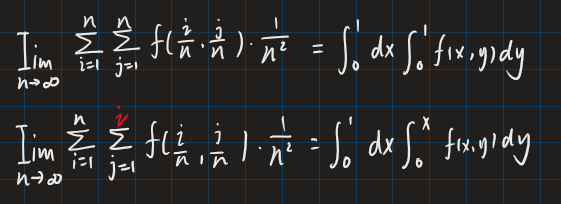
1.3.6 definite integral definition