Lecture 15: Homogeneous Systems of Linear Equations
Postgraduate Entrance Exam Mathematics study notes: Lecture 15: Homogeneous Systems of Linear Equations. Original formulas, diagrams, and examples are retained.
On this page
15.1 Linear Systems and Matrix Equations
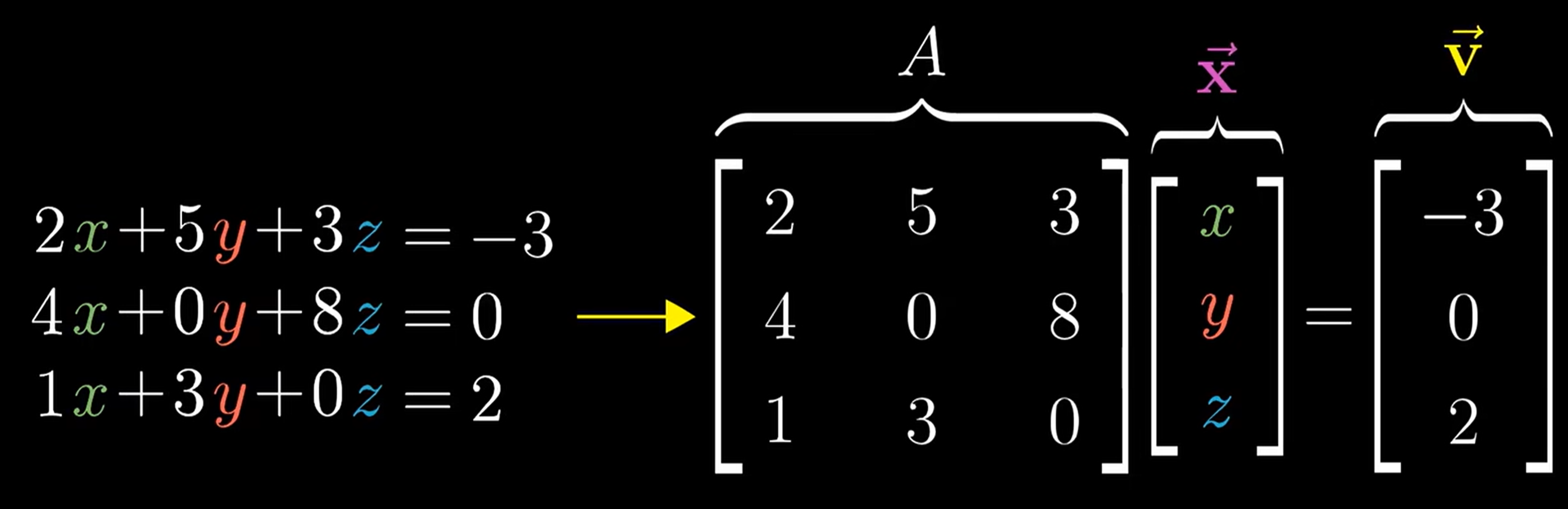
A general linear system can be written as
or, in matrix form,
Here
The coefficient matrix is $A$, and the augmented matrix is
If $\alpha_1,\ldots,\alpha_n$ are the columns of $A$, then $Ax=b$ is equivalent to
Thus solving the system means deciding whether $b$ lies in the span of the columns of $A$ and, if so, finding the coefficients of that representation.
- Original illustration:
If $A$ is square and $\det A\ne0$, then $A$ is invertible and the system has the unique solution
15.2 Homogeneous Linear Systems
Definition: homogeneous-linear-system
A linear system whose constant terms are all zero is homogeneous:
Every homogeneous system has the trivial solution $x=0$. The rank of the coefficient matrix determines whether nonzero solutions exist.
Theorem: solutions-of-a-homogeneous-system
Let $A$ be an $m\times n$ matrix with $\operatorname{rank}(A)=r$.
- If $r=n$, then $Ax=0$ has only the trivial solution.
- If $r<n$, then $Ax=0$ has nonzero solutions, and its solution space has dimension
This is the rank-nullity theorem for a homogeneous linear system. The number $n-r$ is also the number of free variables.
In particular, if the number $n$ of unknowns exceeds the number $m$ of equations, then
so the homogeneous system must have a nonzero solution.
15.3 Fundamental Solution Set and General Solution
Definition: fundamental-solution-set
When $r<n$, solutions
form a fundamental solution set of $Ax=0$ if:
- every $\xi_i$ satisfies $A\xi_i=0$;
- the vectors are linearly independent;
- every solution of $Ax=0$ is a linear combination of them.
Definition: general-solution
If $\xi_1,\ldots,\xi_{n-r}$ is a fundamental solution set, then the general solution is
where $k_1,\ldots,k_{n-r}$ are arbitrary constants.
The fundamental solution set is a basis of the null space $N(A)$, and the coefficients in the general solution are the coordinates of a solution vector relative to that basis.
15.4 Solution Procedure
- Apply elementary row operations to reduce $A$ to row-echelon or reduced row-echelon form:
Elementary row operations preserve the solution set, so $Ax=0$ and $Rx=0$ have the same solutions.
- Count the pivots to obtain
- Choose the $n-r$ nonpivot variables as free variables and express the pivot variables in terms of them.
- Set one free variable at a time to $1$ and the others to $0$. This produces $n-r$ linearly independent solutions
- Write the general solution
As a final check, verify that $A\xi_i=0$ for every basis vector and that the number of vectors is exactly $n-r$.