Lecture 55: Surfaces and Space Curves
Postgraduate Entrance Exam Mathematics Study Notes: Lecture 55: Surfaces and Space Curves. Retain original formulas, diagrams, and example problems.
On this page
55.1 Surface and Space Curves
Definition: SurfacesInSpace
description: $$F(x,y,z)=0\quad\text{ or }z=f(x,y)$$
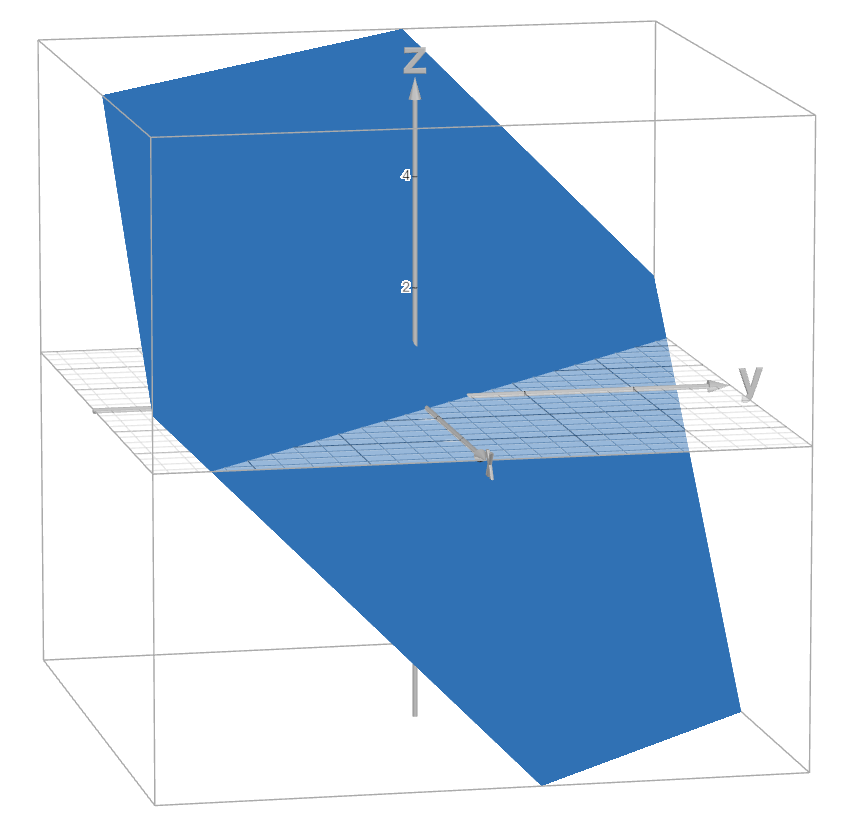
Example: $x+y+z=1$
- Illustration:
Definition: Spacecurves
description: $$\text{ i) Parameter: }\quad\begin{cases}x=x(t)\\y=y(t)\\z=z(t)\end{cases}\quad\text{ ii) General formula: }\begin{cases}F(x,y,z)=0\\G(x,y,z)=0\end{cases}$$
Supplement: Why is one equation usually enough for a surface, while a space curve usually needs two?
- Core:
- One equation reduces one degree of freedom;
- A surface has two degrees of freedom, while a curve has only one;
- Therefore, the general formula of a space curve consists of two equations about
xyz;
55.2 Common Surfaces
Surface One: Surface of revolution -> A plane curve rotates about a line in its plane.
- Let $L$ be a curve on the $yoz$ plane, with the equation $\begin{cases}f({y},z)=0\\x=0\end{cases}$
- (1) Rotating $L$ about the $y$-axis gives
$$f\left(y,\pm\sqrt{x^2+z^2}\right)=0.$$
- (2) Rotating $L$ about the $z$-axis gives
$$f\left(\pm\sqrt{x^2+y^2},z\right)=0.$$
Surface Two: Cylindrical surface -> The surface traced by a straight line (the generator) that remains parallel to a fixed direction while moving along a fixed curve (the directrix).
- If the directrix is $\Gamma:\begin{cases}f(x,y)=0\\z=0,\end{cases}$ and the generators are parallel to the $z$-axis, then the cylinder is $f(x,y)=0$.
- More generally, if eliminating $z$ from $\begin{cases}F(x,y,z)=0\\G(x,y,z)=0\end{cases}$ gives $H(x,y)=0$, then $H(x,y)=0$ is the cylinder parallel to the $z$-axis through the projected directrix.
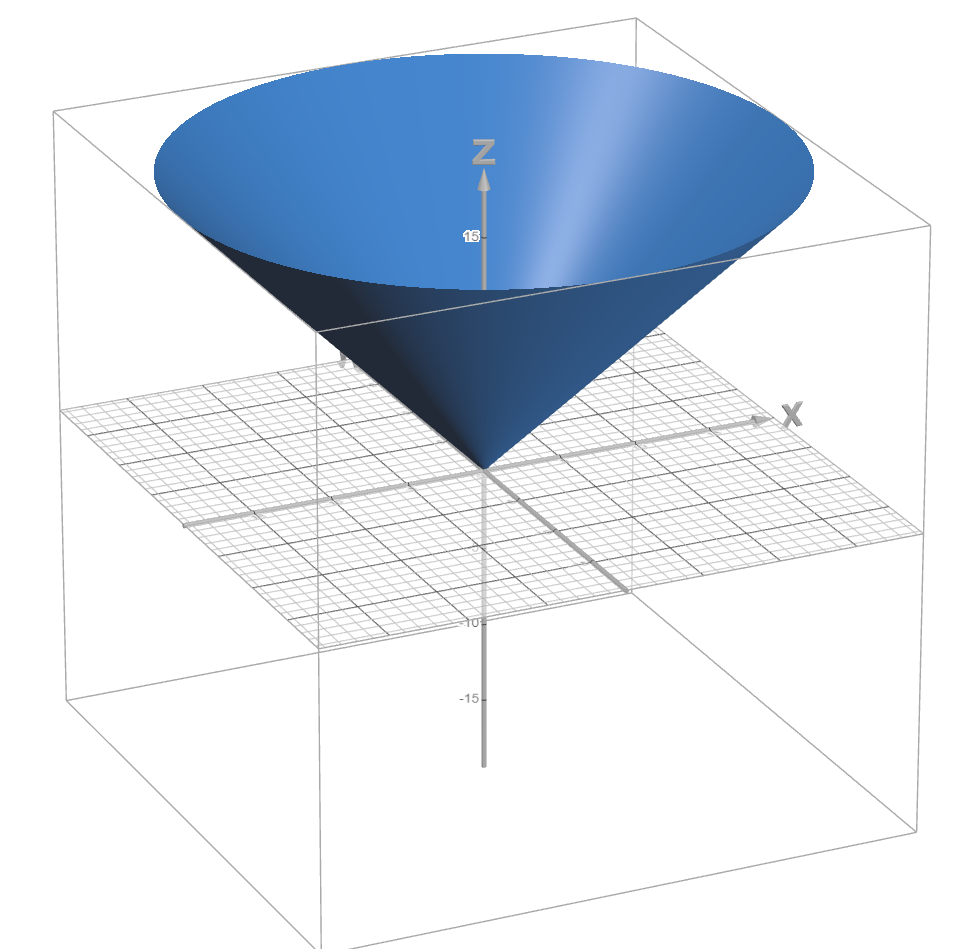
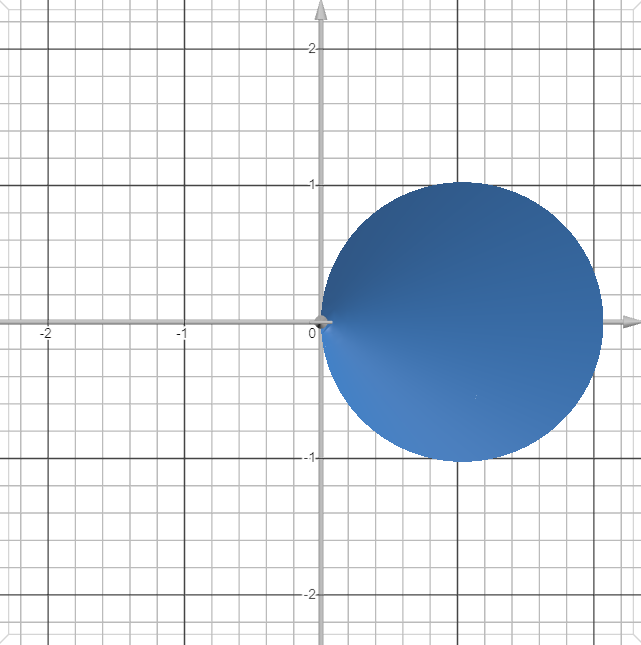
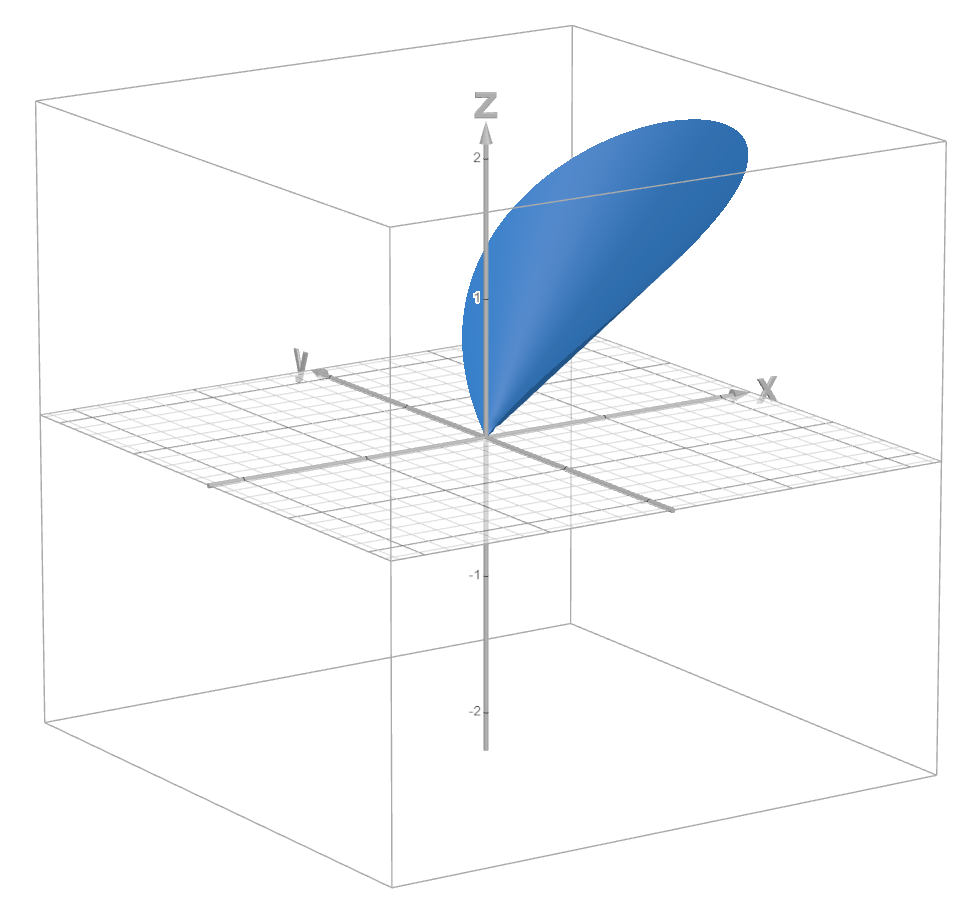
- Illustration: The conical surface $z=\sqrt{x^{2}+y^{2}}$ on the area of the cylinder $x^{2}+y^{2}\le2x$:
- Cone:
- Cylindrical Surface:
- 3D:
Surface Three: Quadric surfaces
- Elliptic cone: $$\frac{x^2}{a^2}+\frac{y^2}{b^2}=z^2.$$
- Ellipsoid: $$\frac{x^2}{a^2}+\frac{y^2}{b^2}+\frac{z^2}{c^2}=1.$$
- Hyperboloid of one sheet: $$\frac{x^{2}}{a^{2}}+\frac{y^{2}}{b^{2}}-\frac{z^{2}}{c^{2}}=1.$$
- Hyperboloid of two sheets: $$\frac {x^{2}}{a^{2}}- \frac {y^{2}}{b^{2}}- \frac {z^{2}}{c^{2}}= 1.$$
- Elliptic paraboloid: $$\frac{x^2}{a^2}+\frac{y^2}{b^2}=z.$$
Surface Four: Projection of a space curve
- If the space curve is $\Gamma:\begin{cases}F(x,y,z)=0\\G(x,y,z)=0,\end{cases}$ and eliminating $z$ gives $H(x,y)=0$, then its projection onto the $xOy$ plane is $\begin{cases}H(x,y)=0\\z=0.\end{cases}$