Lecture 40: Differentiation Rules for Multivariable Composite Functions
Graduate Entrance Examination Mathematics study notes: Lecture 40: Differentiation Rules for Multivariable Composite Functions. Original formulas, diagrams, and examples are retained.
On this page
Chapter Content
- (1) Basic concepts of multivariable functions
- (2) Multivariable Differential Method
- (3) Extrema and extrema of multivariable functions
Section Overview
- (1) Limits of multivariable functions
- (2) Continuity of multivariable functions
- (3) Partial derivative
- (4) Total differential
- (5) Continuous, differentiable, and differentiable relationships
Frequently Tested Question Types in This Section
- Discuss continuity, differentiability, and differentiability
41.1 Limits of Multivariable Functions
41.1.1 Concept of Multivariable Function Limits
Definition: Thelimitofmultivariablefunctions
description: $$\lim_{(x,y)\to(x_0,y_0)}f(x,y)=A$$
Explanation
- 1. Trends in the limits of multivariable functions:
- In a single variable, there is only one independent variable, so the approach to the target point and the method is relatively simple, only along the X-axis;
- But in binary variables, there are two independent variables, but $(x,y)$
->$(x_0,y_0)$ is inarbitrary ways - It must be ensured that in any direction, the function value equals the limit value (similar to the left and right limits in a single-variable limit; only then can this multi-limit be considered to exist;
- 2. Five major characteristics
- (1) Local bounding;
- (2) Number retention;
- (3) Rational operation rules;
- (4) The relationship between limits and infinitesimals;
- (5) Compression;
- Note: L'Hôpital's rule is not available for general multivariable limits.
41.1.2 Basic Methods
Example: Find the value of the limit
- Question: Find $$\lim_{x\to0,\,y\to0}\frac{xy^{2}}{x^{2}+y^{2}}.$$
- Analysis
- This limit has the indeterminate form $0/0$, but L'Hôpital's rule does not apply to a two-variable limit.
- The denominator is quadratic, and the numerator is cubic
- For
A/Btype: - If the power of A > the power of B, it is generally 0;
- If the power of A < the power of B, it is generally infinite;
- If the power of A = the power of B, it generally does not exist;
- In this regard, the preliminary judgment is that the limit of the subfunction is 0;
- When in a single element: take the absolute value of x, then expand the
->squeeze theorem; - Analysis
- Method One:
- $0\leq|\frac{xy^{2}}{x^{2}+y^{2}}|\leq|x|\rightarrow0$
- So $\lim_{x\to0,\,y\to0}\frac{xy^{2}}{x^{2}+y^{2}}=0$
- Method Two:
- You can take the x of the numerator, where x
->0; - After the numerator is presented, the remaining parts are not greater than 1 according to their boundedness, so the limit of the entire function is 0;
Example Question: Proving that limits do not exist
- Question: Find $$\lim_{x\to0,\,y\to0}\frac{xy^{}}{x^{2}+y^{2}}$$ Prove that its limit does not exist
- Analysis
- The numerator is 2 times, the denominator is 2 times;
- If there are two different pathpoints and the obtained limit differs, then this limit does not exist;
- Method: Confine
yto a single straight line; - Analysis
- $$\lim_{x\to0,\,y=kx}\frac{xy^{}}{x^{2}+y^{2}} = \lim_{x\to0,\,y\to0}\frac{kx^{2}}{x^{2}+k^{2}x^{2}}=\frac{k}{1+k^2}$$
- Because k is the slope of a straight line, k is not a fixed value. When k takes different slopes, the function values of the limit are different;
- Therefore, this limit does not exist;
41.2 Continuity of Multivariable Functions
Two Concepts
- 1. Concept;
- 2. Discontinuity;
- 3. Nature;
Definition: Theconceptofcontinuousmultivariablefunctions
description: $$\lim_{(x,y)\to(x_0,y_0)}f(x,y)=f(x_0,y_0)$$
Theorem: Propertiesofmultivariablecontinuousfunctions
description:
Property 1: The sum, difference, product, and quotient of multivariable continuous functions (with nonzero denominator) are still continuous functions;
Property 2: The composite function of a multivariable continuous function is also a continuous function;
Property 3: Multivariable elementary functions are continuous within theirdefinition region;
Property 4: Maximum Theorem -> A continuous function on a bounded closed region D must find its maximum and minimum values on region D;
Property 5: A continuous function on a bounded closed region D must obtain any value between the maximum and minimum values on region D;
41.3 Partial Derivatives
41.3.1 Basic Concepts of Partial Derivatives
Definition: Partialderivative
Description: for $z=f(x,y)$ functions, there are two partial derivatives defined:
1. Partial derivative of X: When partial derivative of X, Y is fixed at$y_0$at (has no effect on x), $x$exist$x.$everywhere$\Delta x$The increment of, at this time there is only one variable x, which is called:
$$\lim_{\Delta x\to0}\frac{f\left(x_{0}+\Delta x,y_{0}\right)-f\left(x_{0},y_{0}\right)}{\Delta x}$$ is the partial derivative with respect to X;
Recorded as:
$\left.\frac{\partial z}{\partial x}\right|_{(x_{0},y_{0})},\left.\frac{\partial f}{\partial x}\right|_{(x_{0},y_{0})},z_{_z}(x_{0},y_{0})\text{ or }$ $f_{x}(x_{0},y_{0})$
2. Partial derivative with respect to Y: The same applies to X,
$$lim_{\Delta y\to0}\frac{f(x_{0},y_{0}+\Delta y)-f(x_{0},y_{0})}{\Delta y}$$
Recorded as:
$\left.\text{}\frac{\partial z}{\partial y}\right|_{(x_{0},y_{0})},\left.\frac{\partial f}{\partial y}\right|_{(x_{0},y_{0})},z_{y}(x_{0},y_{0})\text{ or }f_{y}(x_{0},y_{0}).$
Explanation
- Partial derivative of X:
- Explanation:
- Essentially, it is the derivative of a function of x in one variable, representing the rate of change of the function along the X-axis;
- Other forms: $$\frac{\partial f(x,y)}{\partial x}$$
- Partial derivative of Y:
- Explanation:
- Essentially, it is the derivative of a function of y, representing the rate of change of the function along the Y-axis;
- Other forms:
- $$\frac{\partial f(x,y)}{\partial y}$$
- Summary: Essentially, it is the derivative of a single-variable function;
Method: How to find the partial derivative of x or y
- When $z=f(x,y)$, treat y or x as a constant and take the derivative directly from x or y;
- Example: partial derivative of $z=x^{2}+3xy+y^{2}$ at $(1.2)$;
- Step 1: Calculate the partial derivative function
- Taking partial derivative with respect to x: $\frac{\partial z}{\partial x}=2x+3y$
- Finding partial derivative with respect to y: $$\frac{\partial z}{\partial y}=3x+2y$$
- Step 2: Subtract $(1.2)$ point into the function after finding the partial derivative with respect to x or to y: 2x + 3 y or 3 x + 2 y to get the result
41.3.2 Determining the Existence of a Partial Derivative
Question Type: Determine whether partial derivatives exist
- Method 1: Definition method
- Using the definition of partial derivatives, substitute the function values into the partial derivative of Y and the partial derivative of X, find the limit value of the substituted function, and calculate whether this limit exists;
- Method Two: Essential Method
- Because the partial derivative is essentially the derivative of a function in one variable;
- So you can directly substitute one value of the partial derivative X or Y (the one with the fixed value)
- For example, to find the partial derivative of X, you can directly substitute the value of Y into it to find the limit of the derivative of the function of X;
41.3.3 Geometric Meaning of Partial Derivatives
Definition: Thegeometricmeaningofpartialderivativesofabinaryfunction
description: Surface $Z=f(x,y)$
1. $f_x(x_0,y_0)$ represents the tangent line to $y=f(x)$ on the $y=f(x)$ line, $x_0$;
2. $f_y(x_0,y_0)$ represents the tangent line to $x=f(y)$ on the $x=f(y)$ line, $x_0$;
41.3.4 Higher-Order Partial Derivatives
Definition: Higherorderpartialderivatives
description:
$$\frac{\partial}{\partial x}\biggl(\frac{\partial z}{\partial x}\biggr)=\frac{\partial^{2}z}{\partial x^{2}}=f_{xx}^{\prime\prime}\quad\frac{\partial}{\partial y}\biggl(\frac{\partial z}{\partial x}\biggr)=\frac{\partial^{2}z}{\partial x\partial y}=f_{xy}^{\prime\prime}$$
$$\frac{\partial}{\partial x}\Bigg(\frac{\partial z}{\partial y}\Bigg)=\frac{\partial^{2}z}{\partial y\partial x}=f_{yx}^{\prime\prime}\quad\frac{\partial}{\partial y}\Bigg(\frac{\partial z}{\partial y}\Bigg)=\frac{\partial^{2}z}{\partial y^{2}}=f_{yy}^{\prime\prime}$$
Explanation
- Mixed partial derivative:
- $f_{xy}^{\prime\prime}$
- $f_{yx}^{\prime\prime}$
Theorem: Higherorderpartialderivativetheorem
description: if the two second-order mixed partial derivatives $\frac{\partial^2z}{\partial x\partial y}$ and $\frac{\partial^2z}{\partial y\partial x}$ of function $z=f(x,y)$ are continuous within region $D$, then within that region:
$$\frac{\partial^2z}{\partial x\partial y}=\frac{\partial^2z}{\partial y\partial x}$$
Explanation
- When first x or y is applied first, the limit value is the same;
41.4 Total Differential of Multivariable Functions
Definition: Totaldifferentialofmultivariablefunctions
Description: If $\Delta z=f(x_0+\Delta x,y_0+\Delta y)-f(x_0,y_0)=A\Delta x+B\Delta y+o(\rho)$, then the function $z=f(x,y)$ is differentiable at point $(x_0,y_0)$;
Multivariate differential: $$dz=A\Delta x+B\Delta y$$
Theorem: Differentiablenecessaryconditions
Description: If $z=f(x,y)$ is differentiable at $(x_0,y_0)$, then both partial derivatives exist there and $\mathrm{d}z=\frac{\partial z}{\partial x}\mathrm{d}x+\frac{\partial z}{\partial y}\mathrm{d}y$.
Explanation
- Differentiable
->Differentiable; - Differentiable
-x>Differentiable; - First-order partial derivative continuous
->differentiable; - Differentiable
-x>First partial derivative continuous;
Method: Use definitions to determine differentiability (sufficient condition)
- (1) Whether $f_{x}(x_{0}, y_{0})$ and $f_{y}(x_{0}, y_{0})$ both exist
- If there is none, then it is certainly non-differentiable;
- If both exist, proceed to (2) for judgment;
- (2)$$\lim_{(\Delta x,\Delta y)\to(0,0)}\frac{\Delta z-[f_{x}(x_{0},y_{0})\Delta x+f_{y}(x_{0,}y_{0})\Delta y]}{\sqrt{\left(\Delta x\right)^{2}+\left(\Delta y\right)^{2}}}\text{ Is it zero? }$$
- Explanation:
- According to $\Delta z=f(x_0+\Delta x,y_0+\Delta y)-f(x_0,y_0)=A\Delta x+B\Delta y+o(\rho)$, place $f(x_0+\Delta x,y_0+\Delta y)-f(x_0,y_0)$ on the left side;
- See if $\Delta z-(f(x_0+\Delta x,y_0+\Delta y)-f(x_0,y_0))$ is
0when divided by $o(\rho)$; - Conclusion:
- The above limits exist and are 0
->differentiable; - If it does not exist or is not 0
->is not differentiable; - Meaning:
- The meaning of the above formula
->Because the differential of a point $dz$ equals $A\Delta x+B\Delta y+o(\rho)$, so when the differential of this point exists, whether ${dz-A\Delta x+B\Delta y}\text{ Divide by }{o(\rho)}$ is zero can be seen until its derivative exists;
Theorem: Sufficientconditionsfordifferentiability
Description: If the partial derivative $\frac{\partial z}{\partial x},\frac{\partial z}{\partial y}$ of $z=f(x,y)$ is continuous at point $(x_0,y_0)$, then function $z=f(x,y)$ is differentiable at point $(x_0,y_0)$;
Explanation
- Concept:
- Two partial derivatives are
->continuously, as a binary function, the partial derivative exists when x and y approach $x_0、y_0$ respectively; - Conclusion:
- Two partial derivatives
->consecutive differentiable;
41.5 Relationships among Continuous, Partial Derivatives, and Differentiables
Single-variable Function
- Illustration:
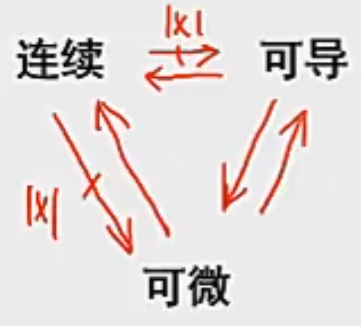
Multivariate Functions
- 1. Similarities with the single dollar:
- (1) Continuously
-x>differentiable; - (2) Differentiable
->Deviable; - (3) Differentiable
->continuous; - (4) Continuous
-x>differentiable; - 2. Differences from the single yuan:
- Cause:
- The differences are all caused byderivative, so why can't diversity be allowed?
- A partial differentiable is actually the partial derivative of $f_x(x_0,y_0)$ and $f_y(x_0,y_0)$;
- $f_x(x_0,y_0)$
->$f(x,y_0)$ On the $y=y_0$ line, the function changes only depending on the function value on that line; - $f_y(x_0,y_0)$
->$f(x_0,y)$ On the $x=x_0$ line, the function changes only depending on the function value on that line; - Continuity
->is a heavy limit because it requires that the function is continuous in any direction, while the partial derivative can only determine whether the current derivative exists on a certain line, so it cannot indicate whether it is continuous in any direction; - Why is differentiable in a single variable: Because in a single variable, the differentiable means that every region is differentiable, so the differentiable
->is differentiable and continuous; - Concept:
- (1) Deflectable
-x>continuity; - (2) Partially differentiable
-x>differentiable; - 3. New points compared to the One Yuan:
- (1) Partial derivatives are continuous
->differentiable; - (2) Differentiable
-x>Partial Derivatives Continuous; - Illustration:
- And
41.5 Frequently Tested Question Types
Question Type: Continuous. Partial Derivatives, Total Derivatives and Their Relationships
PART 1: Problem-solving methods
How to Judge
- Determining whether differentiable:
- 1. Definition:
- Step 1: Determine whether $f_{x}(x_{0}, y_{0})$ and $f_{y}(x_{0}, y_{0})$ both exist;
- Step 2: Use the following definitions to determine whether a double limit exists;
- Formula: $$\lim_{(\Delta x,\Delta y)\to(0,0)}\frac{\Delta z-[f_{x}(x_{0},y_{0})\Delta x+f_{y}(x_{0,}y_{0})\Delta y]}{\sqrt{\left(\Delta x\right)^{2}+\left(\Delta y\right)^{2}}}\text{ Is it zero? }$$
- Determining whether it is differentiable:
- 1. Definition method: Find the partial derivative of x and y separately, use partial derivatives to define and analyze whether the univariate function derivative corresponding to the partial derivative exists;
- Formula (X partial derivative): $$\lim_{\Delta x\to0}\frac{f\left(x_{0}+\Delta x,y_{0}\right)-f\left(x_{0},y_{0}\right)}{\Delta x}$$
- 2. Bring first, ask later:
- Determining continuity:
- 1. Definition:
- (1) Prove continuity: Whether the function value at a certain point equals the limit value of that function; if equal, then continuous;
- (2) Proving discontinuity: same;
- 2. Special
yValue Method: - Substitute a fixed y function into a function, often used to prove discontinuity;
- Common Forms:
- $y=kx$
- $y=0$
- Determining whether the partial derivative is continuous:
- Note:
- Multivariable function continuous
≠Multivariable function partial derivative continuous; - Whether the partial derivative is continuous refers to whether thepartial derivative of the derivative with respect to X or Yis continuous;
- 1. Definition method: Use partial derivative functions with respect to X or Y to solve:
- If the following formula does not hold, the partial derivative is discontinuous;
- Formula (partial derivative function with respect to X): $$\lim_{x\to0,y\to0}f_{x}(x,y)=f_{x}(0,0)$$
PART 2: Typical Example Problems
Example Question: Does the binary function $$f(x,y)=\begin{cases}\frac{xy}{x^{2}+y^{2}},&(x,y)\neq(0,0),\\0,&(x,y)=(0,0)\end{cases}$$ have continuous or partial derivatives at point $(0,0)$?
- Analysis
- Determine whether the function value at this point is continuous
->equal to the function's limit; - Analysis
- Determining continuity:
- substitute $y=kx$ for $\lim_{x\to0,y\to0}\frac{xy}{x^{2}+y^{2}}$ to prove that its limit does not exist
->discontinuity; - Determining partial derivatives:
- Find the partial derivative of x: $f_{x}^{\prime}(0,0)=\lim_{x\to0}\frac{f(x,0)-f(0,0)}{x}=\lim_{x\to0}\frac{0-0}{x}$
->the partial derivative is 0; - Finding the partial derivative of y: The method is similar to finding x, and the result is also zero partial derivative;
- Therefore, partial derivatives exist;