Lecture 2: Concepts of functions and common functions
Postgraduate Entrance Exam Mathematics Study Notes: Lecture 2: Concepts of Functions and Common Functions. Original formulas, diagrams, and example problems are retained.
On this page
2.1 Basic concepts of functions
2.1.1 Definition of function
Definition: # function
Description: If for each number $x\in D$, there is a unique $y$ corresponding to it according to certain rules, then $y$ is called a function of $x$, recorded as $y=f(x)$; $x$ is usually called an independent variable, $y$ is the dependent variable, $D$ is the domain.
Explanation
- Basic concepts
- Domain: $D_f=D.$
- Value range: $R_f=f(D)=\{y|y=f(x), x\in D\}$
- Two basic elements of functions:
- Domain
- Corresponding rules
- As long as two elements are met, two functions can be said to be the same, regardless of the symbol used for the domain;
- NOTE:
- One $x$ can only correspond to one $y$
- For example, $y^2=x$ is not a function, because one $x$ corresponds to two $y.$
2.1.2 Other function types
Rounding function
- Let $x$ be any real number, the largest integer not exceeding $x$ is called the integer part of $x$, denoted as $[x]$.
- Function $y=[x]$ is called a rounding function;
2.2 Other common functions
2.2.1 composite function
Definition: # composite function
Description: Let the domain of $y=f(u)$ be $D_f$, the domain of $u=g(x)$ be $D_g$, and the value domain be $R_g$. If $D_f\cap R_g\neq\varnothing$, then the function $y=f[g(x)]$ is called the functions $y=f(u)$ and $u=g(x)$ The composite function. Its domain is $\left\{x\mid x\in D_g, \ g(x)\in D_f\right\}$.
Explanation
- g: inner function
- f: outer function
- Core: $D_f\cap R_g\neq\varnothing$
Method: Determine whether two functions are composite
- The intersection of the value domain of the inner function and the domain of the outer function must be a non-empty set; otherwise it is not a composite function;
Error-prone points: Pay attention to the value range and domain in composite function
- Concept:
- The domain of composite function is $\left\{x\mid x\in D_g, \ g(x)\in D_f\right\}$.
- Common mistakes:
- Treat the domain of the inner function as the domain of the composite function;
2.2.2 inverse function
Definition: # inverse function
description: Let the domain of function $y=f(x)$ be $D$ and the value range be $R_f$. If for any $y\in R_f$, there is a unique $x\in D$ such that $y=f(x)$, then the function determined by $x=f^{-1}(y)$ is called $y=f(x)$ The inverse function.
Explanation
- Ordinary functions allow multiple different $x$ to correspond to the same $y$;
- The condition for the existence of antiderivative inverse function is that it has a one-to-one mapping in the domain, that is, different $x$ corresponds to different $y$;
- Concept:
- 1. The inverse function $x=f^{-1}(y)$ of $y=f(x)$ is often written as $y=f^{-1}(x)$.
- 2. In the same Cartesian coordinate system, the graphs of $y=f(x)$ and $x=f^{-1}(y)$ coincide.
- 3. The graphs of $y=f(x)$ and $y=f^{-1}(x)$ are symmetric about the line $y=x$.
Method: Is there an inverse function
- Core:
- 1. Is there a unique $x\in D$ for any $y\in R_y$;
- 2. A strictly monotonic function on an interval must have an inverse function;
- 3. A strictly monotonic function on an interval has the same monotonicity as its inverse function;
- For example:
- $y=x^3$ has inverse function, but $y=x^2$ does not;
- Conclusion:
- for $\forall x_{1}\neq x_{2}\in D\Rightarrow f(x_{1})\neq f(x_{2})$
- that is, the f function should be a one-to-one mapping;
Method: Find the inverse function of a function
- Example: find the inverse of $y=\sinh x=\frac{e^x-e^{-x}}{2}$.
- Specific steps:
- 1. Find the inverse solution;
- 2. Reverse functions y, x;
2.2.3 Combination of inverse function and composite function
Combination of both:
- Case 1: When $x\in D$, $f^{-1}[f(x)]=x$
- Ordinary functions are passed into the inverse function of the current function
- Case 2: When $x\in R_f$, $f[f^{-1}(x)]=x$
2.3 elementary functions
2.3.1 basic elementary functions definition
Definition: # basic elementary functions
Description: collectively refers to power functions, exponentials, logarithms, trigonometric functions, and inverse trigonometric functions as basic elementary functions;
>
Explanation
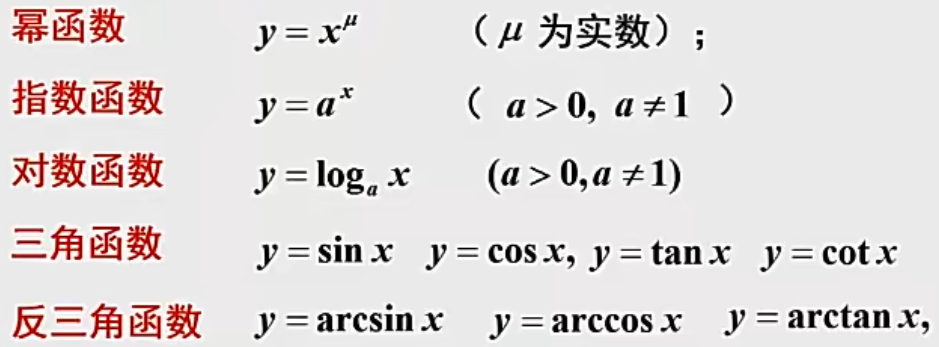
Definition: # elementary functions
Description: by
1. Composed of constants and five categories of basic elementary functions;
2. Addition, subtraction, multiplication, division and compounding
3. The resulting function expressed by an analytical expression
Call it elementary functions;
2.4 common problem types
problem type: # composite function
PART 1: solution method
Test method: If it is a composite of piecewise functions
- 1. The inner layer is still brought into the outer layer;
- 2. If it is segmented, the inner function needs to be brought into the corresponding outer function segmentally according to the segmentation of the inner function (the function value of the inner function falls into which part of the outer function);
Test method: If composite function and outer function are known, inner function is required
- 1. The result of composite function = the function obtained by inserting the outer function into the inner function;
PART 2: representative examples
Example: Let $g(x)=\begin{cases}2-x,&x\leq0,\\x+2,&x>0,\end{cases}$ and $f(x)=\begin{cases}x^2,&x<0,\\-x,&x\geq0.\end{cases}$ Find $g(f(x))$.