Advanced Mathematics - Mind Map
Postgraduate Entrance Exam Mathematics Study Notes: Advanced Mathematics - Mind Map. Original formulas, diagrams, and example problems are retained.
On this page
Advanced Mathematics
Differentiation
Differential Calculus of Single-variable Functions
- Function
- The concept of functions
- Function definition:
If for each number $x\in D$, the variable $x$ always corresponds to a certain $y$ according to certain rules, then $x$ is called a function of $y$, denoted as $y=f(x)$; x is often called the independent variable, $y$ the dependent variable, and $D$ domain.
- Composite function:
Suppose the domain of $y=f(u)$ is $D_f, u=g(x)$, the domain is $D_g$, and the value domain is $R_{s}$; if $D_f\cap R_g\neq\phi, $, then the function $y=f[g(x)]$ is called the composite function of functions $y=f(u)$ and $u=g(x)$. Its domain is $\left\{x|x\in D_g, g(x)\in D_f\right\}$
- Inverse function:
Let the domain of function $y=f(x)$ be ${D}$, and the range be $\underline{R}_{\underline{\nu}}$. If for any $y\in R_y$, there exists a unique and determined $x\in D$ such that $y=f(x)$, then it is denoted as $x=f^{-1}(y)$, and called the inverse of function $y=f(x)$
- The properties of functions
- Monotonicity
- Parity:
- Common odd functions: $\sin x,\tan x,\arcsin x,\arctan x,\ln\frac{1-x}{1+x},{\ln(x+\sqrt{1+x^2})},\frac{e^x-1}{e^x+1},f(-x)=-f(x)$
- Common even functions: $x^2,|x|,\cos x,f(x)=f(-x)$
- Periodicity
- Boundedness
- Limit
- The nature of limits
- Properties of the limit of sequences
- Boundedness: $\text{ If the sequence is }\left\{x_n\right\}\text{ Convergence, then the sequence }\left\{x_n\right\}\text{ There must be boundaries }$
- Number preservation;
- Limit properties of functions
- Local boundedness: if $\lim_{x\to x_0}f(x)$ exists, then $f(x)$ is in a punctured neighborhood of $x_0$
- Number preservation
- Function limit
- Functions tend toward infinite values
- Functions and infinity:
$\lim_{x\to\infty}f(x)=A$ iff, for every $\varepsilon>0$, there is an $X>0$ such that $|x|>X$ implies $|f(x)-A|<\varepsilon$.
- The function tends toward negative infinity:
$\lim_{x\to-\infty}f(x)=A$ iff, for every $\varepsilon>0$, there is an $X>0$ such that $x<-X$ implies $|f(x)-A|<\varepsilon$.
- The function tends toward positive infinity:
$\lim_{x\to+\infty}f(x)=A$ iff, for every $\varepsilon>0$, there is an $X>0$ such that $x>X$ implies $|f(x)-A|<\varepsilon$.
- The function tends toward finite values
- $\lim_{x\to x_0}f(x)=A$ iff, for every $\varepsilon>0$, there is a $\delta>0$ such that $0<|x-x_0|<\delta$ implies $|f(x)-A|<\varepsilon$.
- Unilateral limit
- left limit: $\lim_{x \to x_{0}^{-}}f(x) = A \Leftrightarrow \begin{cases} \hspace{1em} \forall \xi >0, \exists \delta>0, x_{0}-\delta <x<x_{0} \ \mbox{whenever}, \\ \hspace{1em} \lvert f(x) - A\rvert < \xi \\ \end{cases}$
- Right limit: $\lim_{x \to x_{0}^{+}}f(x) = A \Leftrightarrow \begin{cases} \hspace{1em} \forall \xi >0, \exists \delta>0, x_{0}<x<x_{0}+\delta \ \mbox{whenever}, \\ \hspace{1em} \lvert f(x) - A\rvert < \xi \\ \end{cases}$
- Relationship between limit and unilateral limit:
$\lim_{x\to x_0}f(x)=A\Leftrightarrow\lim_{x\to x_0^-}f(x)=\lim_{x\to x_0^+}f(x)=A$
- Limit of the sequence
- Definition of sequence limits:
$\lim_{n\to\infty}x_n=a$ iff, for every $\varepsilon>0$, there is an $N$ such that $n>N$ implies $|x_n-a|<\varepsilon$.
- Criteria for the existence of sequence limits:
If there is $N, $ when $n>N$, $x_n\leq y_n\leq z_n$, $\lim_{n\to\infty}x_n=\lim_{n\to\infty}z_n=a, $ then $\lim_{n\to\infty}y_n=a$
- Find the limit
- Eight methods for finding limits
- Infinity and infinitesimal
- Infinitesimal
- Definition of infinitesimal: If the function $f(x)$ has zero limit at $x\to x_0($ or $x\to\infty)$, then $f(x)$ is called an infinitesimal at $x\to x_0($ or $x\to\infty)$.
- Comparison of infinitesimals:
-Iso-orderinfinitesimal: $\alpha(x)\text{ and }\beta(x)$ The result of division isconstant C(C is not equal to 0);
-Equivalentinfinitesimal: $\alpha(x)\text{ and }\beta(x)$ divide byconstant 1;
- Higher-order infinitesimal: $\alpha(x)\text{ and }\beta(x)$ divide by 0; can be denoted as: $\alpha(x)=o(\beta(x))$
- Low-order infinitesimals: $\alpha(x)\text{ and }\beta(x)$ divide by the opposite order is infinite;
- $\text{ If }\lim\frac{\alpha (x)^{\color{red}{}}}{\left[\beta (x)\right]^{k}\color{red}}=C\neq 0,\text{ Said }$ α is the k-th order infinitesimal of β;
- Properties of infinitesimals:
-Property 1:The sum of infinitesimalsis still infinitesimal;
-Property 2:The product of finiteinfinitesimals is still infinitesimal;
-Property 3:The product of infinitesimals andbounded quantitiesis infinitesimal;
- Infinity
- Definition of infinity:
If the function $f(x)$ infinite at $x\to x_0($ or $x\to\infty)$, then $f(x)$ is called an infinite quantity at $x\to x_0($ or $x\to\infty)$.
- Properties of infinity:
-Property 1:The sum of finite positive infinity is infinity;
-Property 2:Theproductof finite infinity is still infinite;
-Property 3:The sum of infinite quantities and bounded variables remains infinitely large;
- Continuous
- Definition of continuity
- Left continuous
- Right continuous
- Definition:
Let function $y=f(x)$ be defined in a neighborhood of point $x_{0}$. If when $x\to x_0$, the limit of function $y=f(x)$ exists and equals the value of function $f(x_0)$ at $x_{0}$, i.e., $\lim_{x\to x_0}f(x)=f(x_0)$, then function $y=f(x)$ is said to be continuous at point $x_{0}$.
- The nature of continuity
- Properties of continuity functions on closed intervals:
- Boundedness: $\text{ If f(x) is continuous on [a,b], then f(x) is bounded on [a,b]. }$
- Maximum value theorem: If $f(x)$ is continuous on $[a,b]$, then $f(x)$ must have a maximum and minimum value on $[a,b]$;
- Intermediate Value Theorem: If $f(x)$ is continuity on $[a, b]$, and $f(a)\neq f(b)$, then for any number $\mathbf{C}, $ between $f(a)$ and $f(b)$ there is at least one $\xi\in(a, b), $ such that $f(\xi){=}C.$
- Zero point theorem
- The computational properties of continuity
- Breakpoints
- Definition of discontinuity points:
- Several types of discontinuities
- Derivative
- Definition of derivatives
- What is a derivative?
- Left derivative and right derivative
- The geometric meaning of the derivative
- The rule for derivative differentiation
- Differentiation rule for sum and product quotient
- The rule for differentiating inverse functions
- Derivative rule of composite functions
- Derivative of commonly used conclusions
- Logarithmic differentiation method
- Higher-order derivatives
- Definition of higher-order derivatives
- Common formulas for finding higher-order derivatives
- Implicit function
- Parametric equations
- Derivative application
- Interpreting the monotonicity of functions
- Judgment of convexity
- Inflection points
- Extrema and extrema of a function
- Asymptote
- Horizontal asymptote
- Vertical asymptote
- Differential
- Definition of differential:
- $f(x)$ is said to be differentiable at $x _0$ if $f(x_0+\Delta x)-f(x_0)=A\Delta x+o(\Delta x); $
- Relationships among differentiable, differentiable, and continuity
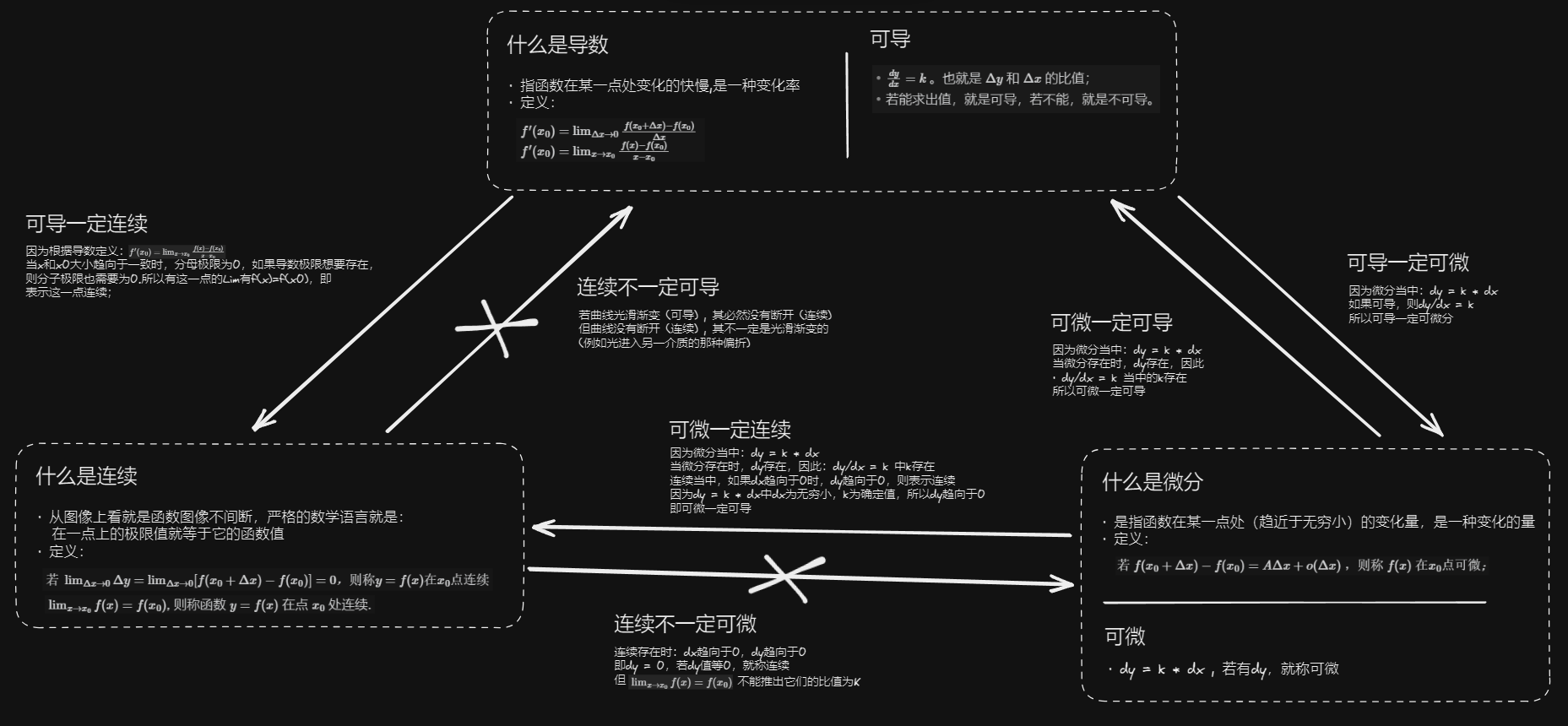
- Mean value theorem for differential calculation
- Rolle's Theorem:
- If three conditions are met:
- 1) $f$ continuous on $[a,b]$;
- 2)$f$ is differentiable within $(a, b)$;
- 3)f (a)=f (b)
- So, it can be known: $\text{ then }\exists\xi\in(a,b)\text{ , to use }f^{\prime}(\xi)=0$
- Derivation conclusion: There is a tangent line at a point parallel to the line connecting points ab
->Lagrange theorem; - Lagrange mean value theorem:
- If the following conditions are met: 1) $f$ is continuously on $[a,b]$ 2) $f$ is differentiable within ($a,b)$;
- Therefore, there exists $\xi\in(a,b)$ such that $f(b)-f(a)=f^{\prime}(\xi)(b-a)$;
- Cauchy Mean Value Theorem:
- If the following conditions are met:
- 1) $f, F$ on $[a, b]$ continuity $; $
- 2) $f, F$ is differentiable within $(a, b)$, and $\forall x\in(a, b), F^{\prime}(x)\neq0$
- Therefore, there exists $\xi\in(a,b)$ such that $\frac{f(b)-f(a)}{F(b)-F(a)}=\frac{f^{\prime}(\xi)}{F^{\prime}(\xi)}$;
Multivariable Differential Calculus
- Basic concepts of multivariable functions
- Limits of multivariable functions
- Continuity of multivariable functions
- Partial derivative
- Definition of partial derivatives
- The geometric meaning of partial derivatives
- Higher-order partial derivative
- Total derivative
- Definition of the total differential
- A necessary condition for differentiability of multivariable functions
- Sufficient condition for differentiability of multivariable functions
- Multivariable function analysis
- Judgments of differentiable, differentiable, continuous, and partially diverging continuous
- The relationship among differentiable, differentiable, continuous, and partially differentiated continuity
- Multivariable function differentiation
- Multivariable Composite Function Differential
- Differentiation rule for multivariable composite functions
- Full-differential form invariance
- Multivariable implicit function differential
- Multivariable function implicit function definition
- The existence theorem of implicit functions in multivariable functions
- Extrema and extrema of multivariable functions
- Definition of extremum of multivariable functions
- The necessary condition for the existence of extremals in multivariable functions
- Unconditional extremum
- Conditional extremums
- Lagrange multiplier method
- Definition of conditional extremums
Integral Calculus
Integral Calculus of Single-Variable Functions
- Indefinite integral
- The concept of indefinite integrals
- Definition of indefinite integrals:
An antiderivative of a function $f(x)$ is a function $F(x)$ whose derivative equals $f(x)$, that is, $F'(x)=f(x)$. The indefinite integral is the family $F(x)+C$.
Or: $\int f(x)dx=F(x)+C$
- Existence of antiderivatives:
- Basic properties of indefinite integrals
- $(\int f(x)\mathrm{d}x)^{\prime}=f(x)$
- $\mathrm{d}\int f(x)\mathrm{d}x=f(x)\mathrm{d}x$
- Calculation of indefinite integrals
- Basic formula
- First type of substitution method
- The second type of substitution method
- Integration by parts
- Definite integral
- The concept of definite integrals
- Definition of definite integrals:
$f(x)$ is bounded on $[a,b]$, arbitrarily insert a node on $[a,b]$, divide it into n small intervals $\Delta x_{1}\Delta x_{2}\cdots\Delta x_{n}$, and take any point $\xi_i$, resulting in: $\int_{a}^{b}f(x)\,dx=\lim_{\lambda\to0}\sum_{i=1}^{n}f(\xi_{i})\Delta x_{i}$.
- Where: $\lambda=\max\{\Delta x_{1},\cdots,\Delta x_{n}\}$.
- Fundamental theorems of calculus
- Calculation of definite integrals
- Newton-Leibniz formula
- Substitution of definite integrals
- Integral by Parts of Definite Integrals
- Properties of definite integrals
- Limit the points
- Method 1: Formula calculation
- Method 2: Extract x
- Method 3: Substitution method
- Improper integral
- Definition of improper integrals
- Two types of improper integrals
- Improper integrals over an infinite interval
- Improper integrals on infinite functions
- Determine the divergence of improper integrals
- Method 1: Definition method
- Method 2: Comparative Discrimination
- Method 3: P integration
- Application of definite integrals
- Area of a plane figure
- The volume of a rotating body
- The arc length of a plane curve
- Lateral area of a rotating body
Multivariable Function Integral Calculus
- Multiintegrals
- Double integral
- Definition of double integrals
- Properties of double integrals
- Calculation of double integrals
- Double integral calculation based on the Cartesian coordinate system
- Double integral calculation based on polar coordinate systems
- Utilizing parity and symmetry
- Triple integral
- Linear area division
- Line integration
- By area
- Points application
Differential Equations
First-Order Differential Equations
- Separable variables
- First-order homogeneous equation
- First-order linear equation
Second-Order Differential Equations
- Second-order homogeneous differential equations with constant coefficients
- Second-order constant coefficient nonhomogeneous differential equation
Higher-Order Differential Equations
- Reduced-order linear differential equations
- Concept of higher-order differential equations
Infinite Series
Series of Constant Terms
- Basic concepts
- Definition of a series of constant terms
- Definition of convergence of series of constant terms: $\lim_{n\to+\infty}S_{n}=\sum_{n=1}^\infty u_n$
- Basic properties of series
- Constant-sign series
- Positive term series
- Convergence of a positive-term series: $\sum_{n=1}^\infty u_n\text{ converges }\Leftrightarrow \{s_n\}\text{ is bounded above}$
- Comparison test
- Limit comparison test
- Ratio method
- Root test
- Integral test
- Sign-changing series
- Alternating series
- Definition of alternating series: $\sum_{n=1}^\infty(-1)^{n-1}u_n,u_n>0$
- Leibniz test
- General series
- Concepts of absolute convergence and conditional convergence
- Convergence tests for general series
Power series
- Basic concepts of power series
- Definition of a power series
- $\sum_{n=0}^\infty a_n(x-x_0)^n=a_0+a_1(x-x_0)+\cdots+a_n(x-x_0)^n+\cdots$
- Convergence of power series
- The concepts of convergence points and divergence points
- Abel's theorem
- Convergence interval
- Convergence domain
- Radius of convergence
- Radius of Convergence Determination Method One: Limit Ratio
- Radius of Convergence Determination Method 2: Based on radicals
- Operations on power series
- Properties of rational operations
- Analytical nature
- The function is expanded into a power series
- Basic concepts
- The power series expansion of a function
- Convergence of Taylor's series
- The function expansion is a power series
- Direct expansion method
- Indirect development method
- Common Development
Fourier series
- Basic concepts of Fourier series
- Fourier coefficient
- Fourier series
- Convergence
- Dirichlet theorem
- The function expansion is a Fourier series
- Expansion of periodic functions: special cases
- Expansion of periodic functions: general case