Chapter 8: Multiple Integrals — Advanced Mathematics - Collection of Formulas
Chapter 8: Multiple Integrals from the formula collection, kept as a focused chapter for faster reading and image loading.
On this page
Chapter 8: Multiple Integrals
8.1 Double Integral
Definition: Double integral
- If $f(x,y)$ is a bounded function on region D, divide region D arbitrarily into n regions: $\sigma_{1}$, $\sigma_{2}$... $\sigma_{n}$, take any point $(\xi_{i},\eta_{i})$ on each $\sigma_{n}$ and do $f(\xi,\eta_{i})\Delta\sigma_{i}$, when $\lambda\to0$:
- The following expression is called a double integral: $$\lim_{\lambda\to0}\sum_{i=1}^{n}\Delta\sigma_{i}f\left(\xi_{i},\eta_{i}\right)=\int\int_{D}f(x,y)d\sigma $$
Theorem: Properties of double integrals
- (1)
- If on D, $f(x,y)\leq g(x,y)$, then there is an inequality:
- $$\int\int_Df(x,y)d\sigma\leq\int\int_Dg(x,y)d\sigma $$
- (2)
- If there is a $m\leq f(x,y)\leq M$ on $D$, then:
- $$mS\leq\iint_Df(x,y)\mathrm{d}\sigma\leq MS$$
- (3)
- The absolute value of an integral, which is less than the absolute value
- $$\left|\iint_Df(x,y)\mathrm{d}\sigma\right|\leq\iint_D\left|f(x,y)\right|\mathrm{d}\sigma.$$
- (4)
- If $f(x,y)$ on region
Dis always equal to1, then its double integral is: - $$\int\int_{D}\left(1) d\sigma=\sigma\times1\right.$$
Theorem: The mean value theorem for double integrals
- Let the function $f(x,y)$ be continuous on the closed region
D,Sbe the area of regionD, then there is at least a bit of $(\xi,\eta)$ onD, such that $$\iint_Df(x,y)\mathrm{d}\sigma=f(\xi,\eta)\cdot S$$
8.2 Calculation of Double Integrals
Suitable for polar coordinates
- (1) Integrands suitable for polar coordinates calculations
- Formula:
- $$f(x^2+y^2),f(\sqrt{x^2+y^2}),f(\frac yx),f(\frac xy)$$
- Cause:
- $\sqrt{x^2+y^2}$ is more complex in the Cartesian coordinate system, but represents
ρin polar coordinates - $\frac yx$ In polar coordinates, it represents an angle
- (2) Integration fields suitable for polar coordinates
- $$x^{2}+y^{2}\leq R^{2};\quad\quad\quad r^{2}\leq x^{2}+y^{2}\leq R^{2};\quad\quad\quad\\x^{2}+y^{2}\leq2ax;\quad\quad\quad x^{2}+y^{2}\leq2by;$$
- Note:
- When the center is not at the origin, $x-x_0$ can be set to $\rho\sin\theta$, and similarly, $y-y_0$
- If (1) and (2) have a conflict, (1) takes precedence
Theorem: Double integral calculation based on rectangular coordinate systems
- (1) First
YX: $$\int\int_D{f(x,y)d\sigma = \int_{a}^{b}[\int_{y_{1}(x)}^{y_{2}(x)}f(x,y)dy]dx}$$ - Area: $\begin{aligned}\varphi_1(x)&\leq y\leq\varphi_2(x)\cdot\\a&\leq x\leq b\end{aligned}$
- Where $\varphi_1(x)\leq y\leq\varphi_2(x)$ represents the range of x values, which is the function of x with respect to y, and $\varphi_1(x)$ is the actual value of y equal;
- (2) First
XY: $$\iint_Df(x,y)\mathrm{d}\sigma=\int_c^ddy\int_{\psi_1(y)}^{\psi_2(y)}f(x,y)dx$$ - Area: $\begin{aligned}\Psi(y)&\leq X\leq\Psi_2(y)\\c&\leq y\leq d\end{aligned}$
- Setting the points limit;
- When Y comes first, then X:
dyupper and lower integral limits->Draw a ray from bottom to top, with the lower end of the ray beingdythe lower limit of the integral and the upper end of the ray being the upper limit of the integral of dy;dxupper and lower limits of integration->Observe the graph to see the range of x values;- When X comes first, then Y:
dxupper and lower integral limits->Draw a ray from left to right, with the left end of the ray being thedxlower limit and the upper end of the ray being thedxlower limit;dyupper and lower limits of integration->Observe the image and see the range fory;
Theorem: Double integral calculation based on polar coordinates
- $$\text{ First }\rho\text{ Afterwards }\theta\quad\iint_Df (x, y)\mathrm{d}\sigma=\int_\alpha^\beta d\theta\int_{\varphi_1 (\theta)}^{\varphi_2 (\theta)}f (\rho\cos\theta,\rho\sin\theta)\rho d\rho$$
- Area: $\begin{aligned}\varphi_1(0)&\leq p\leq\varphi_2(0)\\\alpha&\leq\theta\leq\beta.\end{aligned}$
Theorem: Parity
- If the integral
DrelationYaxial symmetry, then the function is parity with respect toX: - $$\iint\limits_{D}f(x,y)d\sigma=\begin{cases}2\iint\limits_{D_{x\geq0}}f(x,y)\mathrm{d}\sigma;&f(-x,y)=f(x,y)\\0;&f(-x,y)=-f(x,y)\end{cases}$$
- If the integral
DrelationXaxial symmetry, then the function is parity with respect toY: - $$\iint\limits_{D}f(x,y)d\sigma=\begin{cases}2\iint\limits_{D_{y_{z_0}}}f(x,y)\mathrm{d}\sigma&f(x,-y)=f(x,y)\\0&f(x,-y)=-f(x,y)\end{cases}$$
Theorem: Symmetry
- $$\text{ If }D\text{ About }y=x\text{ Symmetric, then }\quad\iint_Df(x,y)\mathrm{d}\sigma=\iint_Df(y,x)\mathrm{d}\sigma $$
- Or:
- $$\int\int_{D(x,y)} f(x,y)\mathrm{d}x\mathrm{d}y=\int\int_{D(u,v)} f(u,v)\mathrm{d}u\mathrm{d}v=\int\int_{D(y,x)} f(y,x)\mathrm{d}y\mathrm{d}x$$
8.3 Triple Integral
Definition: Triple points
- $\iiint_{\Omega}f(x,y,z)\mathrm{d}\mathbf{v}=\lim_{\lambda\to0}\sum_{k=1}^{n}f(\xi_{k},\eta_{k},\xi_{k})\Delta\nu_{k}$
- A ternary function integrating into a spatial field $\Omega$;
- $\Delta\nu_{k}$ is the volume of the geometric solid in the k-th region;
Calculation: Cartesian coordinates
- Method 1: First one, then two, $$\iiint_{\Omega}f(x,y,z)\mathrm{dv}=\iint_{D_{xy}}d\sigma\int_{z_{1}(x,y)}^{z_{2}(x,y)}f(x,y,z)dz$$
- Method 2: Put two first, then one, $$\iiint_{\Omega}f(x,y,z)\mathrm{d}\mathbf{v}=\int_{c_{1}}^{c_{2}}dz\iint_{D_{c}}f(x,y,z)dxdy$$
Calculation: Cylindrical coordinates
- Definition: Cylindrical coordinates
- $$\begin{cases}x=r\cos\theta,&\quad0\leq r<+\infty,\\y=r\sin\theta,&\quad0\leq\theta\leq2\pi,\\z=z,&\quad-\infty<z<+\infty.\end{cases}$$
- Illustration:
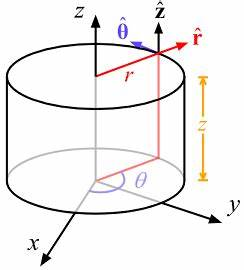
- Calculation:
- Volume microyuan: $dv=\rho d\rho d\theta dz$
- $$\iiint_\Omega f(x,y,z)d\nu=\iiint_{\Omega}f(\rho\cos\theta,\rho\sin\theta,z)r\operatorname{d}r\operatorname{d}\theta\operatorname{d}z$$
Calculation: Spherical coordinates
- Definition: Spherical coordinates
- $$\begin{cases}x=r\sin\varphi\cos\theta,&\quad0\leq r<+\infty,\\y=r\sin\varphi\sin\theta,&\quad0\leq\varphi\leq\pi,\\z=r\cos\varphi,&\quad0\leq\theta\leq2\pi.\end{cases}$$
- Illustration:
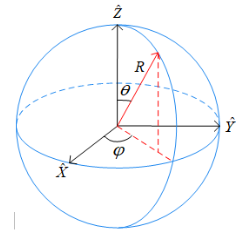
- Calculation:
- Volume microyuan: $dv=r^{2}\sin\varphi drd\varphi d\theta$
- $$\iiint_{\Omega}f(x,y,z)d\nu =\iiint_\Omega f (r\sin\varphi\cos\theta, r\sin\varphi\sin\theta, r\cos\varphi) r^2\sin\varphi\operatorname{d}r\operatorname{d}\varphi\operatorname{d}\theta$$
- Applicable to: The integrand can be written as $f(\sqrt{x^2+y^2+z^2})$ or as a sphere, sphere, hemispherical, or curved cone centered at the origin
->spherical coordinates are suitable