Chapter 5: Definite and Improper Integrals — Advanced Mathematics - Collection of Formulas
Chapter 5: Definite and Improper Integrals from the formula collection, kept as a focused chapter for faster reading and image loading.
On this page
Chapter 5: Definite and Improper Integrals
5.1 Concept of Definite Integrals
Definite Integral Definition
- Definition:
- $f(x)$ is bounded on $[a,b]$, arbitrarily insert a node on $[a,b]$, divide into n small intervals $\Delta x_{1}\Delta x_{2}\cdots\Delta x_{n}$, take any point i, and have: $$\int_{a}^{b}f(x)dx=\lim_{λ\to0}\sum_{x=1}^{n}f(\xi_{i})\Delta x_{i}$$
- Where: $$\lambda=\max\{\Delta x_{1}\cdots\Delta x_{n}\}$$
- Existence of definite integrals:
- Condition 1: $f(x)$ is continuously
->integrable on $[a,b]$; - Condition 2: $f(x)$ is bounded on $[a,b]$ and has a finite number of discontinuities
->integrable; - Condition 3: $f(x)$ There are only a finitely many Type I discontinuities on $[a,b]$;
- Summary:
- Being bounded is a necessary condition for the existence of definite integrals;
- An integrable integral is a sufficient condition for the existence of definite integrals;
Properties of Definite Integrals
- 1. $$\int_{a}^{b}(\alpha f(x)+\beta g(x))dx=\alpha\int_{a}^{b}f(x)dx+\beta\int_{a}^{b}g(x)dx$$
- 2. $$\int_{a}^{b}f\left(x\right)dx=-\int_{b}^{a}f\left(x\right)dx$$
- 3. When $a<c<b$: $$\int_{a}^{b}f\left(x\right)dx=\int_{a}^{c}f\left(x\right)dx+\int_{c}^{b}f\left(x\right)dx$$
5.2 Upgraded Limit Points
Fundamental Theorem of Calculus
- Definition:
- If $f(x)$ continuity is on $[a, b]$, then: $\int_a^xf(t)\mathrm{d}t$ is differentiable on $[a, b]$, and there is $$(\int_a^xf(t)\mathrm{d}t)^{\prime}=f(x)$$
- Other conclusions:
- $$(\int_{\varphi(x)}^{\psi(x)}f(t)dt)^{\prime}=f(\psi(x))\psi^{\prime}(x)-f(\varphi(x))\varphi^{\prime}(x)$$
Parity of Integral Upper Limit Functions
- 1. If f(x) is an odd function, then $\int_0^xf(t)dt$ is even;
- 2. If f(x) is an even function, then $\int_0^xf(t)dt$ is an odd function;
Three Major Methods to Limit Points for Upgrades
- Method 1: Formula calculation
- Example: $$(\int_{e^{x}}^{x^{2}}f(t)dt)^{\prime}=f(x^{2})\cdot2x-f(e^{x})e^{x}$$
- Method 2: Extract x
- Example: $$\int_{0}^{x}(x-t)f(t)dt;=x\int_{0}^{x}f(t)dt-\int_{0}^{x}tf(t)dt$$
- The integral domain and the integrand contain x;
- When x can be proposed: split the terms and extract x;
- Method 3: Substitution method
- Example: $$\int_{0}^{x}cos(x-t)^{2}dt\frac{x-t=u}{}\int_{0}^{x}cos u^{2}du$$
- The integral domain and the integrand contain x;
- When x cannot be proposed: substitute;
- Note: When substituting a substitution, x is a constant, and t and u are the integrand variables;
- Example: When there is no x in both upper and lower limits, but x is present in the integral, you need to replace x and substitute it into the upper and lower limits;
- After $x+t=u$: $$\int_{1}^{2}f(x+t)dt=\int_{x+1}^{x+2}f(u)du$$
5.3 Calculation of Definite Integrals
5.3.1 Method One: Newton-Leibniz Formula
Calculation Basics: Newton-Leibniz formula
- Definition:
- Let $F(x)$ be an antiderivative of the continuous function $f(x)$ on $[a, b]$, then: $\int_{a}^{b}f(x)dx=F(b)-F(a)$, also called the basic formula of calculus;
5.3.1 Method Two: Substitution of Definite Integrals
Official
- $$\int_{a}^{b}f(x)\operatorname{d}x=\int_{\alpha}^{\beta}f(\varphi(t))\varphi^{\prime}(t)\operatorname{d}t$$
5.3.2 Method 3: Integration by Parts of Definite Integrals
Official
- $$\int_{a}^{b}u\operatorname{d}v=uv\bigg|_{a}^{b}-\int_{a}^{b}v\operatorname{d}u$$
5.3.3 Method 4: Properties of Definite Integrals
Method One:Use parity and periodicity
- $$\int_{-a}^af(x)\operatorname{d}x=\begin{cases}0,&f(x)&\text{ is the odd function, }\\2\int_0^af(x)\operatorname{d}x,&f(x)&\text{ is an even function }.\end{cases}$$
- $$\int_a^{a+T}f(x)\operatorname{d}x=\int_0^Tf(x)\operatorname{d}x.$$
Method 2:Use existing formulas
- $$\begin{aligned}(1)&\int_0^{\frac\pi2}\sin^nx\operatorname{d}x=\int_0^{\frac\pi2}\cos^nx\operatorname{d}x=\begin{cases}\frac{n-1}n\frac{n-3}{n-2}\cdots\frac12\frac\pi2,&n\text{ Sorry }\\\frac{n-1}n\frac{n-3}{n-2}\cdots\frac23,&n\text{ Strange }&\end{cases}\\(2)&\int_0^{\pi}x\cdot f(\sin x)\operatorname{d}x=\frac\pi2\int_0^{\pi}f(\sin x)\operatorname{d}x\end{aligned}$$
Method 3: Common conclusions
- 1. $$\int_{0}^{a}\sqrt{a^{2}-x^{2}}dx=\frac{\pi a^{2}}{4}(a>0)$$
- 2. $$\int_{0}^{a}\sqrt{2ax-x^{2}}dx=\frac{\pi}{4}a^{2}$$
- 3. $$\int_{0}^{2a}\sqrt{2ax-x^{2}}dx=\frac{\pi}{2}a^{2}$$
5.4 Improper Integral
Two Types of Improper Integrals
- Improper integrals over an infinite interval:
- $$\int_{a}^{+\infty}f(x)dx=\lim_{t\to+\infty}\int_{a}^{t}f(x)dx$$
- $$\int_{-\infty}^{b}f(x)dx=\lim_{t\to-\infty}\int_{t}^{b}f(x)dx$$
- Improper integrals of infinite functions:
- $$\int_a^bf(x)dx=\lim_{t\to a^+}\int_t^bf(x)dx$$
- $$\int_{a}^{b}f(x)dx=\lim_{t\to b^{-}}\int_{a}^{t}f(x)dx.$$
- $$\int_{a}^{b}f(x)dx=\int_{a}^{c}f(x)dx+\int_{c}^{b}f(x)dx$$
Question Type 1: Determine the convergence and divergence of anomalous integrals
- 1. Definition method;
- Find an antiderivative of the integrand and evaluate its limit at the improper endpoint to determine convergence.
- 2. Comparative discriminant;
- Comparative law;
- The limit form of the comparative method;
- 3. P Integral;
- Improper integrals of infinity
- $$\int_{a}^{+\infty}\frac{1}{x^{P}}dx\begin{cases}P>1&\text{ Convergence }\\P\leq1&\text{ Diverges }\end{cases}(a>0)$$
- Convergence at
->$P>1$, divergence at $P<1$ - Improper integral of unbounded functions
- $$\int_a^b\frac1{\left(x-a\right)^P}dx,\int_a^b\frac1{\left(b-x\right)^P}dx\quad\begin{cases}{P}<1&\text{ Convergence }\\P\geq1&\text{ Diverges }\end{cases}$$
- Convergence at
->$P<1$, divergence at $P>1$ - Use whichever is most convenient;
Problem Type 2: Calculation of Improper Integrals
- Calculate a definite integral + calculate a limit;
- Method 1: Substitution method
- Method 2: Partial Method
5.5 Application of Definite Integrals
Area of Plane Figures
- Scenario 1: Plane coordinates
- If the plane field $D$ is enclosed by curves $y=f(x),y=g(x)(f(x)\geq g(x))$ and $x=a,\quad x=b\quad(a<b)$, then:
- $$S=\int_{a}^{b}[f(x)-g(x)]dx$$
- Scenario 2: Polar coordinates
- If the plane field $D$ is enclosed by curve $\rho=\rho(\theta),\theta=\alpha,\theta=\beta(\alpha<\beta)$, then:
- $$S=\frac 12\int_\alpha^\beta\rho^2 (\theta)\mathrm{d}\theta$$
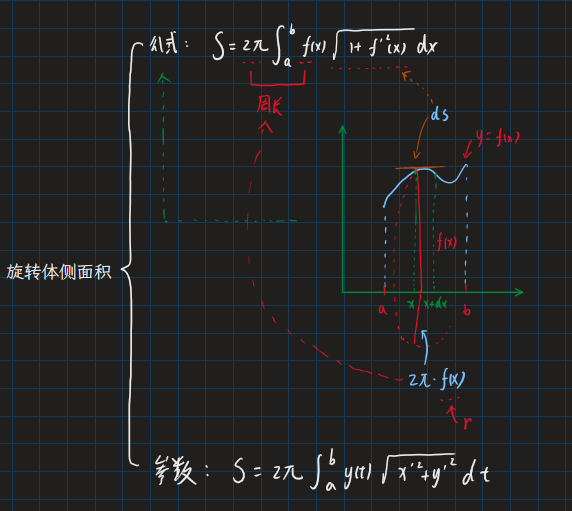
Volume of a Rotating Body
- 1. When rotating around the X-axis: $$V_{x}=\pi\int_{a}^{b}f^{2}(x)\operatorname{d}x$$
- 2. When rotating around the Y-axis: $$V_y=2\pi\int_a^bxf(x)\operatorname{d}x$$
- 3.

Calculation of Arc Length
$$
\begin{aligned}
&1)C:y=y(x),\quad a\leq x\leq b,\quad s=\int_a^b\sqrt{1+{y^{\prime}}^2}dx \\
&2)C:\begin{cases}x=x(t)\\y=y(t)\end{cases}\alpha\leq t\leq\beta.\quad s=\int_\alpha^\beta\sqrt{x^{\prime2}+y^{\prime2}}dt \\
&3)C:\rho=\rho(\theta),\alpha\leq\theta\leq\beta.\quad s=\int_{\alpha}^{\beta}\sqrt{\rho^{2}+{\rho^{\prime}}^{2}}d\theta
\end{aligned}
$$