Lecture 11: Compound Sentences
Graduate Entrance Examination English study notes: Lecture 11: Compound Sentences. Original examples, diagrams, and exercises are retained.
On this page
11.1 How are complex sentences connected?
Simple Sentences
- A simple sentence contains one independent clause;
- Earlier lessons focused on structure within a single clause;
Long and Difficult Sentences
- Learn how clauses are connected and how to choose the correct conjunction;
- What are long and complex sentences:
- Multiple clauses and phrases connected in a single sentence;
Illustration
- Simple sentences
- $n.+v.$
- $n.+v.$
- $n.+v.$
- $n.+v.$
- Long and difficult sentences
- $n.+v.$
- Add conjunctions $conj.$
- $n.+v.$
- Add conjunctions $conj.$
- $n.+v.$
11.2 Basic Concepts of Compound Sentences
Coordinate status
- Coordinate clauses have equal syntactic status;
- Compound sentences:
- 1. A compound sentence contains two or more independent clauses;
- 2. The clauses are joined by a coordinating conjunction, semicolon, or equivalent punctuation;
List the basic concepts
- Structure of compound sentences: multiple simple sentences + coordinating conjunctions;
Summary
- Structure of compound sentences: multiple simple sentences + coordinating conjunctions (the four types of coordinating conjunctions are the focus);
- Omission in compound sentences: identical elements can be omitted, while the remaining elements remain unchanged;
11.3 Coordinating Conjunctions
11.3.1 Coordinating Conjunctions Expressing Addition
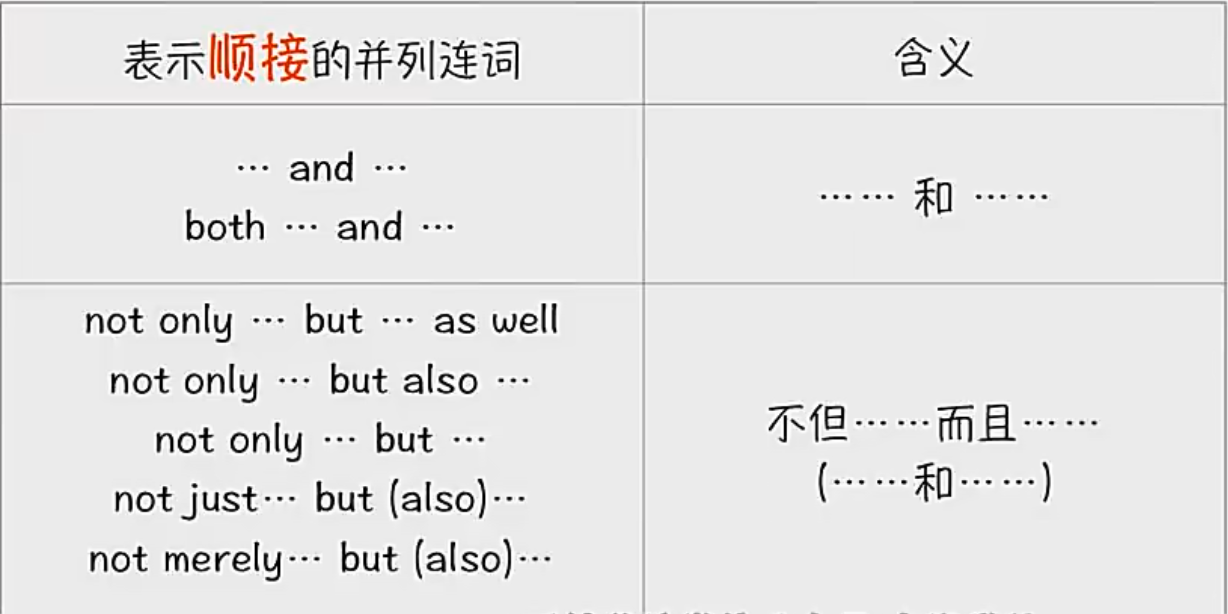
Addition and sequence
- Illustration
Coordinates
- And
- ... And ...
- both ... And
- Not only ... but also ...
not only A but also B- This pattern coordinates two parallel elements while adding emphasis;
Examples
- the Renaissance was over and it was time for a new era—the Age of Reason.
11.3.2 Coordinating Conjunctions Expressing Contrast
Contrast
- Basic concept:
- 1. The two things before and after are opposites;
- More goods are sold, but income decreases;
- 2. The second clause presents an unexpected qualification or result;
- Note: In reading questions, important information often follows a contrast marker;
Common words
however(a conjunctive adverb, normally separated by punctuation)- ... But ...
- ... Yet ...
Examples
- The environment is obviously important, but its role has remained obscure.
- We all understand that at some level, yet as medical consumers, we treat death as a problem to be solved.
11.3.3 Coordinating Conjunctions Expressing Alternatives
Alternatives
- Choose between two or more possibilities;
Coordinates
- Or (choose one)
- ... Or ...
- either ... Or ...
- Neither ... nor ... (both alternatives are negated)
- neither ... nor ...
Examples
- Either Entergy never really intended to live by those commitments, or it simply didn't foresee what would happen next.
11.3.4 Coordinating conjunctions indicating cause and effect
Coordinating Conjunctions Expressing Cause and Effect
- A reason may be introduced by
for; a result may be introduced byso;
Coordinates
- Reason
- ... For ...
- Result
- ... So ...
Examples
- Reporters tend to be part of a broadly defined social and cultural elite, so their work tends to reflect the conventional values of this elite.
- tend to be: often
11.4 Omission in Coordinated Structures
Shared elements
- Coordinate clauses or phrases may omit an element that is grammatically shared and recoverable from the first coordinate;
- Retain every element needed for parallel structure and clear meaning;
Examples
- .... You don't“get”success but become it.
- Note: if two coordinated clauses share a subject and the second subject is omitted, the second finite verb remains part of its clause;
- The program keeps track of your progress and provides detailed feedback on your performance and improvement.
- Here,
andcoordinates two verb phrases; the laterandinperformance and improvementcoordinates two nouns; - Omitted:
- The two coordinated verb phrases share the subject
The program; - The program keeps track of your progress...
- The program provides detailed feedback on your performance and improvement.
- the peoples… died out or became assimilated and lost their native languages.
- A coordinate structure may contain more than two coordinated verb phrases;
- The three verb phrases share the subject the peoples;
- He must either sell some of his property or seek extra funds in the form of loans.
- The modal auxiliary
mustis shared by both coordinated verb phrases; - Expanded second coordinate:
He must seek extra funds in the form of loans; - the federal government must support job training programs, raise the minimum wage, and fund more low-cost housing.
- Before omitting:
- the federal government must support job training programs;
- the federal government must raise the minimum wage;
- the federal government must fund more low-cost housing;