Lecture 11: Linear Dependence of Vectors and Vector Sets
Postgraduate Entrance Exam Mathematics study notes: Lecture 11: Linear Dependence of Vectors and Vector Sets. Original formulas, diagrams, and examples are retained.
On this page
11.1 Vectors and Spans
11.1.1 Vectors
Definition: vector
An $n$-dimensional row vector is an ordered array
and the corresponding column vector is
The scalar $a_i$ is the $i$th component of the vector. Two vectors are equal if and only if all corresponding components are equal.
For vectors $\alpha=(a_1,\ldots,a_n)$ and $\beta=(b_1,\ldots,b_n)$,
The rows or columns of a matrix can be viewed as a vector set. For example, the columns
satisfy $\alpha_3=2\alpha_1$, so $\alpha_3$ contributes no new independent direction.
11.1.2 Span
Definition: span
The span of vectors $\alpha_1,\ldots,\alpha_m$ is the set of all their linear combinations:
- One nonzero vector spans a line through the origin.
- Two linearly independent vectors in $\mathbb R^3$ span a plane through the origin.
- Three linearly independent vectors in $\mathbb R^3$ span all of $\mathbb R^3$.
- Original illustration:
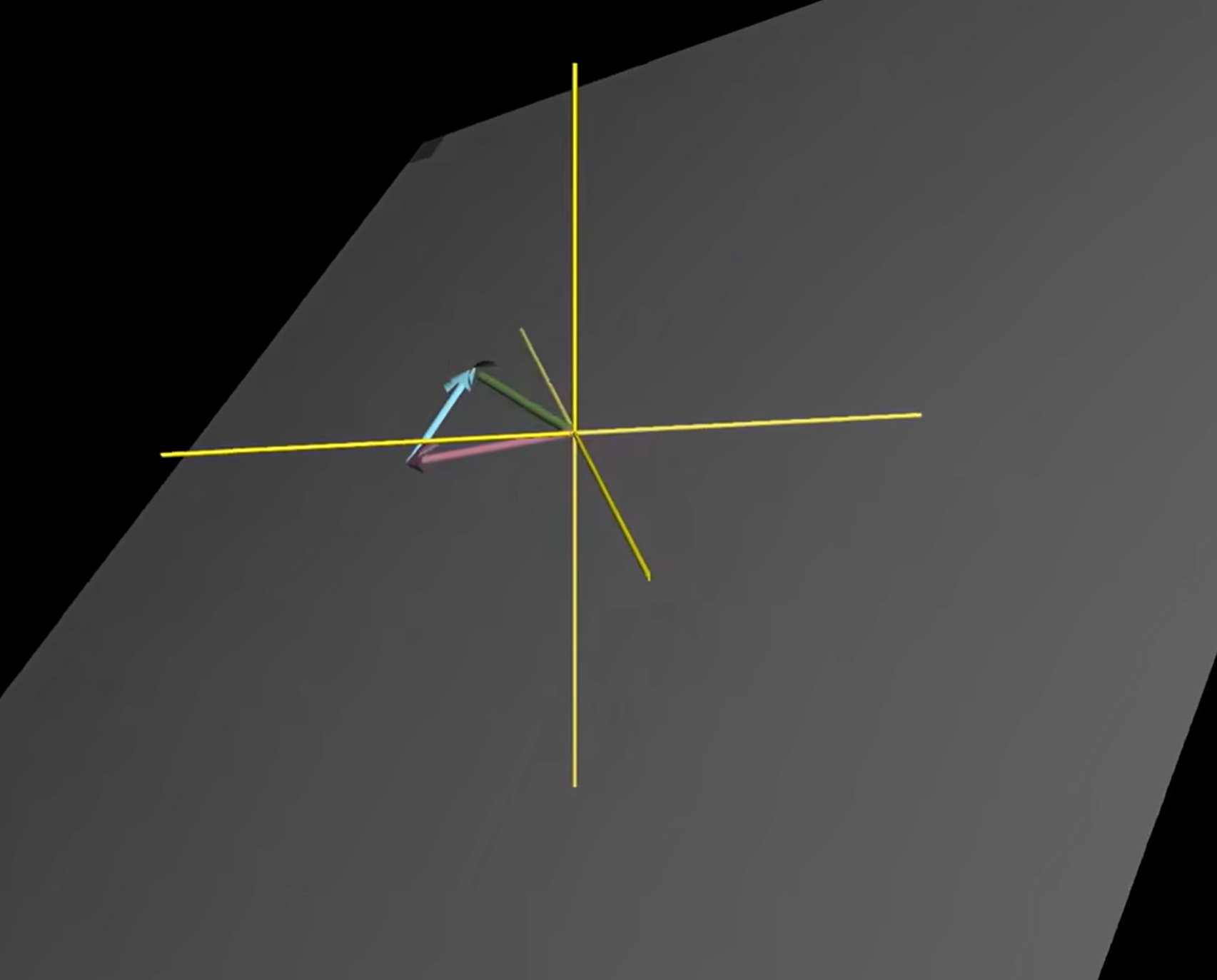
Coordinates depend on the chosen basis, but the geometric vector itself does not.
11.2 Inner Products and Orthogonality
11.2.1 Inner Product and Norm
Definition: inner-product
For $\alpha,\beta\in\mathbb R^n$,
The Euclidean norm is
A vector with norm $1$ is a unit vector.
11.2.2 Orthogonal Vectors and Orthogonal Matrices
Definition: orthogonal-vectors
Vectors $\alpha$ and $\beta$ are orthogonal if
An ordered vector set $\alpha_1,\ldots,\alpha_s$ is orthonormal if
Definition: orthogonal-matrix
An $n\times n$ matrix $A$ is orthogonal if
Equivalently,
and the rows and columns of $A$ are orthonormal sets. Orthogonal transformations preserve inner products, lengths, and angles.
A planar rotation is represented by
11.3 Linear Combinations, Dependence, and Independence
11.3.1 Linear Representation
Definition: linear-combination
An expression
is a linear combination of $\alpha_1,\ldots,\alpha_m$.
A vector $\beta$ is linearly representable by $\alpha_1,\ldots,\alpha_m$ if scalars $k_1,\ldots,k_m$ exist such that
This is equivalent to $\beta\in\operatorname{span}\{\alpha_1,\ldots,\alpha_m\}$.
11.3.2 Linear Dependence
Definition: linear-dependence
The vector set $\alpha_1,\ldots,\alpha_m$ is linearly dependent if scalars $k_1,\ldots,k_m$, not all zero, satisfy
Equivalently, at least one vector in the set can be expressed as a linear combination of the others.
- Any vector set containing the zero vector is linearly dependent.
- Any vector set containing two proportional vectors is linearly dependent.
11.3.3 Linear Independence
Definition: linear-independence
The vector set $\alpha_1,\ldots,\alpha_m$ is linearly independent if
implies
A single nonzero vector is linearly independent. Two vectors are linearly independent if and only if neither is a scalar multiple of the other.
11.4 Criteria and Useful Theorems
11.4.1 Removing or Adding a Vector
Theorem: dependence-criterion
For a set containing at least two vectors, the following are equivalent:
- the set is linearly dependent;
- at least one vector is a linear combination of the remaining vectors.
Theorem: unique-representation
If $\alpha_1,\ldots,\alpha_m$ is linearly independent but $\alpha_1,\ldots,\alpha_m,\beta$ is linearly dependent, then
for a unique set of coefficients $k_1,\ldots,k_m$.
11.4.2 Comparing the Sizes of Vector Sets
Theorem: dimension-bound
If each of the $t$ vectors $\beta_1,\ldots,\beta_t$ can be represented by $\alpha_1,\ldots,\alpha_s$ and $t>s$, then $\beta_1,\ldots,\beta_t$ is linearly dependent.
Equivalently, if $\beta_1,\ldots,\beta_t$ is linearly independent and lies in the span of $\alpha_1,\ldots,\alpha_s$, then $t\le s$.
11.4.3 Dependence, Homogeneous Systems, and Rank
Let
Then
Therefore,
If the number of unknowns exceeds the number of equations in a homogeneous system, then the system has a nonzero solution. For $n$ vectors in $\mathbb R^n$,
11.4.4 Linear Representability and Rank
The vector $\beta$ is linearly representable by $\alpha_1,\ldots,\alpha_s$ if and only if
is consistent. By the rank criterion,
11.4.5 Subsets, Supersets, and Coordinate Extensions
- If a subset of a vector set is linearly dependent, the whole set is linearly dependent.
- Every subset of a linearly independent set is linearly independent.
- If linearly independent $n$-dimensional vectors are extended by appending the same number of additional components to each vector, the resulting higher-dimensional vectors remain linearly independent.
- If a vector set is linearly dependent, deleting the same components from every vector leaves a linearly dependent set.
These statements are often summarized as follows: dependence passes to supersets, independence passes to subsets, coordinate extension preserves independence, and coordinate deletion preserves dependence.