Lecture 1: Course Introduction
Postgraduate Entrance Exam Mathematics Study Notes: Lecture 1: Course Introduction. Original formulas, diagrams, and example problems are retained.
On this page
1.1 Outline Introduction
Introduction
- Basic Content:
- Determinant
- Matrix
- Theme:
- sets of vectors
- System of equations
- Application:
- Eigenvalues;
- At least five points;
- quadratic form;
- With eigenvalues, quadratic forms can be analyzed;
- To study shapes in space, quadratic techniques are needed
->maximum and minimum values in graphs->minimum value problems;
1.2 Course Introduction
1.2.1 Direction, Tools, and Means
Concept: Research directions and tools
- Research Directions:
- The research content isvector:
Vector - The number of vectors equals their dimensions;
- Determinant:
- $$\begin{vmatrix}\mathrm{m}&&\mathrm{n}\\\mathrm{a}&&\mathrm{b}\end{vmatrix}=\mathrm{mb}-\mathrm{an}$$
- Research Tools:
- 1. Linear Operations
->Multiplication and Addition; - 2. Point product operations
->In linear algebra, point product operations are essentially still linear operations; - $(a_{1}a_{2})(\begin{matrix}b_{1}\\b_{2}\end{matrix})=a_1b_1+a_2b_2$
- $(a_1a_2)\begin{pmatrix} b_1 & c_1 \\ b_2 & c_2 \end{pmatrix}=(a_{1}b_{1}+a_{2}b_{2},a_{1}c_{1}+a_{2}c_{2})$
- $\begin{pmatrix} a_1 & a_2 \\ b_1 & b_2 \end{pmatrix}(c_1c_2)=\begin{pmatrix} a_1c_1+a_2c_2 \\ b_1c_1+b_2c_2 \end{pmatrix}$
Concept: Research methods
- Concept:
- Core
->linear transformation; - Matrix
->Represents system information - Data in the matrix cannot be manipulated arbitrarily, otherwise system information will be corrupted;
- Linear transformation:
- Analysis:
- $(\begin{matrix}1&0\\0&-1\end{matrix})(\begin{matrix}1\\1\end{matrix})=(\begin{matrix}1\\-1\end{matrix})$
- Where $(\begin{matrix}1&0\\0&-1\end{matrix})$ is a matrix, corresponding to the function
fin advanced mathematics - Where $(\begin{matrix}1\\1\end{matrix})$ represents the variable, corresponding to
xin advanced mathematics; - Where $(\begin{matrix}1\\-1\end{matrix})$ corresponds to the junction, corresponding to the
yin advanced mathematics; - The input is a vector;
- Example:
- Example: Symmetric transformation
- Matrix: $(\begin{matrix}1&0\\0&-1\end{matrix})$
- Example: Scaling transformation
- Matrix: Scale to the right $(\begin{matrix}2&0\\0&1\end{matrix})$
- Matrix: Scaling upward $(\begin{matrix}1&0\\0&2\end{matrix})$
- Example: Shear transformation
- Matrix: $(\begin{matrix}1&-1\\0&1\end{matrix})$
- Matrix: $(\begin{matrix}-1&1\\0&1\end{matrix})$
1.2.2 Analysis: Systems of Equations and Linear Transformations
Analysis: Systems of equations and linear transformations
- Example: $\begin{cases}x_{1}+2x_{2}=3\\4x_{1}+7x_{2}=10\end{cases}$
- Traditional method: Elimination method
- Linear transformation:
- Because $x_{1}+2x_{2}$ and $4x_{1}+7x_{2}=10$
->are the result of dot products; - So it can be transformed into a linear transformation: $\left.\left(\begin{matrix}1&2\\4&7\end{matrix}\right.\right)\left(\begin{matrix}x_{1}\\x_{2}\end{matrix}\right)=\left(\begin{matrix}3\\10\end{matrix}\right)$
- Therefore, based on this linear transformation, find the $x_1x_2$ of it
- Solution: Multiply both sides of the equivalence by the inverse of the matrix. Assume $A=(\begin{matrix}1&2\\4&7\end{matrix})$, then multiply both sides by $A^{-1}$
- So we get $Ax=B$
->$AA^{-1}x=BA^{-1}$->$x=BA^{-1}$ - That is, the solution for
xcan be obtained;
1.3 Supplement: dot accumulation
Concept: What is dot product?
- Linear transformation angle:
- Formula:
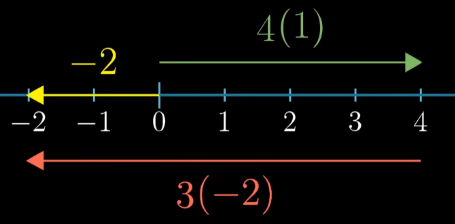
- $$\overbrace{\begin{bmatrix}1&-2\end{bmatrix}}^{\text{Transform}}\underbrace{\begin{bmatrix}4\\3\end{bmatrix}}_{\begin{array}{c}\text{Vector}\\\text{}\end{array}}=4\cdot1+3\cdot-2$$
- Illustration: