Lecture 52: Surface Integrals with Respect to Coordinates
Graduate Entrance Examination Mathematics study notes: Lecture 52: Surface Integrals with Respect to Coordinates. Original formulas, diagrams, and examples are retained.
On this page
60.1 Projection of Directed Surfaces and Surface Elements
60.1.1 Basic Surface Classification
Two-Sided Surface
- A normal direction can be chosen continuously on either side.
One-Sided Surface
- Example: a Möbius strip.
An oriented surface is a surface with a specified side; its orientation is represented by a chosen normal direction.
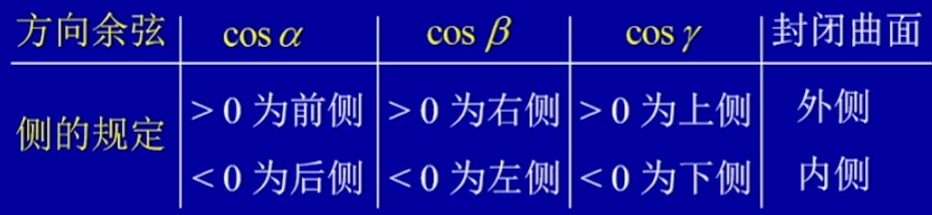
- Let $\Sigma$ be an oriented surface. The signed projection of a surface element $\Delta S$ onto the $xOy$ plane is denoted by $(\Delta S)_{xy}$.
60.2 Surface Integrals of the Second Kind
Definition: SurfaceIntegralOfTheSecondKind
description: $$\iint_{\Sigma}R(x,y,z)dxdy=\lim_{\lambda\to0}\sum_{i=1}^nR(\xi_i,\eta_i,\zeta_i)(\Delta S_i)_{xy}$$
Explanation
- A surface integral of the second kind depends on the orientation of the surface.
- Explanation:
- The function value of a point $R(\xi_i,\eta_i,\zeta_i)$ multiplied by its projection on
xy: $(\Delta S_i)_{xy}$ - If it is $dxdy$
->projection onxy; - If it is $dzdx$
->projection onxz; - Reversing the orientation changes the sign:
$$
\iint_{-\Sigma}(P\,dy\,dz+Q\,dz\,dx+R\,dx\,dy)
=-\iint_{\Sigma}(P\,dy\,dz+Q\,dz\,dx+R\,dx\,dy).
$$
60.3 Calculating Surface Integrals of the Second Kind
60.3.1 Direct Method
Theorem: Calculationofthesecondtypeofcurvedareafraction
description:
Let the integrands be continuous on the smooth surface $\Sigma$.
1. If $\Sigma:z=z(x,y)$ over $D_{xy}$, then
$$\iint_{\Sigma}R\,dx\,dy=\pm\iint_{D_{xy}}R(x,y,z(x,y))\,dx\,dy.$$
Use $+$ for the upward orientation and $-$ for the downward orientation.
2. If $\Sigma:x=x(y,z)$ over $D_{yz}$, then
$$\iint_{\Sigma}P\,dy\,dz=\pm\iint_{D_{yz}}P(x(y,z),y,z)\,dy\,dz.$$
Use $+$ when the normal points toward positive $x$ and $-$ otherwise.
3. If $\Sigma:y=y(z,x)$ over $D_{zx}$, then
$$\iint_{\Sigma}Q\,dz\,dx=\pm\iint_{D_{zx}}Q(x,y(z,x),z)\,dz\,dx.$$
Use $+$ when the normal points toward positive $y$ and $-$ otherwise.
Explanation
- Convert the surface integral to a double integral over the appropriate projection domain.
- Selection of positive and negative signs:
- If projecting onto
xy: - Make the integral
->positive sign on the upper side; - Score the
->minus sign on the lower side; - If projecting onto
yz: - The front side of
yoz->positive sign; - The
->minus sign behindyoz; - If projecting onto
xz: xoz->to the right of the positive sign;- The left side of
xoz->minus; - Note:
- If at
z=f(x,y): - If
xis a constant->the projected field is a line, then the integral equals0; - If
yis a constant->the projection field is also a line, then the integral equals0;
60.3.2 Gaussian Formula
Theorem: GaussDivergenceTheorem
Description: If the closed surface $\Sigma=\partial\Omega$ is oriented outward, then
$$\iint_{\Sigma}\left(P\,dy\,dz+Q\,dz\,dx+R\,dx\,dy\right)
=\iiint_{\Omega}\left(\frac{\partial P}{\partial x}+\frac{\partial Q}{\partial y}+\frac{\partial R}{\partial z}\right)dV.$$
Explanation
- Concept:
- Gauss's theorem relates the outward flux through a closed surface to the triple integral of the divergence over the enclosed volume.
- It is the three-dimensional analogue of Green's theorem.
Supplement: Use the Gaussian formula to cover the surface
- When the surface is not closed, add a face using the Gaussian formula;
- Then, the result calculated using Gauss's formula
-is added to the added part;
60.4 Relationship Between the Two Types of Surface Integral
Concept: Conversion formula
- Formula: $$\iint_{\Sigma}(P\cos\alpha+Q\cos\beta+R\cos\gamma)\mathrm{d}S=\iint_{\Sigma}(P\mathrm{d}y\mathrm{d}z+Q\mathrm{d}z\mathrm{d}x+R\mathrm{d}x\mathrm{d}y)$$
- Explanation:
- The left-hand side is a surface integral of the first kind.
- The right-hand side is a surface integral of the second kind.
- $\cos\alpha$, $\cos\beta$, and $\cos\gamma$ are the direction cosines of the chosen unit normal.