Lecture 35: Basic Concepts of Differential Equations
Postgraduate Entrance Exam Mathematics Study Notes: Lecture 35: Basic Concepts of Differential Equations. Original formulas, diagrams, and example problems are retained.
On this page
Common Question Types and Typical Examples in This Chapter
Exam Content
- (1) Basic concepts of ordinary differential equations
- (2) First-order differential equations
- (3) Higher-order equations that can be reduced (not required in Math III)
- (4) Higher-order linear differential equations
- (5) Difference Equations (only the requirement for Mathematics III)
Frequently Tested Question Types
- Problem Type 1: Solving differential equations
- Question Type 2: Comprehensive questions
- Question Type 3: Word Problems
1.1 What is a Differential Equation?
Definition: Differentialequations
Description: equations containing unknown functionsderivativesordifferentialsare called differential equations;
A differential equation is a mathematical equation used to describe the relationship between afunction and its derivative.
1. Its solution is not a number, but afunction that fits the equations
2. The origin of differential equations dates back to the late 17th century, created to solve physical and astronomical problems encountered in the development of natural sciences;
3. A general equation representing the relationship between unknown functions, derivatives of unknown functions, and independent variables is called differential equations;
4. If the unknown function is a single-variable function, it is called aordinary differential equation; if the unknown function is a multivariable function, it is called apartial differential equation;
5. Differential equations developed alongside calculus;
6. A differential equation contains equations of unknown functions and their derivatives; the highest order of the derivative of an unknown function is called the order of the differential equation;
Basic Concepts
- Differential Equations:
- Concept:
- Equations containing unknown derivatives or differentials
- Example:
- $y^{\prime}=y+x,y^{\prime\prime}+y^{3}=x,y^{\prime\prime}=e^{x}$
- Rank:
- Concept:
-Highest ordercontaining the unknown functionderivative;
- Example:
- When the differential equation is of order n: $F(x,y,y^{\prime},y^{(n)})=0$
- Solution:
- Concept:
- If a function is substituted into a differential equation to make it an identity, then the function is called the solution to the differential equation.
- Suppose: $y=y (x)$ is continuous on the interval I and has derivatives up to the $n$ order, so that $F[x, y (x), y^{\prime}(x), \cdotp\cdotp\cdotp, y^{(n)}(x)]\equiv 0, $ is called $y=y (x)$. The differential equation is in the interval A solution to $I.$
- Example:
- If the current differential equation is $y^{\prime\prime}=e^{x}$
- Then the solution to the current equation is:
- 1. This equation $y=e^{x}$ is the solution to the differential equation;
- 2. This equation $y=e^{x}+c_{1}x+c_{2}$ is also a solution to the differential equation;
- Explanation:
- Concept:
- If the solution to a differential equation contains any constant, and the number ofindependent (non-combinable) constants equals the order of the differential equation, it is called a general solution to the equation;
- That is: the general solution represents the set of solutions, and the number of independent constants must equal the order of the differential equation;
- Example:
- If there is a differential equation with a second-order derivative
- $y^{\prime\prime}=3 ; y^{\prime}=3x+c_{1}$
- At this point, the function of y must have two constants: $y=\frac{3}{2}x^{2}+C_{1}x+C_{2}$
- Particular Solutions:
- Concept:
- A solution containing no arbitrary constants is called a particular solution of the differential equation;
- Supplement:
- Assigning values to the arbitrary constants in the general solution produces a particular solution;
- To find the solution satisfying given initial conditions, first obtain the general solution and then determine its constants from those conditions;
- Initial Conditions:
- Conditions used to determine a unique solution;
- Integral Curve:
- The graph of a solution is called an integral curve of the differential equation;
The Role of Differential Equations
- Illustration:
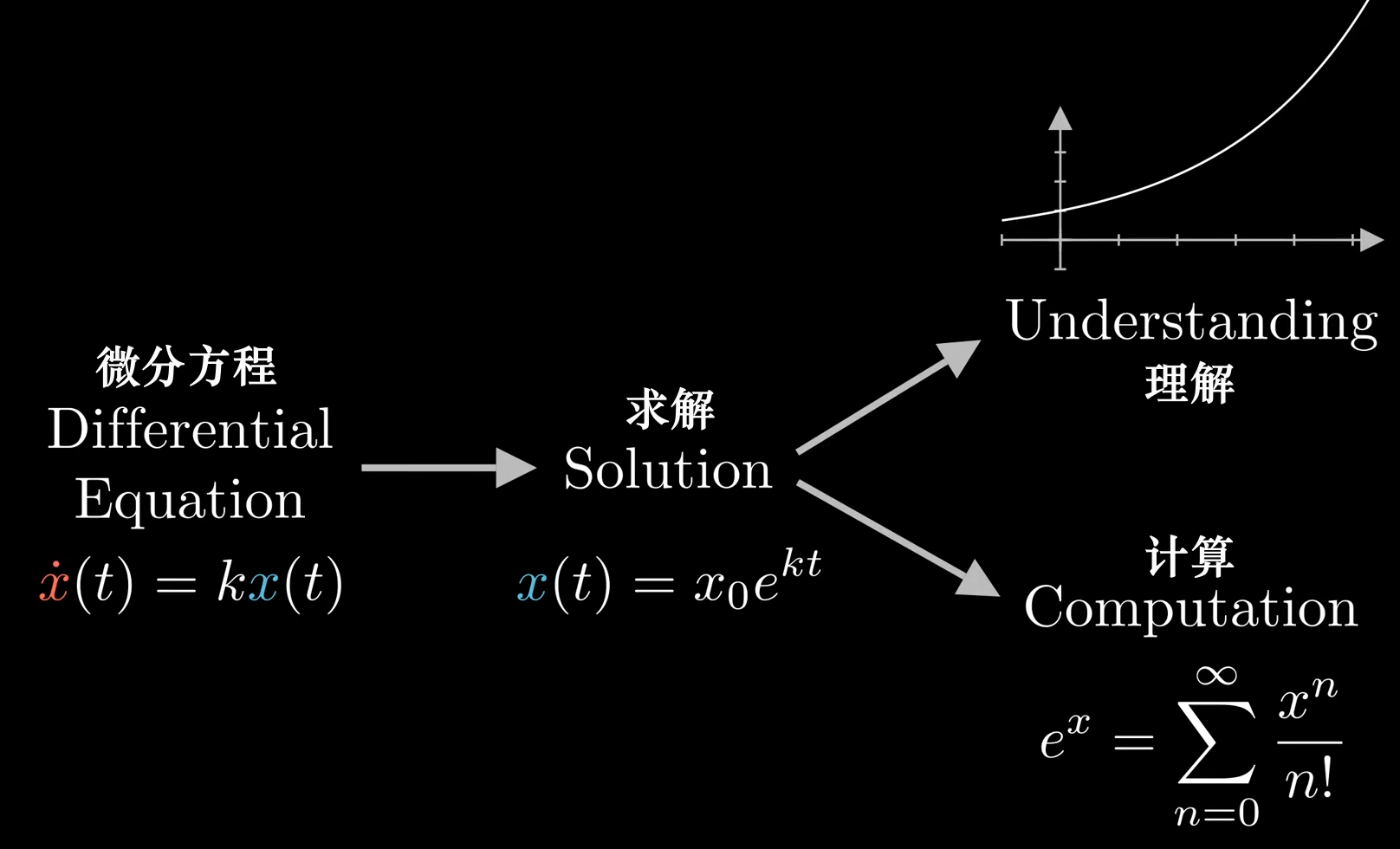
Definition: Firstorderequation
Description: general form of first-order equations: $y^\prime=f(x,y)$
Definition: Secondorderandhigherorderequations
description:
1. Second-order differential equation: the highest derivative in an expression is the second-order derivative;
2. Higher-order differential equations: equations containing third-order derivatives, fourth-order derivatives, or higher-order derivatives;
General form of a second-order differential equation: $y^{\prime\prime}=f(x,y,y^{\prime})$
Definition: Ordinarydifferentialequations
Description: function has only one independent variable;
Explanation
- Introduction:
- In physics: the most commonly used variable in ordinary differential modes is time;
- Example: Study the change in the position of a small ball after it is thrown upward;
- Current differential equation: second-order derivative
- Gravitational acceleration of the ball
- $$\ddot{y}(t)=-g$$
- KnowFirst-Order Derivatives:
- Knowing that the downward component is gravitational acceleration $-g$, thus $\ddot{y}(t)=-g$, its relationship with velocity can also be described: $\frac{d}{dt}(-gt+v_0)=-g$.
- Acceleration alone does not determine the velocity; an initial condition is needed.
- AddInitial Condition 1:
- Based on the speed of $v_0$, the downward g action is performed by $\dot{y}(t)=-gt+v_0$
- The position is still undetermined; at this stage we only know $\frac{d\,y(t)}{dt}=-gt+v_0$.
- Find an antiderivative:
- $\frac{d}{dt}\left(-\frac{1}{2}gt^{2}+v_{0}t\right)=-gt+v_{0}$。
- AddInitial Condition 2:
- When the initial position of an object is $y_0$ and its relationship is: $\frac{d}{dt}\left(-\frac{1}{2}gt^{2}+v_{0}t+y_{0}\right)=-gt+v_{0}$.
- Obtain the solution of thedifferential equation:
- $y(t)=-(1/2)gt^2+v_0t+y_0$
Definition: Partialdifferentialequations
Description: function has multiple independent variables;
Differential equations written based on partial derivatives, hence called partial differential equations;
Explanation
- Partial derivative:
- Consider that there are currently two variables, each with their respective derivative formulas, which is the partial derivative:
- $$\frac{dT}{dt}(x,t)\quad\frac{dT}{dx}(x,t)$$
- To distinguish it from the d derivative of ordinary differential equations, a new notation is used here:
- $$\frac{\partial T}{\partial t}(x,t)\quad\frac{\partial T}{\partial x}(x,t)$$
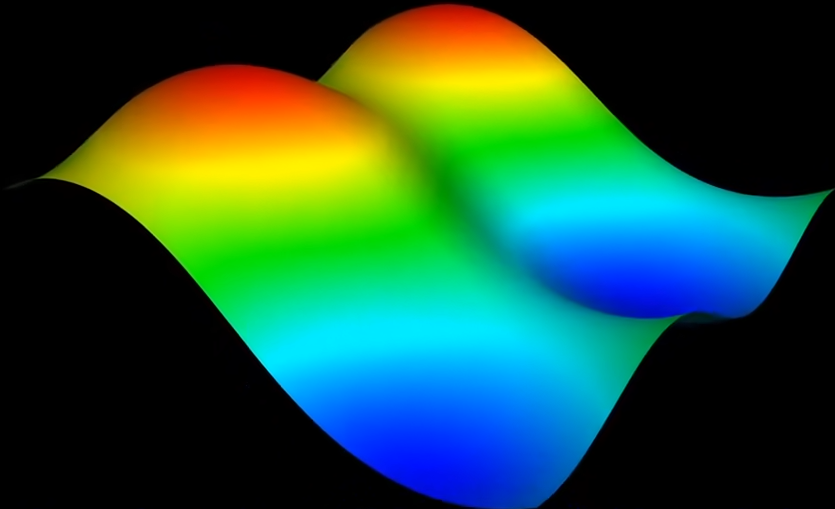
- Example: Heat conduction equation
- Formula:
- $\frac{\partial T}{\partial t}=\alpha\nabla^2T$
- Corresponding partial differential equation:
- Because it is a differential equation written based on partial derivatives, it is called a partial differential equation;
- $$\frac{\partial T}{\partial t}(x,t)=\alpha\cdot\frac{\partial^2T}{\partial x^2}(x,t)$$
- Illustration:
Definition: Partialderivative
Description: for $z=f(x,y)$ functions, there are two partial derivatives defined:
1. Partial derivative of X: When partial derivative of X, Y is fixed at$y_0$at (has no effect on x), $x$exist$x.$everywhere$\Delta x$The increment of, at this time there is only one variable x, which is called:
$\lim_{\Delta x\to0}\frac{f\left(x_{0}+\Delta x,y_{0}\right)-f\left(x_{0},y_{0}\right)}{\Delta x}$ is the partial derivative with respect to X;
Written as: $\left.\frac{\partial z}{\partial x}\right|_{(x_{0},y_{0})},\left.\frac{\partial f}{\partial x}\right|_{(x_{0},y_{0})},z_{_z}(x_{0},y_{0})\text{ or }$ $f_{x}(x_{0},y_{0})$
2. Partial derivative with respect to Y: The same applies to X,
$lim_{\Delta y\to0}\frac{f(x_{0},y_{0}+\Delta y)-f(x_{0},y_{0})}{\Delta y}$;
Written as: $\left.\text{}\frac{\partial z}{\partial y}\right|_{(x_{0},y_{0})},\left.\frac{\partial f}{\partial y}\right|_{(x_{0},y_{0})},z_{y}(x_{0},y_{0})\text{ or }f_{y}(x_{0},y_{0}).$
Method: How to find the partial derivative of x or y
- When $z=f(x,y)$, treat y or x as a constant and take the derivative directly from x or y;
- Example: partial derivative of $z=x^{2}+3xy+y^{2}$ at $(1.2)$;
- Step 1: Calculate the partial derivative function
- Taking partial derivative with respect to x: $\frac{\partial z}{\partial x}=2x+3y$
- Finding partial derivative with respect to y: $$\frac{\partial z}{\partial y}=3x+2y$$
- Step 2: Subtract $(1.2)$ point into the function after finding the partial derivative with respect to x or to y: 2x + 3 y or 3 x + 2 y to get the result
Partial Derivation of Binary Functions
- In a single-variable function
- differentiable -> continuity
- Differentiability is a very strong condition
- In a binary function
- The premise for the partial derivation of a function of two variables with respect to x < - On the line y = $y_0$, it is continuous;
- For a binary function, partial derivatives exist and may not be continuous at $(x_0,y_0)$;
1.2 Differential Equations of Separable Variables
Definition: Equationsofseparablevariables
description:
Form: $$y^{\prime}=f(x)g(y)$$
Explanation: $\frac{dy}{dx}=f(x)g(y)$->$\frac{dy}{g(y)}=f(x)dx$ can separate $g(y)$ and $dy$, $f(x)$ $dx$ to both sides of an equation->differential equations of separable variables;
Solutions of separable variables: Integral of both sides $$\int\frac{dy}{g(y)}=\int f(x)dx$$
Example Question: Find the general solution of $y^{\prime}=\dfrac{y(1-x)}x$.
- Analysis
- Analysis
- Hence $$y=Cxe^{-x},\qquad x\neq0.$$
- Question Type: #
Example Question: $\frac{dy}{dx}=2xy$
- Analysis
- Analysis
- Finding the integral
- $\int\frac{dy}{y}=\int 2x\,dx$
- Obtained:
- $\ln|y|=x^{2}+c$
- So:
- $|y|=e^{x^{2}+c}$
- Ultimate:
- $y=Ce^{x^{2}}$
- Question Type: Separablevariables
1.3 Homogeneous Equations
Definition: Generateorderequations
Description: simplified equation,all nonzero terms have equal exponents: $$\frac{dy}{dx}=\varphi(\frac{y}{x})$$
Explanation
- Concept:
- The right end is a binary function about xy, but it can be written as a $\frac{y}{x}$ binary function;
- Qici:
- The right side acts as a binary function, which is azero-degree and homogeneous function;
- That is: dy is a function compared to dx, andthe number of degrees x and y is equal
Method: Three key strategies
- Step zero: Organize into homogeneous equations with only $\frac{dy}{dx}$ on the left, i.e., $\frac{dy}{dx}=\varphi(\frac{y}{x})$;
- Step one: Write down the $u=\frac{y}{x}$
- Step 2: Since $y=xu$, after taking the derivative of y, we get $\frac{dy}{dx}=u+x\frac{du}{dx}$, which is the expression for $y^{\prime}=\frac{dy}{dx}=u+x\frac{du}{dx}=u+xu^{\prime}$;
- Step 3: Substitute into the original differential equation to obtain $u+x\frac{du}{dx}=\varphi(u)$, which is separable.
- That is, convert it into a separable differential equation and solve.
Example: $\text{Find the solution of }x^2y^{\prime}+xy=y^2\text{ satisfying the initial condition }y(1)=1.$
- Analysis
- Analysis
- The original equation is homogeneous equation $y^{\prime}=(\frac{y}{x})^{2}-\frac{y}{x}$
- $\text{Let }u=\frac yx\text{; then}$
- $xu^{\prime}+u=u^2-u,\quad xu^{\prime}=u^2-2u.$
- At this point, you can separate the variable: $\frac{du}{u^{2}-2u}=\frac1xdx$
- $\frac12[\ln|u-2|-\ln|u|]=\ln|x|+C_1,\frac{u-2}u=Cx^2$
- $\frac{y-2x}y=Cx^2$
- From $y(1)=1$, we get $C=-1$, which gives the specific solution to be $$\frac{y-2x}y=-x^2,\quad\text{ That is }y=\frac{2x}{1+x^2}$$
- Question Type: #
Example Question: $y^{2}+x^{2}\frac{dy}{dx}=xy\frac{dy}{dx}$
- Analysis
- Note:
- 1. First, process the function so that it satisfies y/x;
- 2. How to determine whether the homogeneous equations -> x and y are more symmetric in their degrees?
- Analysis
- First, let's summarize:
- $\frac{dy}{dx}=\frac{y^{2}}{xy-x^{2}}$
- Then divide all numerators and denominators by the square of x;
- $\frac{\left(\frac{y}{x}\right)^{2}}{\frac{y}{x}-1}$
- Then use three key methods to solve the problem
- $x\frac{du}{dx}=\frac{u^{2}}{u-1}-u$
- Then
- $\frac{u-1}{u}du=\frac{dx}{x}$
- Question Type: Generateorderequations
1.4 Frequently Tested Question Types
Question Type: Solvedifferentialequations
PART 1: Problem-solving methods
Core Points: Identify types and select methods
- Concept:
- If the problem requires a particular solution satisfying given conditions, first find the general solution;
- Before finding a general solution, first determine the type of the current differential equation;
Summary: Methods for determining the type of differential equation
- Method:
- 1. Determining type, and when determining type, it is usually in the form of a derivative (i.e., non-differential, without $dy$, $dx$, etc.)
- 2. If you can't judge any form,
-> - Method 1: $x、y$ Swap the two;
- Method 2: Variable substitution;
- 3. Determine the order: determine if and to what degree;
- 4. Core method for combining differentials: grouped differentials
->Easy to assemble on a single basis, use it separately. Hard to assemble, put several expressions together;
Summary: Common form
- Equation in one variable:
- First-order equation:
- (A) Homogeneous equation:
- Format: $$\frac{dy}{dx}=\varphi(\frac{y}{x})$$
- Method: Let $u=\frac yx$, substitute, and simplify
->reduce the equation to separable form; - (B) Linear equation:
- Format: $$y^{\prime}+P(x)y=Q(x)$$
- Method: Write it in standard form, then use the general-solution formula $$y=e^{-\int p(x)dx}\left[\int Q(x)e^{\int p(x)dx}dx+C\right]$$
->Lecture 36: First-order Linear Differential Equations - (C) Bernoulli Equation:
- Format: $$y^{\prime}+p (x) y=Q (x) y^{\alpha} \quad\quad\quad\quad\quad\quad(\alpha\neq1)\quad(y^{1-\alpha}=u)$$
- Method:
- Second-order equations: classify them by their coefficients
- Constant coefficients:
- (D) Second-order homogeneous equation with constant coefficients:
- Form: $$y^{\prime\prime}+py^{\prime}+qy=0$$
- Method: Write the characteristic equation and find its roots
->Lecture 38: Homogeneous Linear Differential Equations with Constant Coefficients - (E) Second-order constant coefficient nonhomogeneous equation:
- Format: $$y^{\prime\prime}+py^{\prime}+qy=f(x)$$
- Method: Split the solution into two parts: general solution of the nonhomogeneous equation = general solution of the corresponding homogeneous equation + one particular solution of the nonhomogeneous equation;
->Lecture 39: Nonhomogeneous Linear Differential Equations with Constant Coefficients - Variable coefficients:
- (F) Order-reducible equations involving $x$ and $y$
- Format: $$y^{\prime\prime}=f(x,y^{\prime})$$
- Method: Set $y^{\prime}=p$ and $y^{\prime\prime}=\frac{dp}{dx}$ to obtain the first-order equation $\frac{dp}{dx}=f(x,p)$, then separate variables when possible;
- (G) Order-reducible equation involving $y$ but not $x$
- Form: $$y^{\prime\prime}=f(y,y^{\prime})$$
- Method: Set $y^{\prime}=p(y)$, so $y^{\prime\prime}=p\frac{dp}{dy}$; this gives a first-order equation in $y$ and $p$;
- Differential Forms in Two Variables:
- (H) Equation in differential form:
- Form: $$P(x,y)\,dx+Q(x,y)\,dy=0$$
- Method: Regroup terms or test for exactness, then integrate with respect to $x$ or $y$ as appropriate;
Question Types: Summary of question types and methods
- 1. Finding a particular solution:
- (1) Find a general solution
- (2) Find the constant
- (3) Obtain a particular solution
- 2. Inverse problem: derive a differential equation from a given family of solutions;
- Analysis: In a second-order constant-coefficient nonhomogeneous equation,
- nonhomogeneous general solution = homogeneous general solution + one particular solution;
- $y=C_{1}y_{1}+C_{2}y_{2}+y^{\star}$;
- Method: Identify the two linearly independent homogeneous components $y_1,y_2$, recover the characteristic roots and homogeneous operator, and then use $y^\star$ to determine the nonhomogeneous term;
Question Type: ComprehensiveDifferentialEquationProblems
PART 1: Problem-solving methods
Method: Solve the differential equation complex
- (1) Analysis: This is a comprehensive question about differential equations and what content it covers;
- (2) Different question types use common methods corresponding to different contents;
PART 2: Typical Example Problems
PART 3: Key Points Review
Question Type: Differentialequationapplicationproblems
PART 1: Problem-solving methods
Question Type: Geometry word problems
- Method:
- (1) Sketch the current image, which needs to highlight the main features;
- (2) Use the relationship given in the problem to establish a differential equation;
- (3) Solving differential equations;