Lecture 32: Calculation of definite integrals
Postgraduate Entrance Exam Mathematics Study Notes: Lecture 32: Calculation of Definite Integrals. Retain the original formulas, diagrams, and example problems.
On this page
1.1 Calculation of Definite Integrals
1.1.1 Concept Introduction
The Relationship Between Position Function and Velocity Function in Variable Speed Linear Motion
- Defining definite integrals, which is cumbersome to use directly
- $\int_a^bf(x)\operatorname{d}x\mathop{\Delta}\lim_{\lambda\to0}\sum_{i=1}^nf(\xi_i)\Delta x_i$
- For example, when calculating distance, $v(t)$ is the velocity function, $s(t)$ is the distance function:
- $\int_{T_1}^{T_2}\nu(t)dt=s(T_2)-s(T_1)\quad s^{\prime}(t)=\nu(t)$
- And, according to the property of the indefinite integral: $s(t)=\int_{t_0}^tv(t)dt\quad s^{\prime}(t)=v(t)$
- Can it be transformed into the difference between two points of the antiderivative of the integrand?
Case Analysis:Suppose $f(x)$ is continuous on $[a,b]$, and x is any point on $[a,b]$:
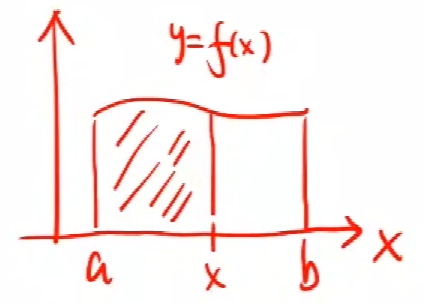
The area of the shaded part is called the function of theupper limit of integrals
- $\Phi(x)=\int_a^xf(t)\mathrm{d}t\quad x\in[a,b]$
Question:Is this function with the upper limit of integration differentiable over the function interval?
- Answer: Yes, provided $f(x)$ is continuous on $[a,b]$;
1.1.2 Functions and Derivatives of the Upper Limit of Integrals
Theorem: Afunctionoftheupperlimitoftheintegral: Fundamental theorem of calculus
Description: If $f(x)$ is continuity on $[a, b]$, then: $\int_a^xf(t)\mathrm{d}t$ is differentiable on $[a, b]$, and there is $$(\int_a^xf(t)\mathrm{d}t)^{\prime}=f(x)$$
Explanation
- Concept:
-Derivative of the integral of a function, equal to the function value at this point;
- When x is constant, it yields a fixed value;
- Core:
- Differentiation and integration are inverse operations;
- Solves the existence of the antiderivative;
- Conclusion:
- $$(\int_{\varphi(x)}^{\psi(x)}f(t)dt)^{\prime}=f(\psi(x))\psi^{\prime}(x)-f(\varphi(x))\varphi^{\prime}(x)$$
Theorem: Parityoftheupperlimitfunctionoftheintegral
description:
1. If f(x) is an odd function, then $\int_0^xf(t)dt$ is even;
2. If f(x) is an even function, then $\int_0^xf(t)dt$ is an odd function;
Explanation
Theorem: Theoriginalfunctionofthedefiniteintegral
Description: If $f$ is continuous on $[a,b]$, then $F(x)=\int_a^x f(t)\,dt$ is an antiderivative of $f$ on $[a,b]$.
Explanation
- When $f$ is continuous, the integral with variable upper limit, $F(x)=\int_a^x f(t)\,dt$, satisfies $F^{\prime}(x)=f(x)$.
- Thus every continuous function has an antiderivative; the variable-upper-limit integral provides one.
Corollary: A more general form
- If $\varphi$ and $\psi$ are differentiable and $f$ is continuous, then:
- $\frac d{dx}\int_{\psi(x)}^{\varphi(x)}f(t)dt=f(\varphi(x))\varphi^{\prime}(x)-f(\psi(x))\psi^{\prime}(x)$
1.1.3 Example Problems
Example: $\text{Let }\Phi(x)=\int_{0}^{x^{2}}e^{-t^{2}}dt.\text{ Find }\Phi^{\prime}(x).$
- Analysis
- Apply the Fundamental Theorem of Calculus together with the chain rule.
- Solution
- $\Phi=\int_{0}^{u}e^{-t^{2}}dt$
- Let $u=x^2$.
- Differentiate the outer integral with respect to $u$, then multiply by $du/dx$:
- $\bar{\Phi}_{x}^{\prime}(x)=\bar{\Phi}_{u}^{\prime}\cdot U_{x}^{\prime}=e^{-u^2}\cdot2x=e^{-x^4}\cdot2x.$
- Question Type: Theoriginalfunctionofthedefiniteintegral
Example: When both upper and lower limits of the function change: $g(x)=\int_{\sin x}^{x^2}e^{-t^2}dt\quad$, find its derivative;
- Analysis
- It can be split into two segments, from sinx to 0, and then from 0 to x squared;
- Solve separately and add them together;
- Analysis
- ${\int_0^{x^2}e^{-t^2}dt+\int_{sinx}^0e^{-t^2}dt}$
- Question Type: Theoriginalfunctionofthedefiniteintegral
1.2 Calculation Methods
1.2.1 Newton-Leibniz Formula
Theorem: NewtonLeibnizformula
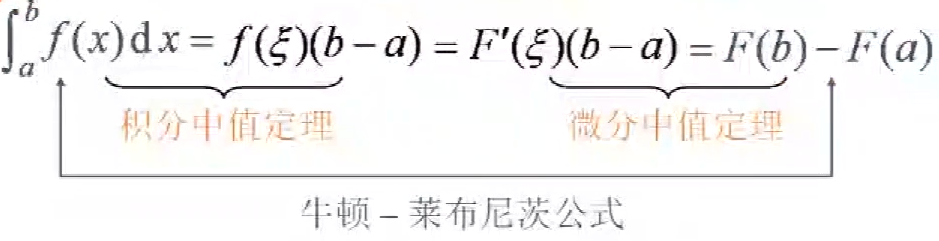
Description: Let $F(x)$ be an antiderivative of continuous function $f(x)$ on $[a, b]$, then: $\int_{a}^{b}f(x)dx=F(b)-F(a)$, also called the basic formula of calculus;
Explanation
- Turning the problem of solving definite integrals into the problem of finding the antiderivative;
- And this formula communicates the relationship between integral calculus and differential calculus;
Corollary:Prove the mean value theorem of integrals n
- If $f(x)$ has continuity on $[a, b]$, then
- $\int_a^bf(x)\operatorname{d}x=f(\xi)(b-a)\quad\quad a<\xi<b$
1.2.2 Substitution Method
Theorem: Substitutionmethodfordefiniteintegrals
description: $$\int_{a}^{b}f(x)\operatorname{d}x=\int_{\alpha}^{\beta}f(\varphi(t))\varphi^{\prime}(t)\operatorname{d}t$$
Explanation
- Note: The integrand and the upper and lower limits must be substituted;
1.2.3 Integration by Parts
Theorem: IntegrationbyPartsofDefiniteIntegrals
description: $$\int_{a}^{b}u\operatorname{d}v=uv\bigg|_{a}^{b}-\int_{a}^{b}v\operatorname{d}u$$
1.2.4 Other Methods
Method One: Utilizing Parity and Periodicity
- $$\int_{-a}^af(x)\operatorname{d}x=\begin{cases}0,&f(x)&\text{ is the odd function, }\\2\int_0^af(x)\operatorname{d}x,&f(x)&\text{ is an even function }.\end{cases}$$
- $$\int_a^{a+T}f(x)\operatorname{d}x=\int_0^Tf(x)\operatorname{d}x.$$
Method 2: Use Existing Formulas
- $$\begin{aligned}(1)&\int_0^{\frac\pi2}\sin^nx\operatorname{d}x=\int_0^{\frac\pi2}\cos^nx\operatorname{d}x=\begin{cases}\frac{n-1}n\frac{n-3}{n2}\cdots\frac12\frac\pi2,&n\text{ Sorry }\\\frac{n-1}n\frac{n-3}{n-2}\cdots\frac23,&n\text{ Strange }&\end{cases}\\(2)&\int_0^{\pi}x\cdot f(\sin x)\operatorname{d}x=\frac\pi2\int_0^{\pi}f(\sin x)\operatorname{d}x\end{aligned}$$
1.2.2 Example Problems
Example Question: $\int_{0}^{\pi}\sin xdx$
- Analysis
- Analysis
- $\int_{0}^{\pi}\sin xdx=\left(-cosx\right)\int_{0}^{\pi}=1-(-1)=2.$
- Question Type: NewtonLeibnizformula
1.3 Frequently Tested Question Types
Question Type: Calculationofdefiniteintegrals
PART 1: Problem-solving methods
Five Common Methods
- 1. Newton-Leibniz formula;
- 2. Cycle change method
- 3. Partial Integration Method;
- 4. Parity, periodicity;
- Obtain the function and first observe its parity and periodicity;
- 5. Two special formulas;
- $$\begin{aligned}(1)&\int_0^{\frac\pi2}\sin^nx\operatorname{d}x=\int_0^{\frac\pi2}\cos^nx\operatorname{d}x=\begin{cases}\frac{n-1}n\frac{n-3}{n2}\cdots\frac12\frac\pi2,&n\text{ Sorry }\\\frac{n-1}n\frac{n-3}{n-2}\cdots\frac23,&n\text{ Strange }&\end{cases}\\(2)&\int_0^{\pi}x\cdot f(\sin x)\operatorname{d}x=\frac\pi2\int_0^{\pi}f(\sin x)\operatorname{d}x\end{aligned}$$
- Supplementary Methods:
- Use geometric analysis: If a function is a type of geometric figure, you can draw its shape and observe its geometric properties;
Common Conclusions in Indefinite Integral Geometry
- 1. $$\int_{0}^{a}\sqrt{a^{2}-x^{2}}dx=\frac{\pi a^{2}}{4}(a>0)$$
- 2. $$\int_{0}^{a}\sqrt{2ax-x^{2}}dx=\frac{\pi}{4}a^{2}$$
- 3. $$\int_{0}^{2a}\sqrt{2ax-x^{2}}dx=\frac{\pi}{2}a^{2}$$
Fixed Points with Variable Limits
- When calculating definite integrals with variable upper limit functions, consider using the integration by parts method;
PART 2: Typical Example Problems
PART 3: Key Points Review
Question Type: Upgradedlimitedpoints
PART 1: Problem-solving methods
Core Formulas
- Concept:
- $$(\int_a^xf(t)\mathrm{d}t)^{\prime}=f(x)$$
- Calculation:
- $$(\int_{\varphi(x)}^{\psi(x)}f(t)dt)^{\prime}=f(\psi(x))\psi^{\prime}(x)-f(\varphi(x))\varphi^{\prime}(x)$$
Three Major Methods to Limit Points for Upgrades
- Method 1: Formula calculation
- Example: $$(\int_{e^{x}}^{x^{2}}f(t)dt)^{\prime}=f(x^{2})\cdot2x-f(e^{x})e^{x}$$
- Method 2: Extract x
- Example: $$\int_{0}^{x}(x-t)f(t)dt;=x\int_{0}^{x}f(t)dt-\int_{0}^{x}tf(t)dt$$
- The integral domain and the integrand contain x;
- When x can be proposed: split the terms and extract x;
- Method 3: Substitution method
- Example: $$\int_{0}^{x}cos(x-t)^{2}dt\frac{x-t=u}{}\int_{0}^{x}cos u^{2}du$$
- The integral domain and the integrand contain x;
- When x cannot be proposed: substitute;
- Note: When substituting a substitution, x is a constant, and t and u are the integrand variables;
- Example: When there is no x in both upper and lower limits, but x is present in the integral, you need to replace x and substitute it into the upper and lower limits;
- After $x+t=u$: $$\int_{1}^{2}f(x+t)dt=\int_{x+1}^{x+2}f(u)du$$
Question Type: Variable Upper Limit Integral + Limit Calculation
- When a limit contains a variable-upper-limit integral in the numerator or denominator, the Fundamental Theorem of Calculus often makes L'Hôpital's rule convenient.
Problem Type: Variable Upper Limit Integral + Differentiation of Implicit Functions
- Example: Let the differentiable function $y=y(x)$ be determined by equation $\int_0^{x+y}\mathbf{e}^{-t^2}\mathbf{d}t=\int_0^xx\sin t^2\operatorname{d}t$, find $\frac{\operatorname{d}y}{\operatorname{d}x}_{x=0}$
- Analysis: The left side of the equivalence is a function about x and y, and the right side of the equation is a function about x. Therefore, when you need to find the derivative of $y=y(x)$ on $\frac{\operatorname{d}y}{\operatorname{d}x}_{x=0}$, essentially it is an implicit function with y and x whose derivative is at point 0, so it is a problem of derivative of implicit functions;
- Core: Derivative by the upper limit