Lecture 20: Differentials of Functions
Graduate Entrance Examination Mathematics study notes: Lecture 20: Differentials of Functions. Original formulas, diagrams, and examples are retained.
On this page
1.1 Definition of a Differential
1.1.1 Why Differentials Are Useful
Core Idea
- A differential is the linear part of a small change in a function. It approximates the actual increment when the independent-variable increment is small.
- A derivative describes an instantaneous rate of change; a differential uses that rate to approximate an actual small change.
Example
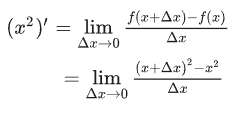
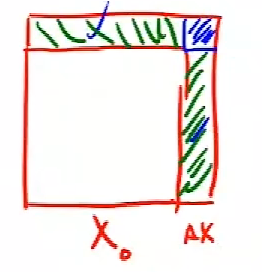
- Let $f(x)=x^2$. At $x_0$,
- As $\Delta x\to0$, the term $(\Delta x)^2$ is of higher order than $\Delta x$, so
$$\Delta y\approx2x_0\Delta x.$$
- The linear term is the differential:
$$dy=f'(x_0)\,dx=2x_0\Delta x,\qquad dx=\Delta x.$$
- This approximation is useful in error estimation.
Relationship Between a Derivative and a Differential
- The derivative $f'(x_0)$ is the local rate of change.
- The actual increment is $\Delta y=f(x_0+\Delta x)-f(x_0)$.
- The differential $dy=f'(x_0)\Delta x$ is the linear principal part of $\Delta y$.
- Therefore,
$$\frac{dy}{dx}=f'(x_0).$$
1.1.2 Formal Definition
Definition: Differential
Description: If
$$f(x_0+\Delta x)-f(x_0)=A\Delta x+o(\Delta x)\qquad(\Delta x\to0),$$
then $f$ is differentiable at $x_0$. Its differential is
$$dy=A\Delta x.$$
Explanation
- The term $A\Delta x$ is the linear principal part of $\Delta y$.
- The remainder $o(\Delta x)$ is a higher-order infinitesimal.
- Hence
$$\Delta y=dy+o(\Delta x),\qquad dy\approx\Delta y.$$
Geometric Meaning
- For the curve $y=f(x)$, $dy=f'(x_0)dx$ is the vertical increment along the tangent line at $x_0$ corresponding to a horizontal increment $dx$.
1.1.3 Differentiability and Existence of the Derivative
Theorem: DifferentiabilityAndDerivative
Description: For a single-variable function, $f$ is differentiable at $x_0$ if and only if $f'(x_0)$ exists. In that case,
$$dy=f'(x_0)\,dx.$$
1.2 Continuity, Differentiability, and the Derivative
Illustration
Main Relationships
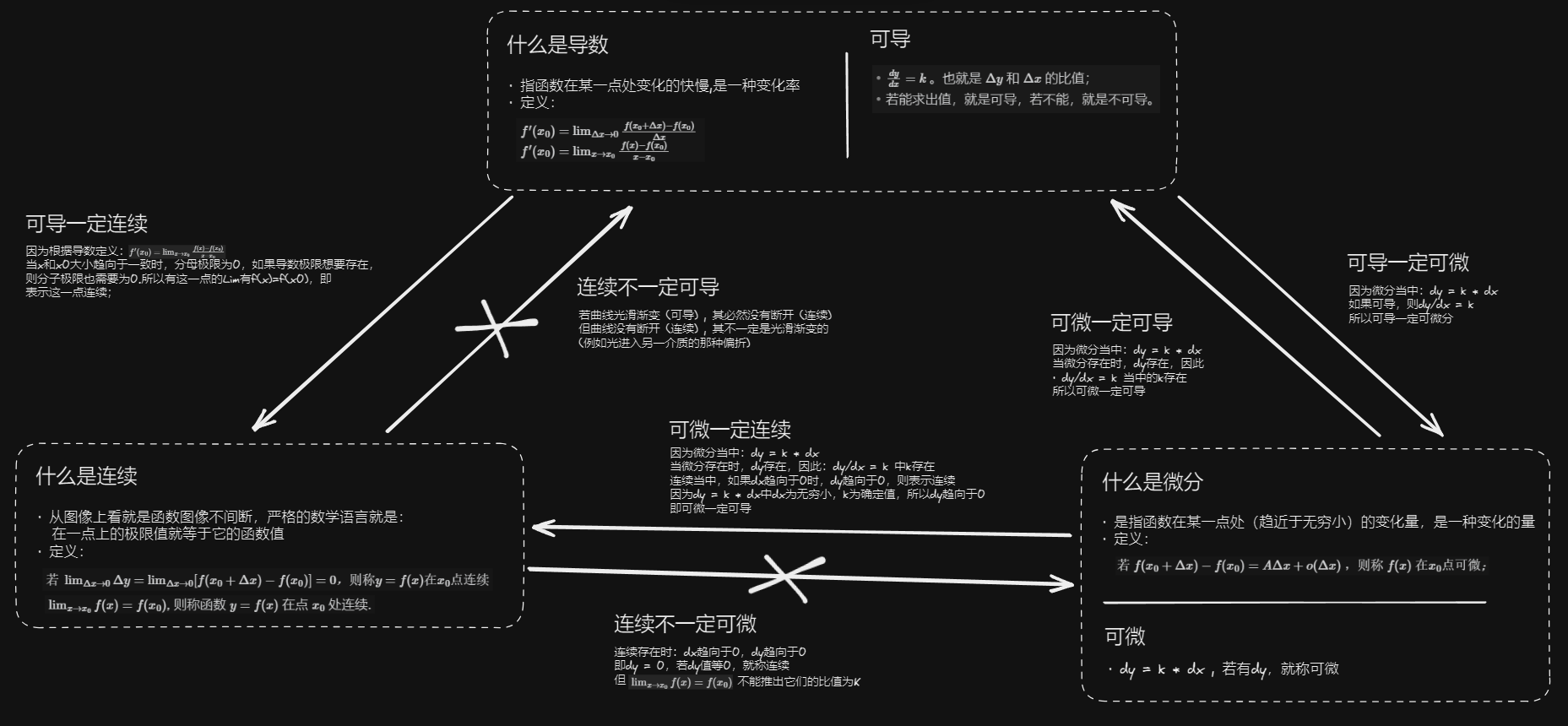
- Differentiability at $x_0$ implies continuity at $x_0$.
- Continuity does not imply differentiability. For example, $f(x)=|x|$ is continuous at $0$, but its one-sided derivatives are $-1$ and $1$.
- Existence of $f'(x_0)$ does not imply that $f'$ is continuous at $x_0$.
- Existence of $f''(x_0)$ does not by itself imply that $\lim_{x\to x_0}f''(x)$ exists.
Proof That Differentiability Implies Continuity
- If $f'(x_0)$ exists, then
$$\Delta y=\frac{\Delta y}{\Delta x}\Delta x.$$
- As $\Delta x\to0$, the difference quotient tends to the finite number $f'(x_0)$, while $\Delta x\to0$. Therefore $\Delta y\to0$, which is continuity at $x_0$.

How to Test Differentiability
- If the function is discontinuous at the point, it is not differentiable there.
- If it is continuous, differentiability still must be checked:
- use the derivative definition; or
- verify that the left- and right-hand derivatives both exist and are equal.
1.2.2 Repeated Use of L'Hôpital's Rule
- Reapply the rule only while the expression remains of type $0/0$ or $\infty/\infty$ and all hypotheses of the rule continue to hold.
- At every application, check that the derivative of the denominator is nonzero in a punctured neighborhood and that the new derivative ratio has a limit.
1.3 Supplement: Historical View of Differentials
1.3.1 Classical Calculus
Characteristics
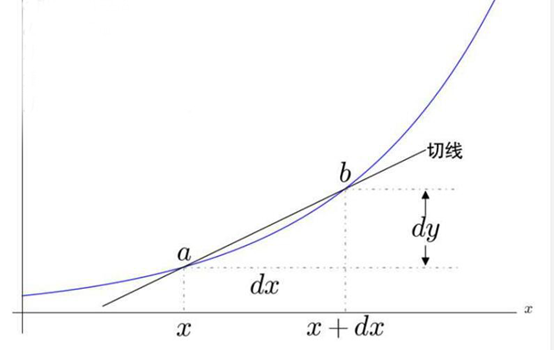
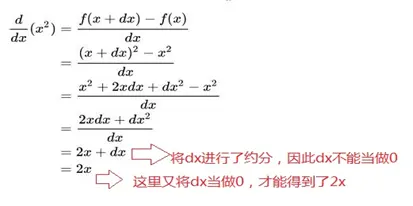
- Early calculus treated $dx$ and $dy$ as infinitesimal changes.
- Tangents were described using these infinitesimals.
- The derivative was interpreted as the tangent slope $dy/dx$.
1.3.2 Limit-Based Definition
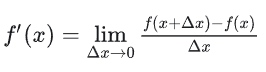
Limits provide a precise meaning for infinitesimals: a quantity is infinitesimal when its limit is zero.
Modern Interpretation
- In general, $dy$ is not identical to $\Delta y$.
- Instead,
$$\Delta y=dy+o(dx),\qquad dy\approx\Delta y\quad(dx\to0).$$
- Thus the differential is the best linear approximation to the actual increment.