Lecture 16: Basic Concepts of Derivatives
Postgraduate Entrance Exam Mathematics Study Notes: Lecture 16: Basic Concepts of Derivatives. Retain original formulas, diagrams, and example problems.
On this page
Common Question Types and Typical Examples in This Chapter
Exam Content
- 1. Concepts of Derivatives and Differentials (Difficult Points)
- 2. Derivative formulas and differentiation rules (Key Points)
- 3. Higher-Order Derivatives (Difficult Point)
Typical Example Problems
- Problem Type 1: Definition of Derivatives (Difficult Point)
- Problem Type 2: Composite Functions, Implicit Functions, and Differentiation of Parametric Equations (Key Focus)
- Problem Type 3: Advanced Derivatives (Difficult Point)
- Problem Type 4: Derivative Applications
1.1 Definition of Derivatives
1.1.1 Basic Concepts
Why Derivatives Are Needed
At a point, the derivative is the limit of the ratio between the change in the dependent variable and the change in the independent variable. It describes the instantaneous rate at which the dependent variable changes with the independent variable.
- A derivative is a special limit of average rates of change as the interval approaches zero.
Definition: Whatisaderivative
Description: If $\lim_{\Delta x\to0}\frac{f(x_0+\Delta x)-f(x_0)}{\Delta x}$ exists, then $f$ is differentiable at $x_0$.
Another form: $f^{\prime}(x_0)=\lim_{\Delta x\to0}\frac{f(x_0+\Delta x)-f(x_0)}{\Delta x}=\lim_{x\to x_0}\frac{f(x)-f(x_0)}{x-x_0}$
Form One: $f^{\prime}(x_0)=\lim_{\Delta x\to0}\frac{f(x_0+\Delta x)-f(x_0)}{\Delta x}$
Form 2: $f^{\prime}(x_0)=\lim_{x\to x_0}\frac{f(x)-f(x_0)}{x-x_0}$
Explanation
- Equivalent form:
- Because $x_0+\Delta x=x\quad\Delta x=x-x_0.$
- So $f^{\prime}(x_0)=\lim_{\Delta x\to0}\frac{f(x_0+\Delta x)-f(x_0)}{\Delta x}=\lim_{x\to x_0}\frac{f(x)-f(x_0)}{x-x_0}$
- Other forms: $f^{\prime}(x_0)=y^{\prime}|_{x=x_0}=\frac{dy}{dx}|_{x=x_0}$
- Note:
- 1. The derivative of a point is related to $f(x_0)$;
- 2. $f(x_0)$ is a fixed point, $f(x)$ is a moving point;
- 3. If the limit does not exist, then $f(x)$ is said to be non-differentiable at $x_{0}$;
- 4. If the limit is infinite, then $f(x)$ is called the derivative at $x_{0}$ that the derivative is infinite (the derivative is infinite and is non-differentiable).
What is differentiability
- $\frac{dy}{dx}=k$ 。 That is, the ratio of $\Delta y$ to $\Delta x$;
- If the value can be found, it is differentiable; if not, it is non-differentiable.
Derivation: Suppose the current distance function is $d(s)=t^3$, the current derivative is $v(t)$, let $t=3$
- Derivation of rate of change near a point: $\begin{gathered}\text{Derivative}\\\frac{ds}{dt}(t)=\underbrace{\frac{s(t+dt)-s(t)}{dt}}_{dt\to0}\end{gathered}$
- Suppose at point $t=2$, find the tangent at this point: $\begin{aligned}\frac{ds}{dt}(2)=\frac{\left(2+dt\right)^3-\left(2\right)^3}{dt}\end{aligned}$
- Now expand $(2+dt)^3$ to get: $\begin{aligned}\frac{2^3+3(2)^2dt+3(2)(dt)^2+(dt)^3-2^3}{dt}\end{aligned}$
- Dividing it by $dt$ gives the $3(2)^2+3(2)(dt)+(dt)^2$
- At this point, as $dt$ approaches infinite hours, we get: $\frac{ds}{dt}(2)=3(2)^2=12$
- If $t=2$ in it is changed to a general expression $t=t$, we get: $\frac{ds}{dt}(t)=3(t)^2$
Definition: Leftderivativeandrightderivative
description: $\begin{aligned}&\text{ Left derivative: }f_0^{\prime}(x_0)=\lim_{\Delta x\to0^-}\frac{f(x_0+\Delta x)-f(x_0)}{\Delta x}=\lim_{x\to x_0^-}\frac{f(x)-f(x_0)}{x-x_0}\\&\text{ Right derivative: }{f_0^{\prime}(x_0)}=\lim_{\Delta x\to0^+}\frac{f(x_0+\Lambda x)-f(x_0)}{\Delta x}=\lim_{x\to x_0^+}\frac{f(x)-f(x_0)}{x-x_0}\end{aligned}$
Explanation
- The function of the left derivative should be marked with a minus sign below
- For the function of the right derivative, add a positive sign below it
Theorem: Therelationshipbetweenleftrightderivativesandderivatives
description: $f^{\prime}(x_0)=a\Leftrightarrow f_-^{\prime}(x_0)=f_+^{\prime}(x_0)=a$
Explanation
- The relationship between the left and right derivatives: differentiable
<-->The left and right derivatives exist and are equal;
Definition: Theintervalcanbeguided
Description: differentiable on the interval = every point on the interval has a derivative;
1. $(a,b)$: Every point on the interval is differentiable;
2. $[a,b]$: Every point on the interval is differentiable, and point a is differentiable to the right and point b to the left;
1.2 Definition and Proof of Derivatives
Guided on the Interval
Each point within an interval has a derivative, which is called in-interval differentiable;
The function formed by this derivative is called the derivative of the function;
Derivative Functions
$f^{\prime}(x)\quad x\in I$
1.2.1 Prove the derivative of a function
Title:$\left(a^x\right)^{\prime}=a^x\ln a\left(a>0,a\neq1\right)$
- Proof process:
- $\lim_{\Delta x\to0}\frac{a^{x+\Delta x}-a^x}{\Delta x}=\lim_{\Delta x\to0}\frac{a^x\left[a^{\Delta x}-1\right]}{\Delta x}=a^x\ln a$
- Here, step two directly becomes a step of LNA because there is an equivalent limit: $\lim_{x\to0}\frac{a^x-1}{x}=\ln a$
Question: $(\sin x)^{\prime}=\cos x$
- Proof process:
- $\lim_{\Delta x\to0}\frac{\sin(x+\Delta x)-\sin x}{\Delta x}=\lim_{\Delta x\to0}\frac{2\sin\frac{\Delta x}{2}\cos\frac{2x+\Delta x}{2}}{4x}$
- Because sinx~x, so:
- $\operatorname*{lim}_{\Delta x\rightarrow0}\frac{2-\frac{\Delta x}{2}\sin\frac{2x+\Delta x}{2}}{\Delta x}=\cos x$
1.2.2 Geometric Meaning of Derivatives
Derivative Functions and Tangents
- Definition:
- derivative $f^{\prime}(x_0)$ Geometrically, expressed as the slope of the tangent line to the curve $y=f(x)$ at the point $\left(x_0, f(x_0)\right)$
- Tangents and Normals:
- Tangent equation: $y-y_{0}=f^{\prime}(x_{0})(x-x_{0})$
- Normal equation: $y-y_0=-\frac1{f^{\prime}(x_0)}(x-x_0)$
- Illustration:
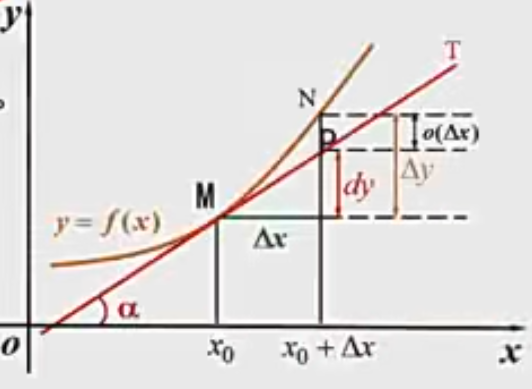
Derivatives and Tangents
- differentiability must have tangents;
- Having tangents does not necessarily mean differentiability;
1.3 Frequently Tested Question Types
Question Type: Piecewisefunctionsdiscussdifferentiabilityattheboundarypoint
Question Type 1: Does the left-right derivative exist?
- For example, in piecewise functions, analyze whether left and right derivatives exist at a certain point;
- Method: Use definitions
- A point left derivative exists: $f_0^{\prime}(x_0)=\lim_{\Delta x\to0^-}\frac{f(x_0+\Delta x)-f(x_0)}{\Delta x}=\lim_{x\to x_0^-}\frac{f(x)-f(x_0)}{x-x_0}$
- After substituting $x_0$ points, calculate the limit of this point, then check whether its value equals the derivative and whether the derivative value exists;
Note: For piecewise functions, when finding the derivative with value, you need to bring the value to the point where the point is defined. For example, x = 1 is the dividing point. Among the values less than or equal to 1 and greater than 1, the part of the function less than or equal to 1 can be carried in the value;
Question Type: Definitionofderivatives
PART 1: Problem-solving methods
Features: Similar forms such as $f^{\prime}(x_0)=-1$ point derivative exist, which often test the definition of a point derivative;
Core Idea: Rounding the current derivative into a form similar to the definition of a derivative;
- Form: $f'(x_0)=\lim_{h\to0}\frac{f(x_0+h)-f(x_0)}{h}$.
- The numerator in division has one dynamic and one definite, so this form must be formed;
- Supplement: Condition analysis
- When $x=0$ is differentiable and $f(0)=0$ appears, the definition of derivative at 0 point must be used;
Similar Question Type: Derivative zero deciding problem
- Example: $\text{ Among the following functions, }x=\mathbf{0}\text{ Could it be settled? }\text{ What can be derivated is: }$
- Common conclusion: Let $f(x)=A(x)x-a$, where $A(x)$ is continuous at x=a, then the necessary and sufficient condition for $f(x)$ to be differentiable at x=a is: $A(x)=0$
Related problem type: An expression such as $\lim_{h\to0}\frac{f(x_0+h)-f(x_0)}{h}$ is used to test differentiability at a point.
- Method: write the increment as $h$. The derivative exists only if the difference-quotient limits as $h\to0^+$ and $h\to0^-$ both exist and are equal.
PART 2: Typical Example Problems
Example Question: $\text{ Known }f^{\prime}(x_0)=-1,\text{ then }\lim_{x\to0}\frac x{f(x_0-2x)-f(x_0-x)}=?$
- Analysis
- Form the form of the derivative definition;
- You can also use concrete functions to substitute the evaluation (since it's a fill-in-the-blank question);
- Analysis
- $\lim_{x\to0}\frac{f(x_{0}-2x)-f(x_{0}-x)}{x}=\lim_{x\to0}\frac{f(x_{0}-2x)-f(x_{0})}{-2x}\cdot\frac{-2x}{x}-\lim_{x\to0}\frac{f(x_{0}-x)-f(x_{0})}{-x}\cdot\frac{-x}{x}$
- Question Type: Definitionofderivatives
Example: It is known that $f(x)$ is differentiable at $x=0$, and $f(0)=0, $ then $\quad\lim_{x\to0}\frac{x^2f(x)-2f(x^3)}{x^3}$ =?
- Analysis
- Analysis
- Question Type: #
PART 3: Key Points Review
Note: A derivative exists at a point iff the corresponding two-sided difference-quotient limit exists.
- If the derivative is known to exist, the limit in the derivative definition may be used directly.
- To prove differentiability, prove that the two-sided difference-quotient limit exists, or that the left and right limits both exist and are equal.
Question Type: Derivativeapplication
PART 1: Problem-solving methods
Question Type 1: The geometric meaning of derivatives
- Find the slope of the tangent: $k_{\text{ Tch }}=\frac{dy}{dx}$
- Find the slope of the normal: $k_{\text{ Law }}=-\frac1{k_{\text{ Tch }}}$
Question Type 2: Correlation Change Rate
- 1. Establishing relationships between related quantities;
- 2. Derivative of both sides of the equation with respect to t;
PART 2: Typical Example Problems
Example Question: The normal equation at the point of $\left.\text{ Curve }\left\{\begin{aligned}x&=\arctan t,\\y&=\ln\sqrt{1+t^2},\end{aligned}\right.\text{ The above corresponds }{t=1}\right.$
- Analysis
- Analysis
- Question Type: #
1.4 Derivative Derivatives
Examples of Distance and Speed
- s is $s(t)$
- Distance and speed relationship
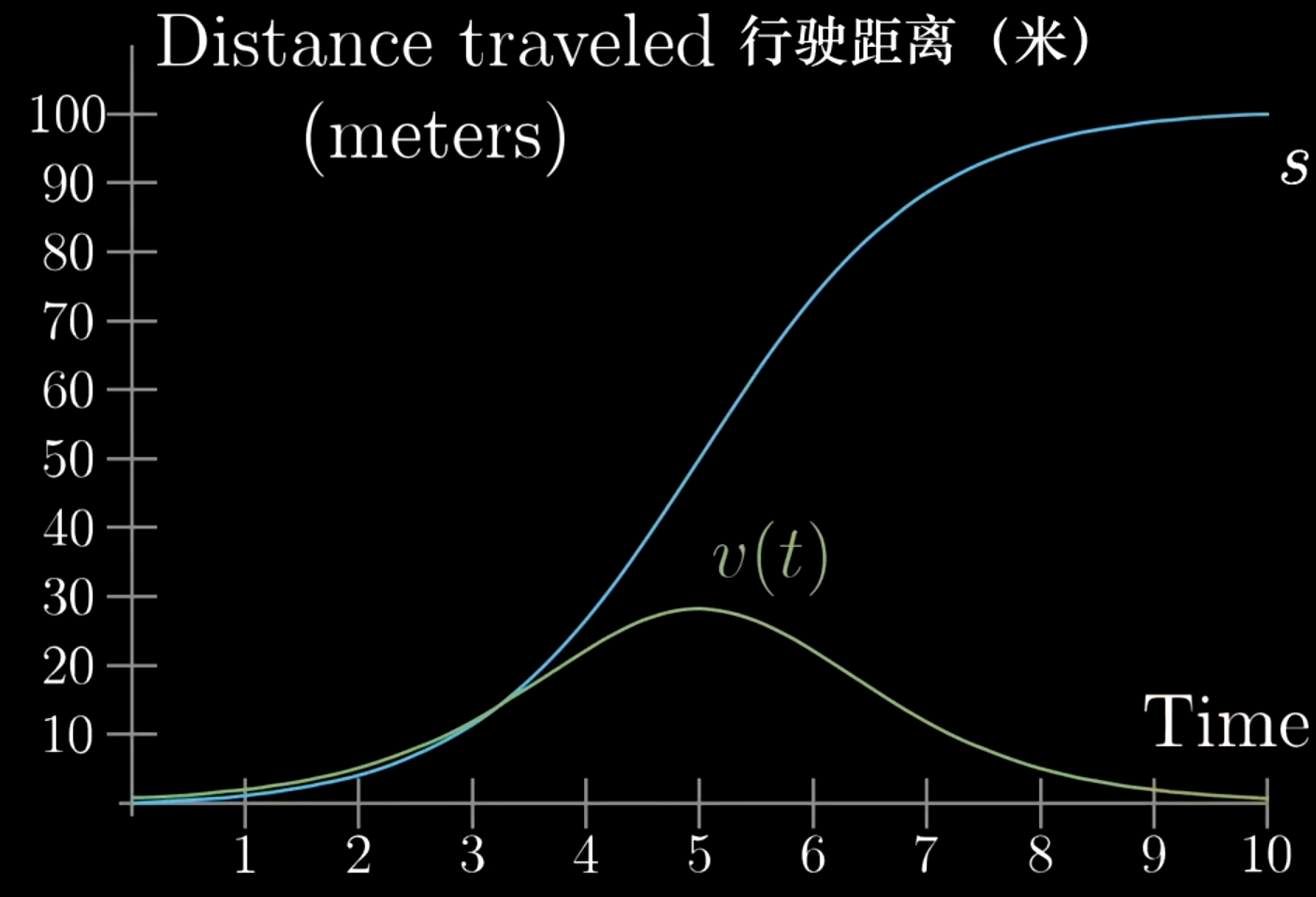
- Amount of change:
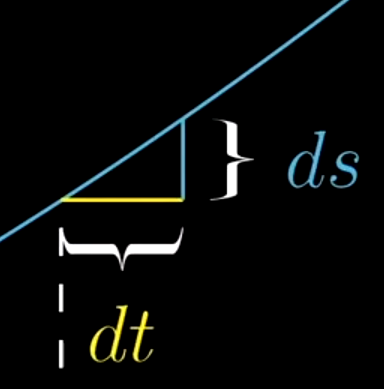
- Derivation of rate of change near a point: $\begin{gathered}\text{Derivative}\\\frac{ds}{dt}(t)=\underbrace{\frac{s(t+dt)-s(t)}{dt}}_{dt\to0}\end{gathered}$
- Suppose at point $t=2$, find the tangent at this point: $\begin{aligned}\frac{ds}{dt}(2)=\frac{\left(2+dt\right)^3-\left(2\right)^3}{dt}\end{aligned}$
- Now expand $(2+dt)^3$ to get: $\begin{aligned}\frac{2^3+3(2)^2dt+3(2)(dt)^2+(dt)^3-2^3}{dt}\end{aligned}$
- Dividing it by $dt$ gives the $3(2)^2+3(2)(dt)+(dt)^2$
- At this point, as $dt$ approaches infinite hours, we get: $\frac{ds}{dt}(2)=3(2)^2=12$
- If $t=2$ in it is changed to a general expression $t=t$, we get: $\frac{ds}{dt}(t)=3(t)^2$