Chapter 10: Vector Algebra and Spatial Geometry — Advanced Mathematics - Collection of Formulas
Chapter 10: Vector Algebra and Spatial Geometry from the formula collection, kept as a focused chapter for faster reading and image loading.
On this page
Chapter 10: Vector Algebra and Spatial Geometry
10.1 Vector Algebra
10.1.1 Dotting Products
Theorem: Theproductofvectoralgebra
description:
$$1\text{ ) Geometric representation: }\mathbf{a}\cdot\mathbf{b}=\mid\mathbf{a}\mid\mid\mathbf{b}\mid\cos\alpha $$
$$2\text{ ) Algebraic representation: }\quad\mathbf{a}\cdot\mathbf{b}=\mathbf{a}_xb_x+\mathbf{a}_yb_y+\mathbf{a}_zb_z$$
$$3\text{ ) Calculation Pattern: }\quad \text{ Commutative law }:\,\mathbf{a}\cdot\mathbf{b}=\mathbf{b}\cdot\mathbf{a} \quad \text{ Distributive Law: }\mathbf{a\cdot(b+c)=a\cdot b+a\cdot c}$$
$$4\text{ ) Geometric applications: }\quad \text{Norm: }|\mathbf{a}|=\sqrt{\mathbf{a}\cdot\mathbf{a}} \quad \text{Angle: }\cos\alpha=\frac{\mathbf{a}\cdot\mathbf{b}}{|\mathbf{a}||\mathbf{b}|}\quad \text{Orthogonality: }\mathbf{a}\perp\mathbf{b}\Leftrightarrow\mathbf{a}\cdot\mathbf{b}=0$$
10.1.2 Vector Product
Theorem: Thevectorproductofvectoralgebra
description:
$1. \text{ Geometric representation: }\quad\mathbf{a}\times\mathbf{b}\text{ It is a vector }.\quad\text{ Model }:\mid\mathbf{a}\times\mathbf{b}\mid=\mid\mathbf{a}\mid\mid\mathbf{b}\mid\sin\alpha$
$2. \text{ Algebraic representation: }\quad{\mathbf{a}\times\mathbf{b}}=\begin{vmatrix}\mathbf{i}&\mathbf{j}&\mathbf{k}\\a_x&a_y&a_z\\b_x&b_y&b_z\end{vmatrix}$
$3. i) a\times b= - ( b\times a) \quad ii)\text{ Distribution law }:\,a\times(b+c)=a\times b+a\times c$
$4. \text{ Calculation rules }:\,i)\text{ Find the simultaneous perpendicular to } a \text{ and } b \text{ vector }: a×b\quad ii)\text{ Seek it } a \text{ and } b \text{ is the area of the parallelogram of the adjacent side }:S=|a×b|\quad iii)\text{ Determine that two vectors are parallel }:\,\mathbf{a//b}\Leftrightarrow\mathbf{a\times b}=0$
Explanation
- Geometric representation
->right-hand rule->a line perpendicular to $a,b$ vector; - Note:
- The product of quantities satisfies the commutative law, while the vector product does not;
10.1.3 Mixed Product
Theorem: Mixedproductofvectoralgebra
description:
Basic expression: $\left[ abc \right] = (a \times b) \cdot c$
Definition: $$\ a = a_xi + a_yj + a_zk \\ b = b_xi + b_yj + b_zk \\ c = c_xi + c_yj + c_zk$$
Properties:
(1)$$(a\times b)\cdot c = a\cdot(b\times c) = b \cdot (c\times a)$$
$$\text{ Rotation symmetry }:\,(abc)=(bca)=(cab)\quad \text{ Swap and change numbers }:\,(\mathbf{abc})=-(\mathbf{acb})$$
(2)$$\begin{aligned}(a\times b)\cdot c=-(b\times a)\cdot c\\(a\times b)\cdot c=-(c\times b)\cdot a\\(a\times b)\cdot c=-(a\times c)\cdot b\end{aligned}$$
(3) $$\mathbf{a},\mathbf{b},\mathbf{c}\text{ are coplanar }\Leftrightarrow[\mathbf{a}\mathbf{b}\mathbf{c}]=0.$$
Geometric Meaning:
1. The absolute value of the mixed product $[abc]=(a\times b)\cdot c$ of vectors numerically equals the volume of parallelepiped with vectors a, b, and c as edges
2. $V_\text{ Parallelepiped }=|\mathrm{(abc)}|$
10.2 Spatial Planes and Straight Lines
10.2.1 Plane Equations
Definition: Planeequations
description:
$1\text{ ) General formula: }\quad Ax+By+Cz+D=0.\quad\mathbf{n}=\{A,B,C\}$
$2\text{ ) Point French: }\quad A(x-x_0)+B(y-y_0)+C(z-z_0)=0$
$3\text{ ) Intercept type: }\quad\frac xa+\frac yb+\frac zc=1$
10.2.2 Line Equations
Definition: Alinearequation
description:
$$1)\text{ General formula: }\quad\begin{cases}A_1x+B_1y+C_1z+D_1=0\\A_2x+B_2y+C_2z+D_2=0\end{cases}$$
$$2)\text{ Symmetric Formula: }\quad\frac{x-x_0}l=\frac{y-y_0}m=\frac{z-z_0}n$$
$$3)\text{ Parametric expression }:\,x=x_0+lt,y=y_0+mt,z=z_0+nt.$$
10.2.3 Distance Relations
Core: Plane -> Normal Vector; Straight Line -> Direction Vector
Concept: The distance from point to surface
- The distance from point $(x_0,y_0,z_0)$ to plane $Ax+By+Cy+D=0$
- $$d=\frac{|Ax_0+By_0+Cz_0+D|}{\sqrt{A^2+B^2+C^2}}$$
Concept: Point-to-line distance
- $\text{ Point }({x_0,y_0,z_0})\text{ To a straight line }\frac{x-x_1}l=\frac{y-y_1}m=\frac{z-z_1}n$
- $$d=\frac{|\{x_1-x_0,y_1-y_0,z_1-z_0\}\times\{l,m,n\}|}{\sqrt{l^2+m^2+n^2}\quad J}$$
10.3 Surface and Space Curves
10.3.1 Basic Concepts
Definition: Spatialsurfaces
description: $$F(x,y,z)=0\quad\text{ or }z=f(x,y)$$
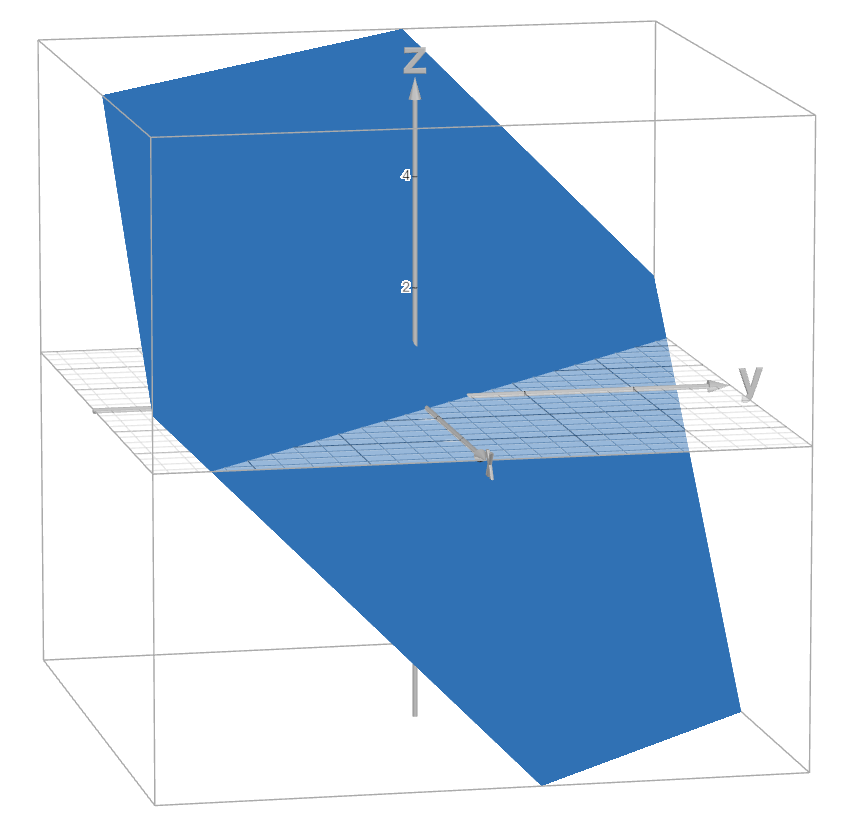
Example: $x+y+z=1$
- Illustration:
Definition: Spacecurves
description: $$\text{ i) Parameter: }\quad\begin{cases}x=x(t)\\y=y(t)\\z=z(t)\end{cases}\quad\text{ ii) General formula: }\begin{cases}F(x,y,z)=0\\G(x,y,z)=0\end{cases}$$
Supplement: Why do spatial surfaces require only one equation to be determined, while space curves need two?
- Core:
- One equation reduces one degree of freedom;
- A surface has two degrees of freedom, while a curve has only one;
- Therefore, the general formula of a space curve consists of two equations about
xyz;
10.3.2 Common Surface Surfaces
Surface One: Rotation Surface -> A plane curve rotates around a straight line on the plane
- Let $L$ be a curve on the $yoz$ plane, with the equation $\begin{cases}f({y},z)=0\\x=0\end{cases}$
- (1) Rotating $L$ about the $y$-axis gives
$$f\left(y,\pm\sqrt{x^2+z^2}\right)=0.$$
- (2) Rotating $L$ about the $z$-axis gives
$$f\left(\pm\sqrt{x^2+y^2},z\right)=0.$$
Surface Two: Cylindrical surface -> The trajectory formed by line L that is parallel to a fixed line and moves along the curve;
- If the directrix is $\Gamma:\begin{cases}f(x,y)=0\\z=0,\end{cases}$ and the generators are parallel to the $z$-axis, then the cylinder is $f(x,y)=0$.
- More generally, if eliminating $z$ from $\begin{cases}F(x,y,z)=0\\G(x,y,z)=0\end{cases}$ gives $H(x,y)=0$, then $H(x,y)=0$ is the cylinder parallel to the $z$-axis through the projected directrix.
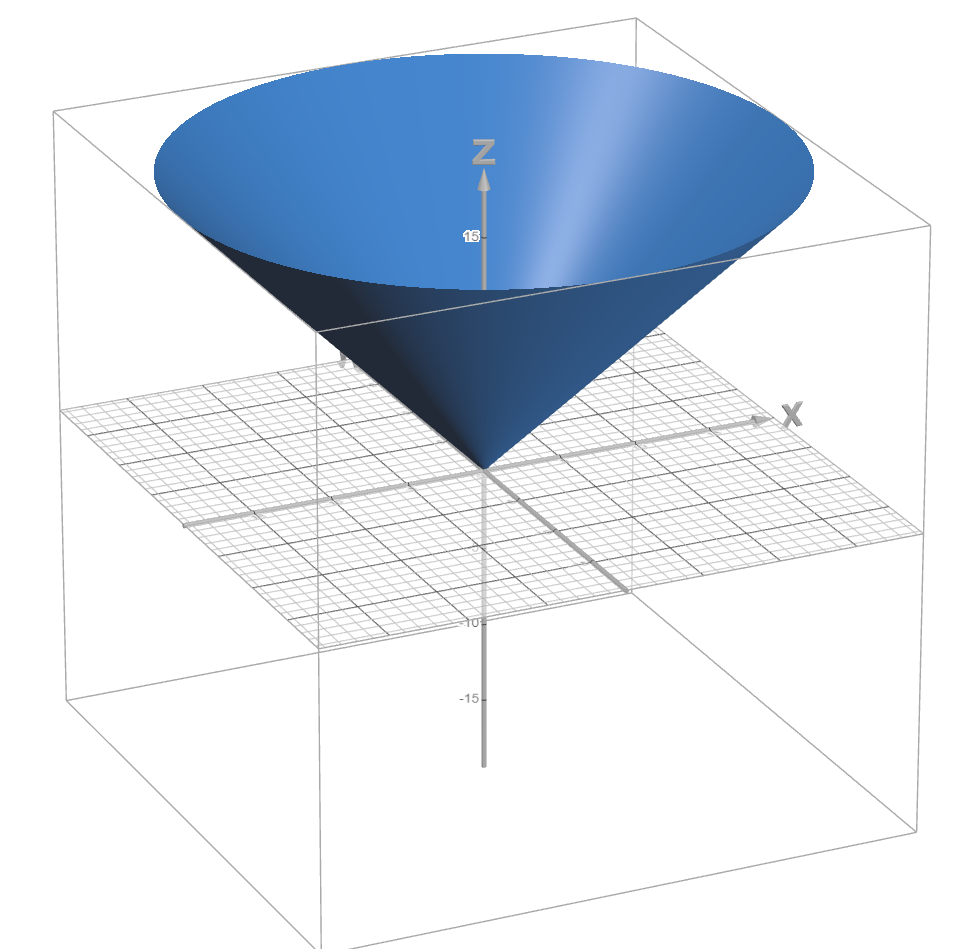
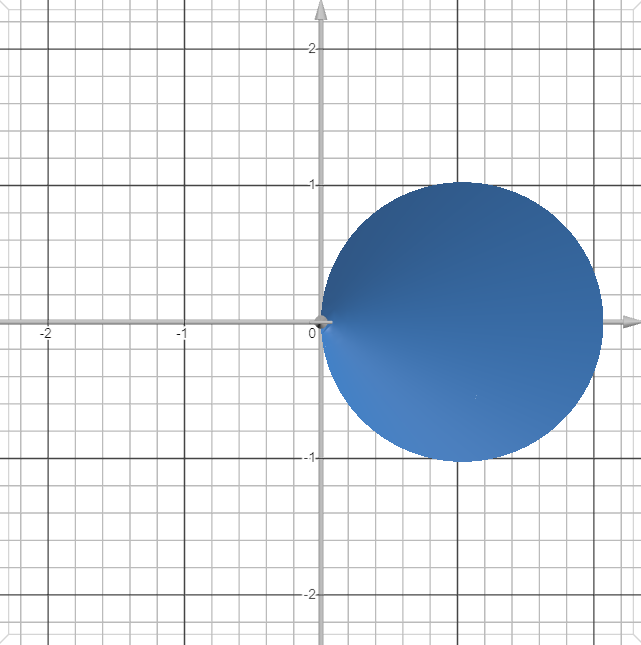
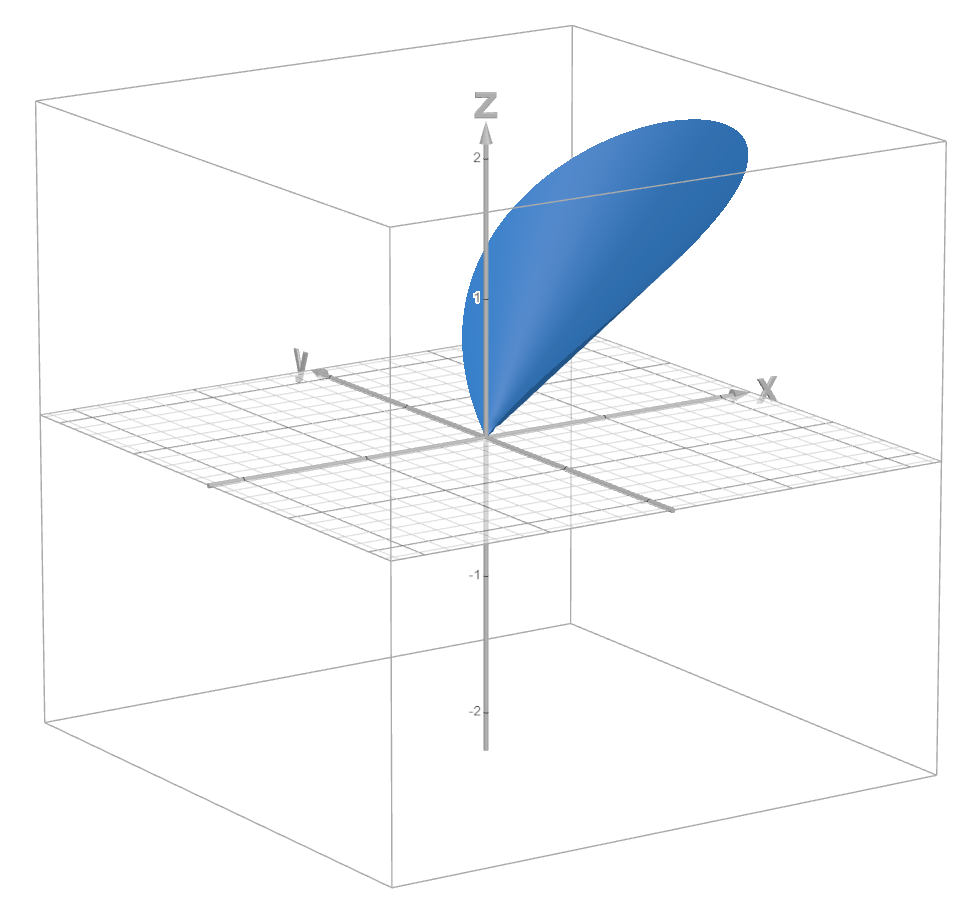
- Illustration: The conical surface $z=\sqrt{x^{2}+y^{2}}$ on the area of the cylinder $x^{2}+y^{2}\le2x$:
- Cone:
- Cylindrical Surface:
- 3D:
Surface Three: Quadratic surface
- $$\text{ Elliptical conical surface }\frac{x^2}{a^2}+\frac{y^2}{b^2}=z^2;$$
- $$\text{ Ellipsoidal surface }\quad\frac{x^2}{a^2}+\frac{y^2}{b^2}+\frac{z^2}{c^2}=1;$$
- (3) Single-leaf hyperboloid $$\frac{x^{2}}{a^{2}}+\frac{y^{2}}{b^{2}}-\frac{z^{2}}{c^{2}}=1$$
- (4) Double-leaf hyperboloid $$\frac {x^{2}}{a^{2}}- \frac {y^{2}}{b^{2}}- \frac {z^{2}}{c^{2}}= 1$$
- (5) Ellipse-parabolic $$\text{ Elliptical parabola }\quad\frac{x^2}{a^2}+\frac{y^2}{b^2}=z;$$
Surface Four: Spatial Surface Projection
- The equation of the $q$ curve $\Gamma: \begin{cases}F(x, y, z)=0\\G(x, y, z)=0\end{cases}$ projected onto the $xoy$ surface is $: \begin{cases}H(x, y)=0\\z=0\end{cases}$