Lecture 24: Parallel structures
Postgraduate English Study Notes: Lecture 24: Parallel Structure. Original formulas, diagrams, and example questions are retained.
On this page
24.1 What is a parallel structure?
24.1.1 Basic Concepts
Concept
- Concept:
- Parallel structure places coordinate elements in matching grammatical forms;
- Features:
- 1. Coordinate elements should have the same grammatical function and a consistent form;
- For example, coordinate prepositional phrases with other prepositional phrases;
- Exact wording may differ, but the structure should remain parallel;
- 2. Use coordinating conjunctions or correlative conjunctions to connect them;
- A compound sentence is one kind of coordinate structure;
- Common patterns:
and,but,or,nor,not only ... but also; - Punctuation: commas, semicolons
- In short: coordinate elements should be grammatically parallel;
- Note:
- If multiple components are listed side by side and the middle conjunctions are equal, the preceding conjunction can be omitted and replaced with a comma;
Three-Step Method: Find Parallel Structures
- Step 1:
- Find the coordinating conjunction;
- Step 2:
- Look behind the coordinating conjunction to see what form the connecting content is;
- Step 3:
- Look forward for something in the same form as it
About the Number of Parallel Structures
- Scenario One:
- If two components are listed side by side in a sentence
- In this case, you only need to use and to connect directly:
1and2 - Scenario Two:
- If the sentence contains multiple components side by side, for example, 1, 2, or 3 components
- At this point, you only need to use the and component before the last sentence:
1,2, and3 - Or the five sentences are:
1,2,3,4, and5
24.1.2 Classification of Parallel Structures
Four Types of Structures
- (1) Parallel arrangement of nouns (phrases).
- (2) Parallel arrangement of verbs (finite verbs, non-finite verb).
- (3) Parallel arrangement of prepositional phrases
- (4) Parallel clauses and compound sentences
24.2 Four Types of Parallel Structures
24.2.1 Parallel Arrangement of Nouns and Phrases
Examples
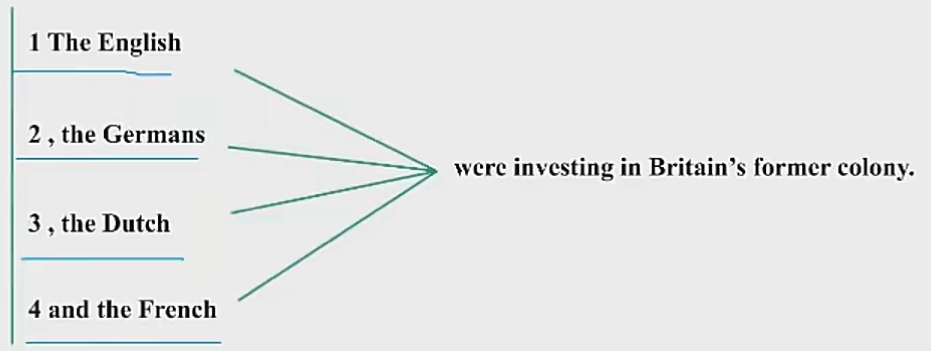
- The English, the Germans, the Dutch and the French were investing in Britain's former colony.
- Find the subject
->Find the finite verb->were investing->Subject: The English, the Germans, the Dutch and the French<-The four contents are listed side by side; - Illustration:
- The networked computer is an amazing device, the first media machine that serves as the mode of production, means of distribution, site of reception, and place of praise and critique.
- Image:
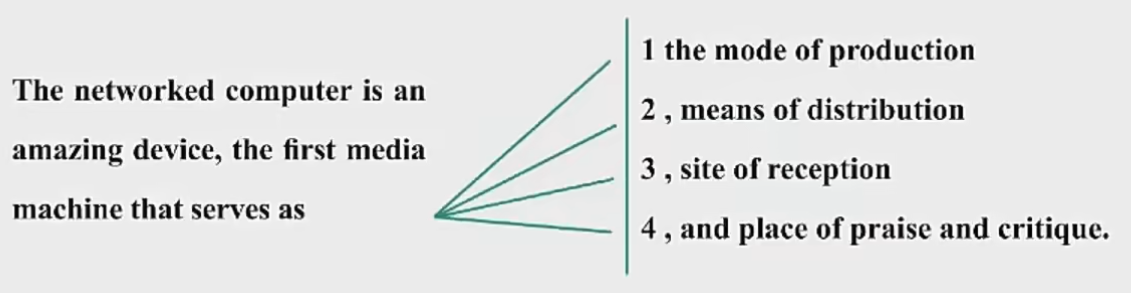
- as: Why do you serve? -> Four types of services:
- 1 the mode of production
- 2 means of distribution
- 3 site of reception
- 4 and place of praise and critique.
- Note: You can mark parallel content with numbers;
24.2.2 Parallel Arrangement of Verbs
Concept
- Note:
- Finite predicates and non-finite constructions can each form parallel structures, provided the coordinated elements have the same grammatical function;
- Tips:
- To know where the juxtaposition in the current coordinating conjunction comes from, you can look at the first word after the coordinating conjunction (such as and) to assess its part of speech. The word in the first half of the sentence that belongs to this part of speech is the beginning of the sentence where the first half is being paralleled;
Examples
- The process sweeps from hyperactive America to Europe and reaches the emerging countries with unsurpassed might.
- Two finite verbs are placed side by side;
- Illustration:

- It allows us to have perspective on our lives-the ability to not take ourselves too seriously, to laugh at ourselves, to see the bigger picture, and to see that things will work out.
- Parallel structure; to do non-finite verb parallel;

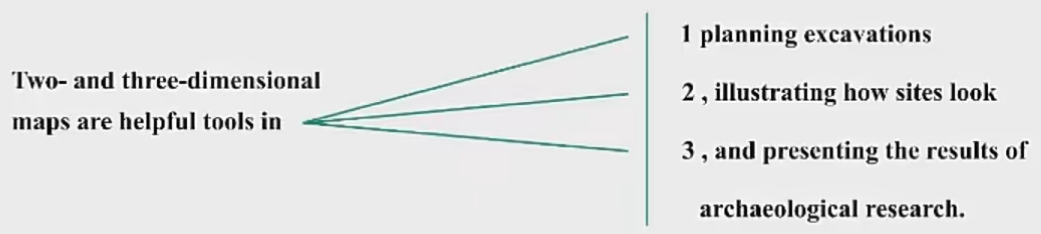
- Two and three-dimensional maps are helpful tools in planning excavations, illustrating how sites look, and presenting the results of archaeological research
- All are placed side by side with the non-finite verb (doing) that is followed by in;
- Image:
- The financial crisis has made it more acceptable to be between jobs or to leave a bad one.
- Structure: subject-verb and object complement
- Subject: The financial crisis
- Predicate: has made
- Object: it (formal object)
- Complement: more acceptable to be between jobs or to leave a bad one
- True object: to be between jobs or to leave a bad one
- Parallel structure;
- Image:

24.2.3 Parallel Juxtaposition of Prepositional Phrases
Examples
- ... He advocated freedom of thought and of personal expression.
- Illustration:

- Two prepositions side by side, together modifying the preceding 'freedom';
- Mental health allows us to view others with sympathy if they are having troubles, with kindness if they are in pain, and with unconditional love no matter who they are.

- So disciplines acquire a monopoly not just over the production of knowledge, but also over the production of the producers of knowledge.
24.2.4 Parallel Parallel Arrangement of Sentences
Examples
- The problem is not merely that people do bad science, but that our current system of career advancement positively encourages it.
- Co-conjunction: not merely... But...
- Illustration:

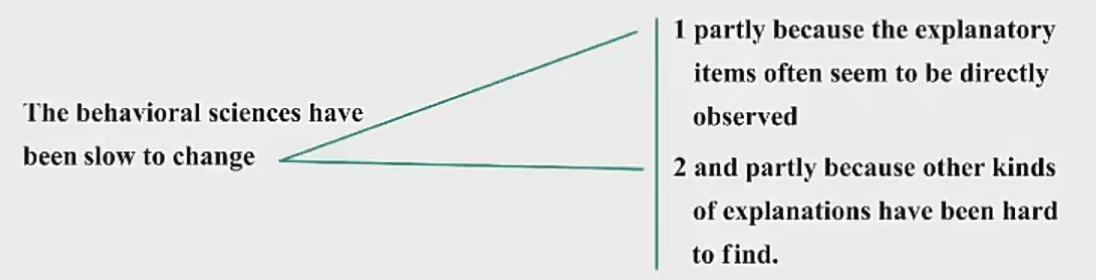
- The behavioral sciences have been slow to change partly because the explanatory items often seem to be directly observed and partly because other kinds of explanations have been hard to find.
- However, whether such a sense of fairness evolved independently in capuchins and humans, or whether it stems from the common ancestor that the species had 35 million years ago, is, as yet, an unanswered question.
- Two subject clauses;
- Because the first subject clause is too long, a comma pause is used;
24.2.5 Supplement: Multiple parallel structures
Additional Information
- Concept:
- Generally, when multiple parallels are listed side by side, only the last one uses and;
Examples
- The development of the Elizabethan drama for the next twenty-five years is of exceptional interest to students of literary history, for in this brief period we may trace the beginning, growth, blossoming, and decay of many kinds of plays, and of many great careers.
- For the time, attention, and money of the art-loving public, classical instrumentalists must compete not only with opera houses, dance troupes, theater companies, and museums, but also with the recorded performances of the great classical musicians of the 20 th century
24.2.6 Supplement: Parallel structure without coordinating conjunctions
Examples
- “Those first few days should be spent looking for work, not looking to sign on,” he claimed.
24.3 Past-Paper Practice
Examples
- In addition, new digital technologies have allowed more rapid trading of equities , quicker use of information at the speed of Twitter ,and thus shorter attention spans in financial markets.
- Step 1: Coordinate the conjunction
->And - Find the parallel structure as and;
- Step 2: Find the parallel form;
- This sentence: thus shorter attention spans in financial markets
->consistent in form; - Step 3: Find ingredients with consistent form
- Three forks;
- 1. More rapid trading of equities;
- 2. Quicker use of information at the speed of Twitter;
- 3. Thus shorter attention spans in financial markets;
- The court's ruling is a step forward in the struggle against both corruption and official favoritism.
- Coordinating conjunction: both... And
- The court's ruling is a step forward in the struggle against both corruption and official favoritism.
- Coordinating conjunction: either... Or
- Grammar , punctuation, and spelling can wait until you revise.
- Coordinating conjunction: and
- Connect the three components together, then use a comma to connect them;
- But we are now knowledgeable enough to reduce many of the risks that threatened the existence of earlier humans and to improve the lot of those to come.
- Coordinating conjunction: and
- Co-component: two phrases for 'to do';
- The point of a style upgrade isn't to become more vain or to spend more time fussing over what to wear.
- Coordinating conjunction: or
- Coordinated component: a phrase meaning 'to do'
- to become more vain
- to spend more time fussing
- Teachers are responsible for teaching kids how to learn;parents should be responsible for teaching them how to work.
- Coordinating conjunctions: semicolon ";"
- In one case, many researchers working around the ancient Maya city of Copán, Honduras, have located hundreds of small rural villages and individual dwellings by using aerial photographs and by making surveys on foot.
- First parallel structure:
- hundreds of small rural villages and individual dwellings
- Second parallel structure:
- by using aerial photographs and by making surveys on foot
24.4 Exam Room Guide
Strategy 1: The key to resolving a split structure is to restore it into coherent sentences
- Two types of splits:
- Parenthetical split;
- Shift the clause backward and split;
- Concept:
- After finding the split, resolve the split sentence (remove or move) it to form a coherent sentence;
- Example:
- Bob Liodice, the chief executive of the Association of National Advertisers, says consumers will be worse off if the industry cannot collect information about their preferences.
- Temporarily set aside the appositive, identify the core clause, and then restore the background information;
Strategy 2: The key to solving nested structures is to divide sentences into layers
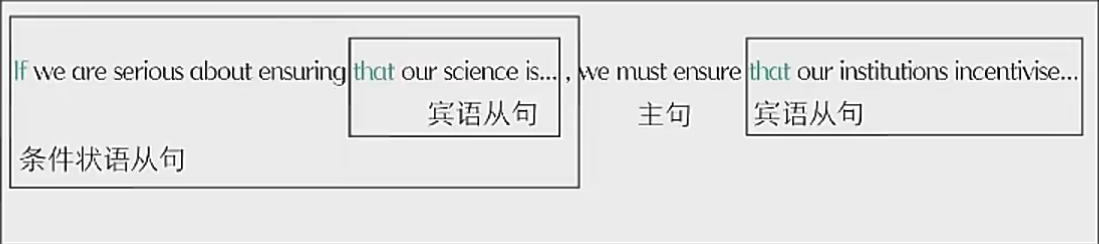
- Method:
- Step 1: Segment the sentence into finite clauses;
- Step 2: Analyze the outer main clause first, then each embedded clause;
- Example:
- If we are serious about ensuring that our science is both meaningful and reproducible, we must ensure that our institutions incentivise that kind of science.
Strategy 3: The key to solving parallel structures is to clarify multiple parallel structures
- Concept:
- 1. Coordinate elements should have the same grammatical function and a consistent form;
- 2. Find the coordinating or correlative conjunction that links them;
- Method: Three-step method
- Step 1: Find the coordinating conjunction;
- Step 2: Look behind the coordinating conjunctions to examine the sentence form and components;
- Step 3: Look before the coordinating conjunctions and find sentence forms and components that match them;
- Tips:
- You can mark the number in the juxtaposition sentence to indicate which sentence it is;
- Example:
- Simply arranging a meeting, making a phone call, or hosting an event is not an “official act".
- Parallel gerund-participial phrases:
- arranging a meeting
- making a phone call
- hosting an event
- Why is the finite verb singular
is? - The alternatives joined by
orare treated here as individual possible activities, and the final alternative nearest the verb is singular;
Strategy 4: Graduate Exam past-paper question, always ask questions in difficult sentences
- Example:
- As a linguist, he acknowledges that all varieties of human language, including non-standard ones like Black English, can be powerfully expressive-there exists no language or dialect in the world that cannot convey complex ideas.
- Step 1: Find the finite verb
- acknowledges: acknowledges
- can be: modal verb, following the base form of the verb
exists- cannot convey: to negate
- Step 2: Find punctuation and conjunctions
- Dash: one dash is for explanation;
- Two commas: parenthetical words, can be removed;
- that: connector
- After segmentation:
- 1. As a linguist, he acknowledges
- 2. That all varieties of human language, ......, can be powerfully expressive
- Inserted sections: including non-standard ones like Black English
- 3. --there exists no language or dialect in the world
- 4.
that cannot convey complex ideasmodifiesno language or dialect; - This restrictive relative clause completes the meaning of the antecedent; it is not a movable parenthetical;
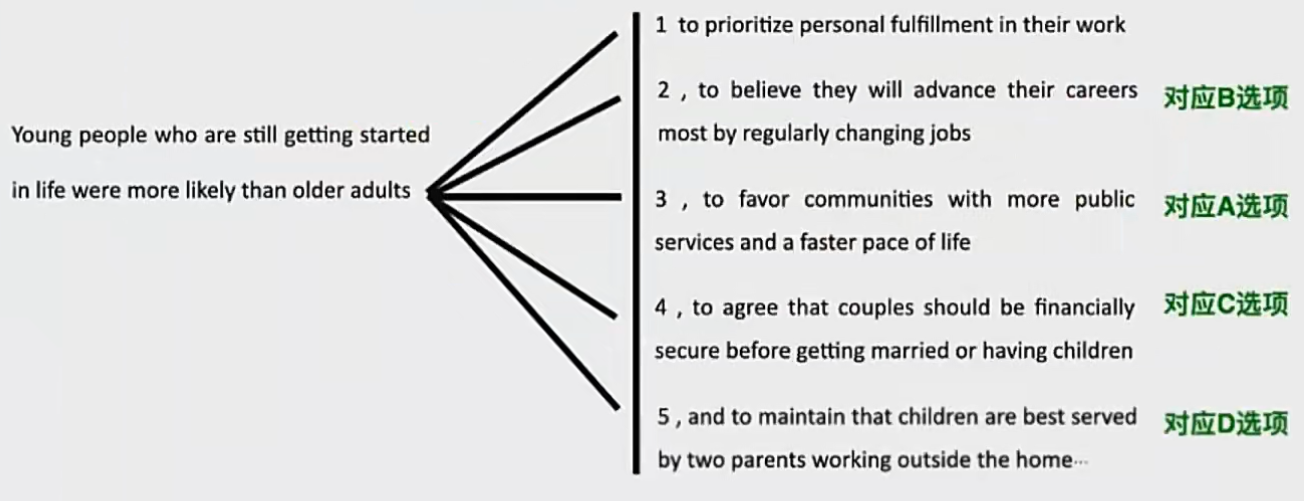
- young people who are still getting started in life were more likely than older adults to prioritize personal fulfillment in their work, to believe they will advance their careers most by regularly changing jobs, to favor communities with more public services and a faster pace of life, to agree that couples should be financially secure before getting married or having children, and to maintain that children are best served by two parents working outside the home...
- Typical parallel structures;
+