Lecture 15: The Subjunctive Mood
Graduate Entrance Examination English study notes: Lecture 15: The Subjunctive Mood. Original examples, diagrams, and exercises are retained.
On this page
15.1 Special Sentence Patterns
Basic Concepts
- Section 1: Subjunctive mood;
- Expressing hypothetical, unlikely, or counterfactual situations;
- Section 2: Inversion;
- Connecting ideas while giving special emphasis to one element;
- Section 3: Emphasis;
- Giving particular prominence to one part of a sentence;
15.2 The Subjunctive Mood
Four moods discussed in these notes
- The subjunctive is used for wishes, demands, hypotheticals, and situations contrary to fact;
- Four useful categories:
- Indicative: presents something as factual;
- Conditional: presents a result that depends on a condition;
- Subjunctive: presents a wish, demand, hypothetical situation, or counterfactual;
- Imperative: expresses a command, request, or instruction;
15.2.1 What Is the Subjunctive Mood?
Core idea
- The subjunctive expresses unreality or remoteness. Past-tense forms often mark distance from present reality rather than past time;
- A counterfactual describes a situation that is not true;
- Test 1: compare the statement with the known facts and ask whether it is contrary to fact;
- Test 2: if it refers to a hypothetical situation, ask whether it is presented as unlikely to occur;
Subjunctive verb forms
- The subjunctive is expressed through the finite verb phrase, whose form signals that the situation is hypothetical or counterfactual;
15.2.2 Counterfactual If-Clauses
How to recognize them
- Note:
- Not every sentence with
ifis counterfactual; manyif-clauses describe real possibilities; - Use ordinary indicative forms when the condition is genuinely possible;
- Use counterfactual forms when the condition is unreal, contrary to fact, or presented as unlikely;
- Tips:
- The clause introduced by
ifis the conditional clause; the other clause is the main clause; - Method:
- 1. Backshift the verb in the
if-clause; - Present counterfactuals normally use a past-tense form; past counterfactuals use the past perfect;
- For a counterfactual about the past, use
had + past participle; - 2. Use an appropriate modal in the main clause;
- Main clause:
would/could/should/might would: expected result;could: ability or possibility;should: expected or appropriate result;might: weaker possibility;- Choose the modal that matches the intended meaning;
- 3. Unlikely future conditions often use the same main-clause pattern as present counterfactuals;
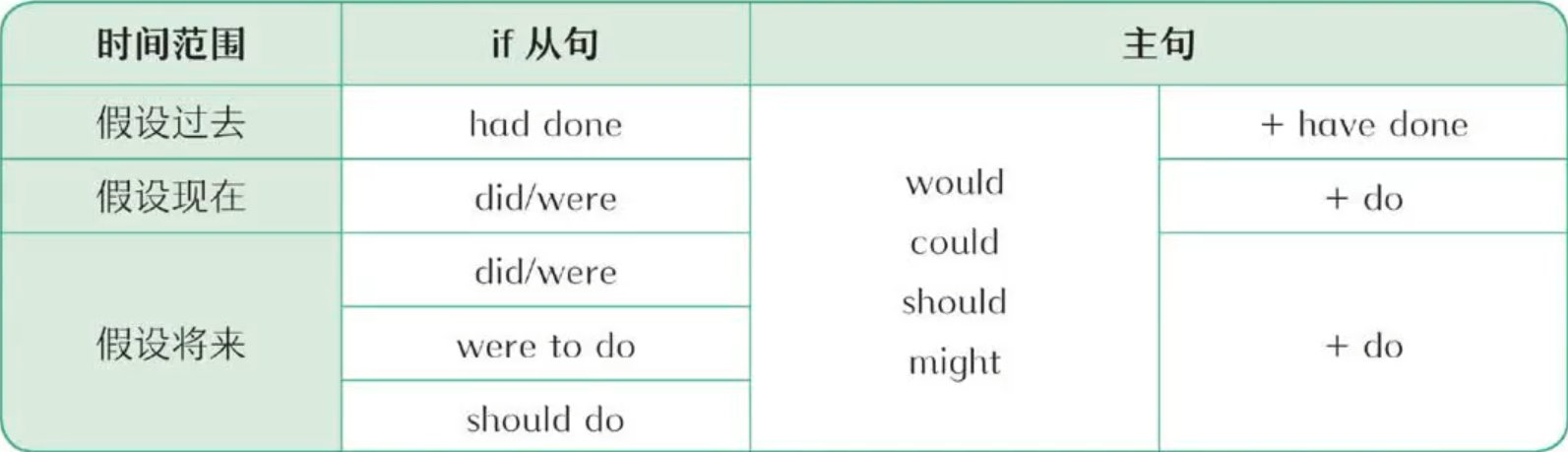
Past counterfactual
- Concept:
- Use the past perfect in the
if-clause to describe a past condition that did not occur; - Clause pattern:
- if clause:
had done - Main clause:
would/could/should/might + have done - Example:
- If he had played last season, however, he would have been one of 42.
If he had played last seasonimplies that he did not play last season;- The
if-clause useshad + past participle;
Present counterfactual
- Concept:
- Use a past-tense form in the
if-clause for a present situation contrary to fact; - Clause pattern:
- if clause:
did/were - Main clause:
would/could/should/might + do - Example:
- Your prospects would be almost as dismal if arguments were even just competitions-like, say, tennis games.
- If arguments were merely competitions, such as tennis matches, your prospects would be almost equally bleak.
Unlikely future condition
- Concept:
- A future event has not happened yet, so it may still occur; these marked forms present it as especially unlikely;
- The
if-clause may use a past form,were to + verb, orshould + verb; - Clause pattern:
- if clause:
- 1.
did/were - 2.
were to do - 3.
should do - Main clause:
would/could/should/might + do - Example:
- If railroads charged all customers the same average rate…. Shippers… would do so, leaving remaining customers to shoulder the cost of keeping up the line.
- If railroads charged every customer the same average rate, some shippers would choose another option, leaving the remaining customers to bear the cost of maintaining the line;
- The situation has not occurred; it is presented as a hypothetical future outcome;
Summary
- Study goal:
- Be able to recognize and interpret the pattern;
- Direct questions on the subjunctive are relatively uncommon;
- Conclusion:
15.2.3 Subjunctive Mood in Nominal Clauses
Basic Concepts
- If the main clause contains suggestions, commands, or demands, the subordinate clause should use the subjunctive mood;
- Whether it's a noun, verb, or adjective, if you want to express a suggestion, command, or request, you need to use the subjunctive mood;
- Nominal clauses include four types:
- Object clauses, predicative clauses, subject clauses, and appositive clauses;
Examples
- European ministers instantly demanded that the International Accounting Standards Board (IASB) do likewise.
- This year, it was proposed that the system be changed: ...
- The main clause expresses a proposal;
- The subordinate clause therefore uses the mandative subjunctive (
be changed);